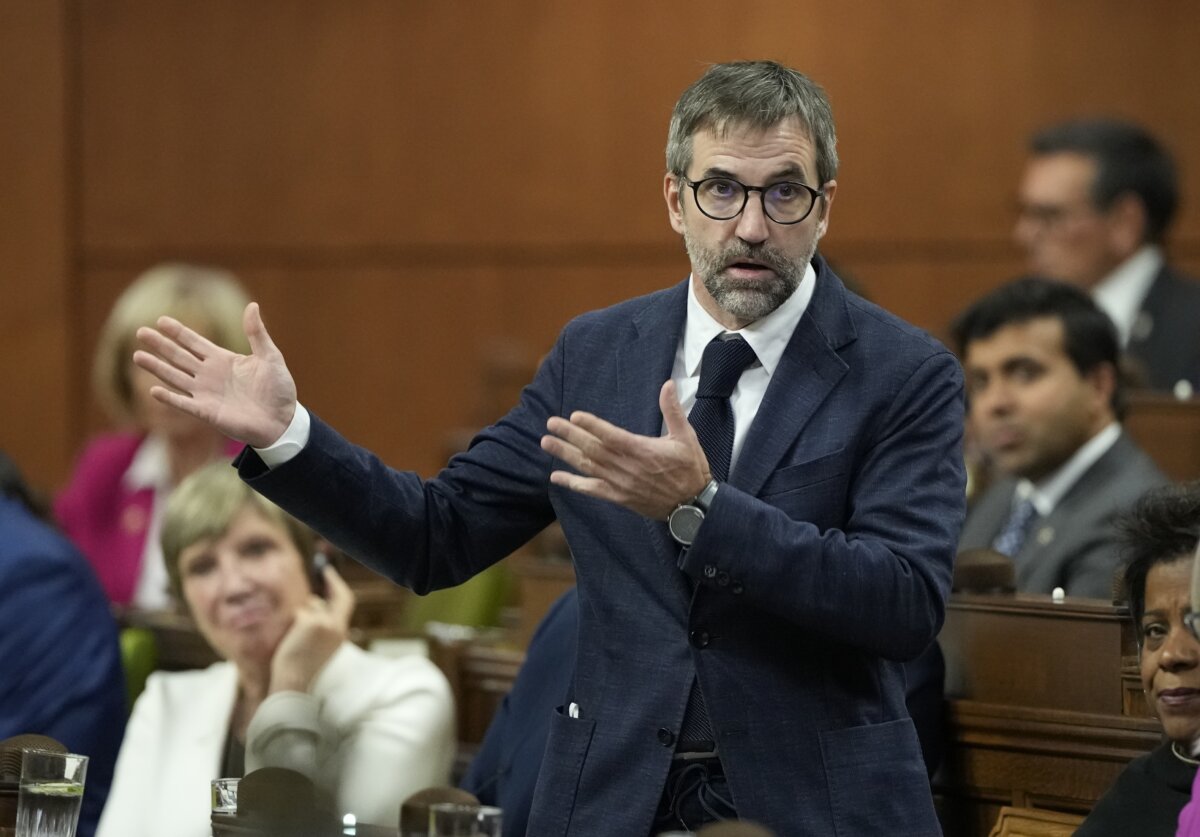

The Liberal government is set to make its third attempt at introducing legislation to address “online harms,” similar to a bill tabled in the last Parliament, and another that was tabled in 2021, Heritage Minister Steven Guilbeault says.
Guilbeault made the comments at a Sept. 24 House of Commons heritage committee meeting, saying the Liberal government has “made a commitment to combat online harms.”
Then-Justice Minister David Lametti first proposed online harms legislation in 2021 with the introduction of Bill C-36, a bill aimed at cracking down on hate speech and hate crimes online.
The bill received widespread criticism from the Opposition Tories, privacy experts, civil liberties groups, and others, who said the bill would undermine free expression, especially its provision requiring online platforms to remove offending content within 24 hours. The bill lapsed when the federal election was called that year.
At the heritage committee, Guilbeault said many of his colleagues have continued to work on the online harms legislation, noting that the Liberals tabled Bill C-63 last year, another version of the Online Harms Act. The bill “aimed not specifically at online harms, but also modernizing the Criminal Code,” Guilbeault said.
Bill C-63 aimed to amend the Criminal Code and Human Rights Act to regulate the internet when it comes to content involving sexual exploitation, bullying, deepfakes, and “hateful conduct.” The legislation would apply to social media services, live-streaming websites, and user-generated adult content services, but would not include private communications such as through email and direct messaging on social media.
Conservatives raised concerns about the legislation leading to censorship and disproportionate penalties for crimes. Tory MP Larry Brock said Bill C-63 would “force Canadians into a false choice between their safety and free expression, instead of addressing the real issues,” and would silence Canadians “under the guise of security.”
Brock noted that the legislation could impose lengthy prison sentences for even minor infractions involving “mere words alone” considered to be “motivated by hatred.” He said that while the government claimed a serious underlying act must happen for the punishment to apply, that wasn’t reflected in the bill’s wording.
NDP MP Don Davies said at the time that all MPs wanted to protect children from pornography and online hate, but highlighted a warning from the Canadian Civil Liberties Association that the Online Harms Act would grant “sweeping powers” that pose a “significant threat to privacy rights.” He suggested the bill be split into two so the legislation to protect children could move forward.
The bill lapsed when Parliament was prorogued in January of this year. Before prorogation, then-Justice Minister Arif Virani said the bill would be split into two bills to put a priority on passing measures to fight child predators. The decision came as there was opposition to provisions in the legislation that impacted freedom of expression.
The first bill would deal with keeping children safe online, combatting sex predators, and issues related to revenge pornography, Virani said. It would involve establishing a new Digital Safety Commission of Canada, which would compel social media companies to outline how they plan to reduce their platforms’ risks for users, particularly minors. It would be able to lay fines and evaluate companies’ digital safety plans.
In addition, the first bill would include new measures for prosecuting child sex predators, Virani said. Internet service providers and some online services would be required to report child sexual abuse material.
The second bill would impose measures that deal with the Criminal Code and Human Rights Act amendments that target hate, including stiffer penalties for hate-related offences.
Liberal Platform
In their spring election platform, the Liberals pledged to “make it a criminal offence to distribute non-consensual sexual deepfakes” and “increase penalties for the distribution of intimate images without consent.”
The party also pledged to “introduce legislation to protect children from horrific crimes including online sexploitation and extortion and give law enforcement and prosecutors the tools to stop these crimes and bring perpetrators to justice.”
Justice Minister Sean Fraser told reporters on Sept. 11 that his department would table legislation during the fall parliamentary session that would introduce measures aiming to better protect victims of intimate partner violence, victims in the criminal justice system, and kids online.
He noted this could include establishing offences that relate to the non-consensual sharing of intimate images or “deep fakes,” other measures to protect children against online exploitation, and “more support for victims through the criminal trial process.”
Matthew Horwood, Noé Chartier, and The Canadian Press contributed to this report.
 Friends Read Free
Copy
Facebook
Tweet
Friends Read Free
Copy
Facebook
Tweet