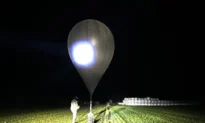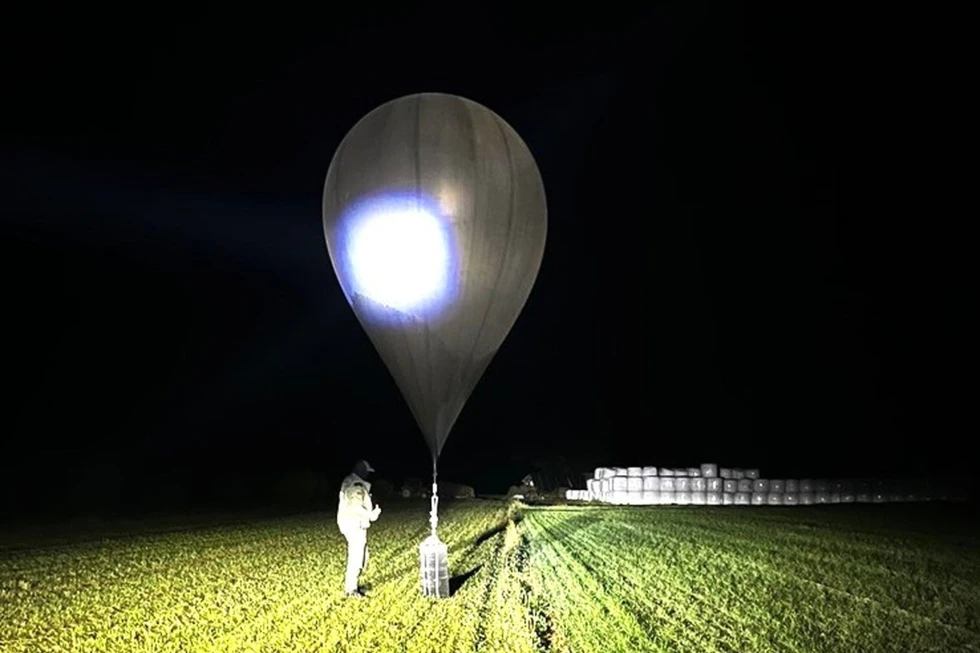

Lithuania declared a state-level emergency on Dec. 9 due to “hybrid attacks” comprising weather balloons used to smuggle contraband across the border from neighboring Belarus, a close ally of Russia.
The Ministry of the Interior of Lithuania said in a statement that the nationwide state of emergency will control the threat posed to civil aviation and national security interests.
According to the department, every night, the police, military police, State Border Guard Service, and Customs Criminal Service conduct raids at its border, checking vehicles, intercepting meteorological balloons, and seizing contraband.
Minister of the Interior Vladislav Kondratovic said the declaration will allow military personnel to work more effectively on their own and with internal ministry officers to tackle the threat.
The emergency declaration follows two months of increased sightings of weather balloons, including over airports, which have resulted in skies being closed and flights grounded. The ministry said in its statement that since October, Vilnius Airport has been closed for more than 60 hours, impacting 350 flights and 51,000 travelers.
The ministry said the emergency status is not being enacted nationwide “because depending on the wind, contraband balloons can move in more than one municipality in the country.”
The department added that recorded navigational markers for these balloons have been documented near Vilnius Airport, which is about 20 miles from the border with Belarus, as well as farther into the interior of the country, including over Kaunas Airport, Siauliai, and Kedainiai.
“In combating the Belarusian hybrid attack, we must take the strictest measures and defend the areas most affected by this attack,” Lithuanian Prime Minister Inga Ruginiene said. “All relevant institutions are joining forces to prevent the threat posed by smuggled balloons.”
On Oct. 27, Lithuania temporarily closed its borders with Belarus, with Ruginiene suggesting that Minsk was not doing enough to stop the criminal activity originating from its country.
Lithuanian officials have previously cited cigarettes as the main item illegally entering Lithuania from Belarus by balloon.
Belarusian Foreign Minister Maxim Ryzhenkov called the closure a “provocation,” saying that the problem of smuggling contraband was a longstanding issue, recommending that Vilnius focus more on tackling “organized gangs of Lithuanians who use smuggling for profit.”
Belarus has consistently denied being responsible for the balloons.
On Dec. 9, Belarusian President Alexander Lukashenko denied the accusations that Minsk was behind these incidents and accused Vilnius of “politicizing” the issue.
Lukashenko called for negotiations, saying during a session of Belarus’s security council: “If you want normal relations, sit down at the table and discuss these issues. We are ready to do that.”
Belarusian Deputy Foreign Minister Igor Sekreta also urged Vilnius to meet with Minsk for discussions.
Accusations of Airspace Violations
Last week, Minsk and Vilnius got into a row, accusing each other of airspace violations.
On Dec. 1, Lithuania complained to the European Union after Vilnius Airport was forced to close on Nov. 30 due to suspected balloons in the airspace, again blaming Lukashenko for allowing the criminal activity.
That same day, Belarus accused Lithuania of being behind the deployment of a spy drone that dropped “extremist” material.
The Belarusian interior ministry said that on Nov. 30, a drone was found in Grodno, western Belarus, “equipped with a photo and video camera with the ability to collect intelligence data.”
“In addition, extremist printed materials were dropped from the drone,” it said.
The ministry said specialists had determined it had been launched from Kapciamiestis, Lithuania, near the borders of Belarus and Poland.
Lithuania’s National Crisis Management Center denied Belarus’s accusations, with a spokesperson saying, “It is not the first time the Belarusian regime is inventing stories and hurling accusations at Western countries and Lithuania.”
European Commission President Ursula von der Leyen wrote in a post on X on Dec. 1 that she had spoken with Lithuanian President Gitanas Nauseda, saying the situation at the border with Belarus was “worsening.”
“Such hybrid attack by the Lukashenka regime is completely unacceptable,” she wrote, adding that the EU was preparing further measures under its sanctions regime.
The Associated Press and Reuters contributed to this report.
 Friends Read Free
Copy
Facebook
Tweet
Friends Read Free
Copy
Facebook
Tweet