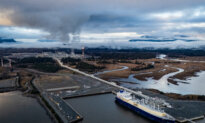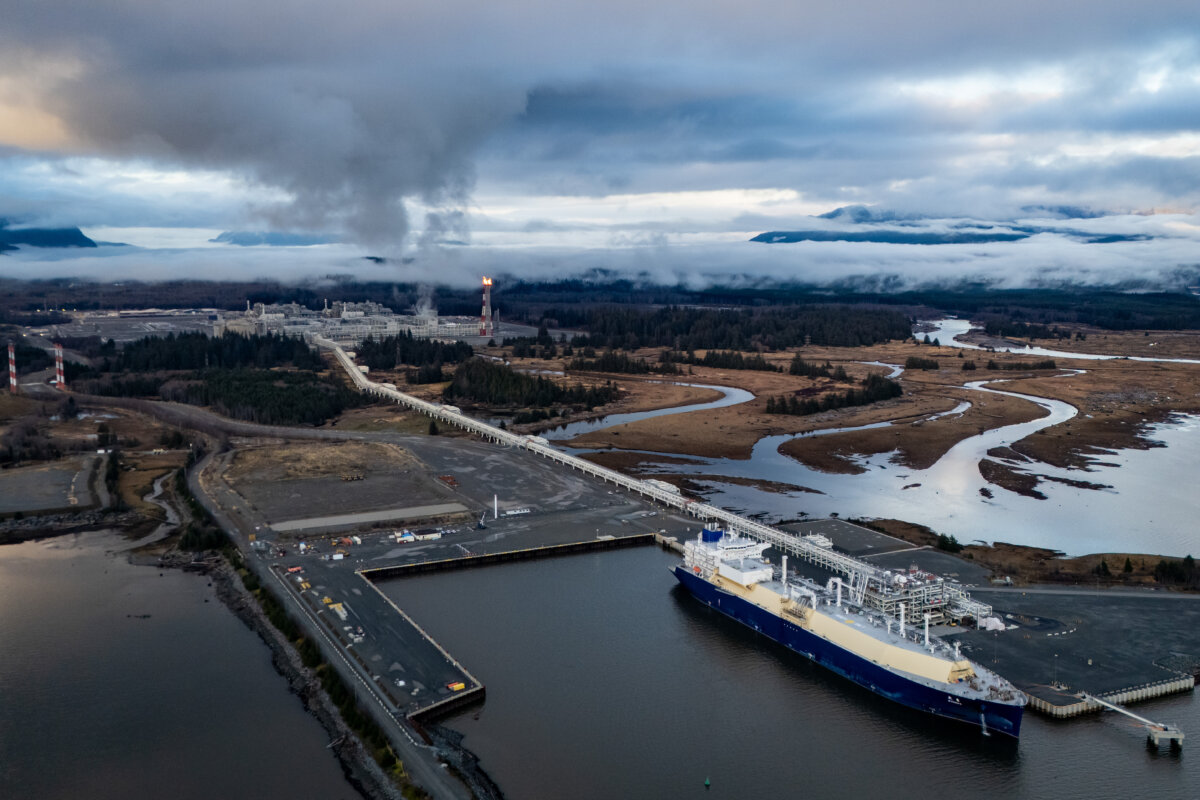

LNG Canada has announced it will be going ahead with an expansion of its liquefied natural gas export terminal in Kitimat, B.C., after it was referred to the federal government’s Major Projects Office in 2025.
LNG Canada CEO Chris Cooper said in a statement that the Phase 2 project will double Canada’s LNG capacity from 14 to 28 million tonnes a year, and put the export terminal on a “trajectory to become one of the largest LNG facilities in the world.”
“It will create thousands of jobs and further strengthen Canada’s role as a trusted energy partner, bringing more responsibly produced Canadian LNG to global markets while supporting long-term prosperity at home,” Cooper said on Sept. 29.
LNG Canada is owned by five joint-venture participants: Shell, Malaysia’s Petronas, PetroChina, Japan’s Mitsubishi Corporation, and South Korea’s Kogas. The facility receives natural gas through pipelines from B.C. and Alberta, cools it to a liquid, and loads it onto tankers for export, mainly to Asian markets.
The Phase 2 expansion will build on the infrastructure of the first phase of the project, which began shipping LNG in 2025.
The expansion will add two additional LNG processing units to the facility, including an additional storage tank, condensate tank, loading berth, and expanded utility and process systems. LNG Canada will also work with Coastal GasLink to expand the capacity of the existing 670-kilometre pipeline by constructing five new compressor stations.
LNG Canada estimates that Phase 2 could generate more than $50 billion in government revenues over the life cycle of the project, including through taxes, royalties, and other government revenues.
It also predicted the project will create “significant employment opportunities,” as 50,000 Canadians contributed to the delivery of the first phase, and 25,000 Canadians were employed during the construction of the connecting Coastal GasLink pipeline.
LNG Canada said Phase 2 is expected to host up to 4,000 new construction jobs in Kitimat, alongside around 2,100 jobs related to building new compressor stations along the pipeline.
The federal government’s Major Projects Office recommended that Phase 2 be approved in September 2025. The office is intended to accelerate major projects by streamlining regulatory approvals and coordinating financing.
Energy and Natural Resources Minister Tim Hodgson said in a statement that LNG Canada’s decision to move forward with Phase 2 is a “massive vote of confidence in Canada.” Hodgson said the investment would help Canada to build a stronger economy and become an “energy superpower for the long term.”
Conservative Leader Pierre Poilievre said on Sept. 29 that the announcement was “long-delayed good news,” but argued that the project received its permit a decade ago under former prime minister Stephen Harper and was delayed by what he called “bad Liberal policies.”
“Over the same period, the U.S. built, not announced but built, 9 LNG terminals. Germany built an LNG import terminal in 194 days,” Poilievre said on social media, adding that Prime Minister Mark Carney should “explain why it took him so long to do so little.”
 Friends Read Free
Copy
Facebook
Tweet
Friends Read Free
Copy
Facebook
Tweet