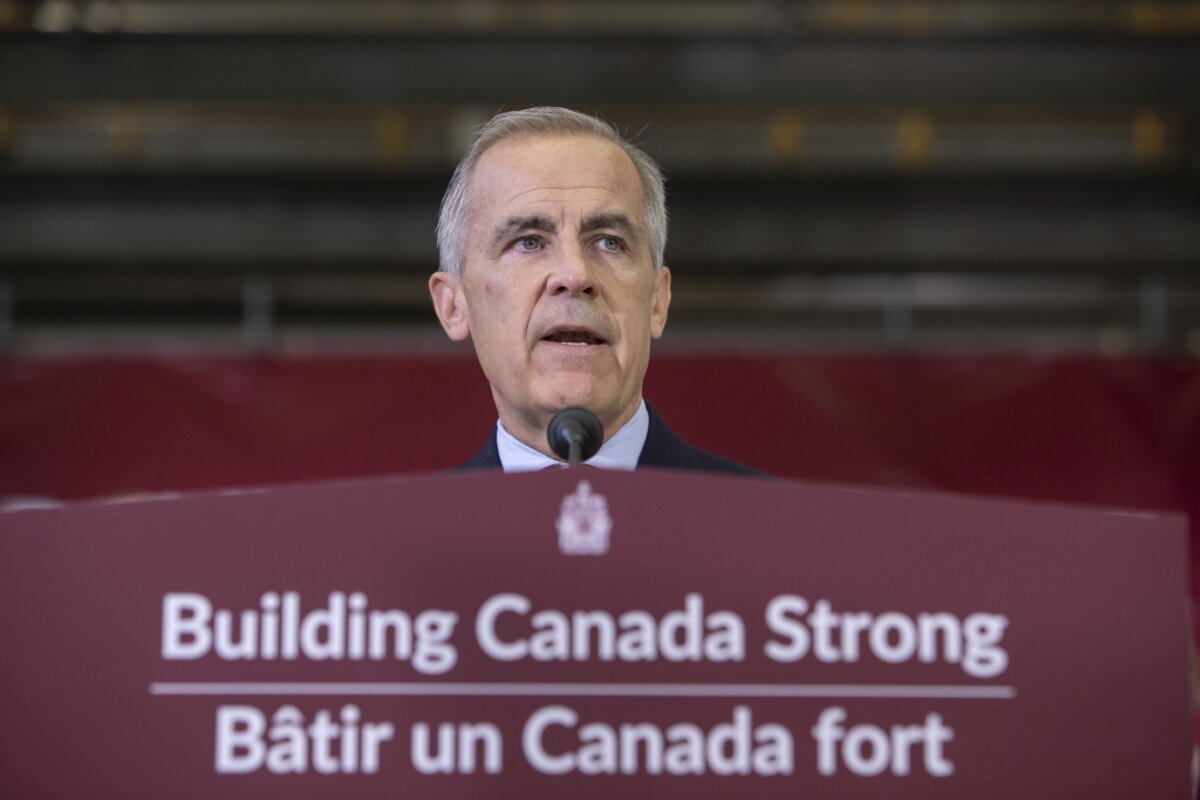

Prime Minister Mark Carney says the first set of major projects the federal government is recommending for approval includes the expansion of a liquified natural gas (LNG) project in B.C. and upgrading the Port of Montreal.
The first five major projects are set to include the second phase of LNG Canada in Kitimat, B.C., which will double its production of LNG, the Darlington New Nuclear Project in Clarington, Ont., which will make small modular reactors, as well as the Contrecœur Terminal Container Project to expand the Port of Montreal, Carney announced at a Sept. 11 press conference in Edmonton.
Two mining projects are also included on Carney’s list, including the McIlvenna Bay Foran Copper Mine Project in Saskatchewan and the expansion of the Red Chris Mine in northwestern B.C.
“We’ll advance projects that turbocharge and connect our regional economies as well as our economy to the world, projects that diversify our products and markets, projects that create hundreds of thousands of high-paying careers, good union careers for our workers,” Carney said.
Carney said at the end of last month that there were “medium-term opportunities” to export energy products like LNG, and that he would be announcing investments in Canadian ports that could be used to ship LNG to other countries. The prime minister said on Sept. 11 the LNG Canada project will “directly help transform our country into an energy superpower.”
“This project will double Canada’s LNG production capacity and make it the second-largest liquified natural gas facility of its kind in the world,” he said.
Carney said the Darlington nuclear project will make Canada the first G7 country to have an operational small modular nuclear reactor and expanding the Port of Montreal in Contrecœur will allow Canada to explore new markets.
Last week, the Montreal Port Authority said it had submitted its permit application to Ottawa to begin in-water project works to expand the Port of Montreal in Contrecœur. It said Fisheries and Oceans Canada recognized the application as complete, marking “a decisive step forward in the project’s progress.”
Additionally, Carney said the two mining projects he announced will “strengthen Canada’s position as a global supplier of critical minerals for clean energy, advanced manufacturing, and modern infrastructure.”
Future Projects
The first tranche of projects are ones that have already carried out “extensive” consultations with First Nations, have worked with provincial and territorial governments and local authorities, and have already met many of the necessary regulatory standards to be approved by the Major Projects Office (MPO), Carney said.
The second tranche is set to be announced by mid-November.
The prime minister also listed several projects that are at an earlier stage of development but that could be part of the next wave of projects after further development. These include Ontario’s Ring of Fire mining projects, a Wind West Atlantic Energy project, which supports wind power in Atlantic Canada, the Alberta-based Pathways Plus carbon capture project, an Arctic economic and security corridor, upgrades to the Port of Churchill in Manitoba, and the Alto high-speed rail corridor between Toronto and Quebec City.
The federal government’s first batch of projects does not include an oil pipeline. Alberta Premier Danielle Smith has been advocating to have a pipeline built to B.C.’s north coast to export Alberta oil and gas to other markets as part of efforts to reduce reliance on the United States amid ongoing tariffs.
However, in reacting to Carney’s announcement, Smith told reporters in Edmonton that the first tranche of major projects “demonstrates a real shift in the focus of the government,” and said she had an “encouraging” meeting with the prime minister on Sept. 10. She said Alberta is making “great progress” towards its mission of building a pipeline to the B.C. coast through its Pathways Plus project, and that people will have to “be patient.”
“I can tell you that when I looked at the first five projects, I thought, ‘finally they get it,’” Smith told reporters at a Sept. 11 press conference. “Because it’s all the projects that have been difficult to build.”
Tory Opposition Leader Pierre Poilievre criticized Carney’s announcement, saying the prime minister’s recommendation to approve the five projects doesn’t mean the projects will immediately be able to proceed, and rather that the Major Projects Office will “one day consider possibly approving the five projects.”
“He’s not permitted a single major mine, pipeline, nuclear plant, or anything else,” Poilievre told reporters at an unrelated Sept. 11 press conference. Poilievre added that the federal government is “blocking 39 projects that are in the regulatory system,” and another 100 projects in Saskatchewan alone are “waiting on federal decisions.”
‘Building Canada’
Ottawa launched its MPO on Aug. 29, which will be headquartered in Calgary. It aims to get major projects deemed to be of national interest built faster by streamlining and accelerating regulatory approvals and coordinating financing.
The office was launched under the Building Canada Act, part of the One Canadian Economy Act, also known as Bill C-5, which was passed by Parliament in June. The legislation aims to enable the federal government to streamline federal approval processes to have major projects built faster.
On Sept. 10, Carney announced he was appointing 11 indigenous representatives to form an Indigenous Advisory Council for the MPO. The prime minister’s office said the council will “help guide the MPO’s work to ensure that major projects create opportunities for equity ownership and responsible resource management through meaningful participation with Indigenous Peoples.”
 Friends Read Free
Copy
Facebook
Tweet
Friends Read Free
Copy
Facebook
Tweet