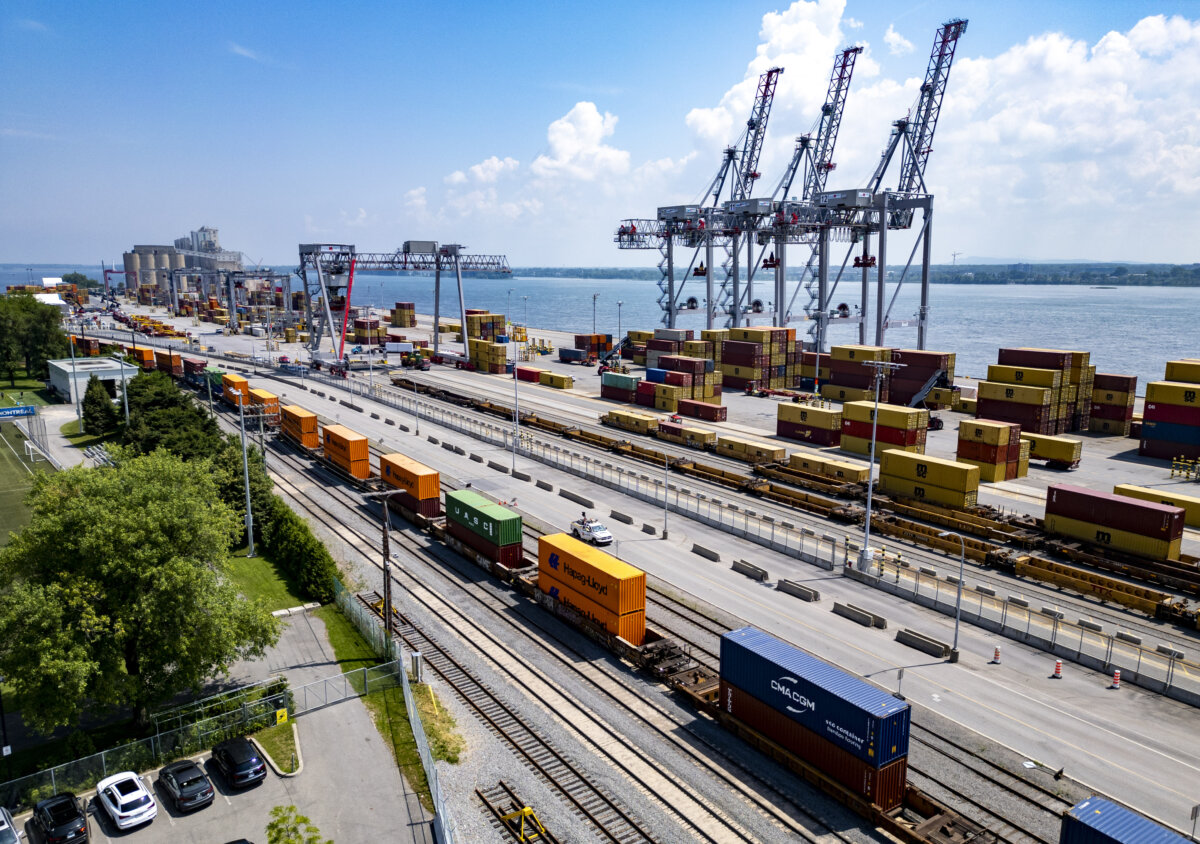

The Montreal Port Authority says it has submitted its permit application to Ottawa to begin in-water project works to expand the Port of Montreal in Contrecœur.
Fisheries and Oceans Canada has recognized the authority’s application as complete, which marks “a decisive step forward in the project’s progress,” the Montreal Port Authority (MPA) said in a Sept. 4 statement. As per the regulatory timeframe, the MPA said it expects to receive an official response from federal authorities in the coming weeks.
“We’re moving forward with the project fully transparent and in line with the highest environmental standards,” MPA President and CEO Julie Gascon said in a Sept. 4 statement.
The Impact Assessment Agency of Canada began an environmental assessment process for the Port of Montreal Contrecœur expansion project in 2016. In 2021, then-Environment Minister Jonathan Wilkinson issued a decision statement and announced that the project could proceed, after he concluded that the project was “not likely to cause significant adverse environmental effects when mitigation measures are taken into account.”
Wilkinson set out 330 legally binding conditions that the MPA is required to comply with throughout the project, including measures to protect human health, fish and fish habitat, migratory birds, wetlands, First Nations use of land and resources, natural and cultural heritage, and species at risk. The MPA was then allowed to proceed with obtaining additional authorizations and permits from federal departments.
In 2024, the MPA launched its process of obtaining the required permit applications for the in-water works.
The authority has listed several environmental offsetting measures it’s implementing as part of the Port of Montreal expansion project to minimize the impact of in-water works. These include building dikes and breakwaters to support the planting of aquatic grass beds at Île aux Bœufs, creating 27.7 hectares of fish and aquatic bird habitat in the Boucherville Islands sector, and developing the wetlands on Port lands in Contrecœur.
Other measures include planting 40,000 trees and shrubs, creating wildlife habitats for bank swallows and bats, greening and ecological enhancement projects, as well as monitoring the results of the implemented measures.
Major Projects
The MPA has called the Port of Montreal expansion project in Contrecœur a “key infrastructure project for Canadian trade.”
“Located at the hub of the St. Lawrence—Great Lakes corridor, it will make it possible to meet long-term growth in international trade and to bolster the resilience of supply chains, while supporting the competitiveness of local businesses,” the authority said. “They, in turn, will be able to develop new markets without having to go through the United States.”
Prime Minister Mark Carney told reporters while visiting Germany on Aug. 26 that the federal government would announce investments in Canadian ports in the coming weeks, which are expected to facilitate trade via the Atlantic Ocean.
In addition to investing in a new port in the northern Manitoba town of Churchill, Carney said Ottawa will make investments toward the expansion of the Port of Montreal, noting that building new port infrastructure will “open up enormous LNG, plus other opportunities.” He also mentioned other unspecified East Coast ports.
The move appears to be part of the major projects deemed to be in national interest that would be fast-tracked under the One Canadian Economy Act, also known as Bill C-5, which was adopted by Parliament before the summer break.
The Port of Montreal is the largest container port in Eastern Canada and the only container port in Quebec, located roughly 40 kilometres downstream from Montreal. It handles containerized and non-containerized cargo, liquid bulk, and dry bulk, and has its own dockside rail network that connects to Canada’s two national rail networks.
The expansion project intends to develop a new container terminal with the ability to handle 1.15 million twenty-foot equivalent units by 2030. The MPA estimates the construction work will generate roughly 8,000 jobs.
The project could potentially start as early as Sept. 29, pending the final required approvals, the MPA said in a July press release.
Matthew Horwood and Noé Chartier contributed to this report.
 Friends Read Free
Copy
Facebook
Tweet
Friends Read Free
Copy
Facebook
Tweet