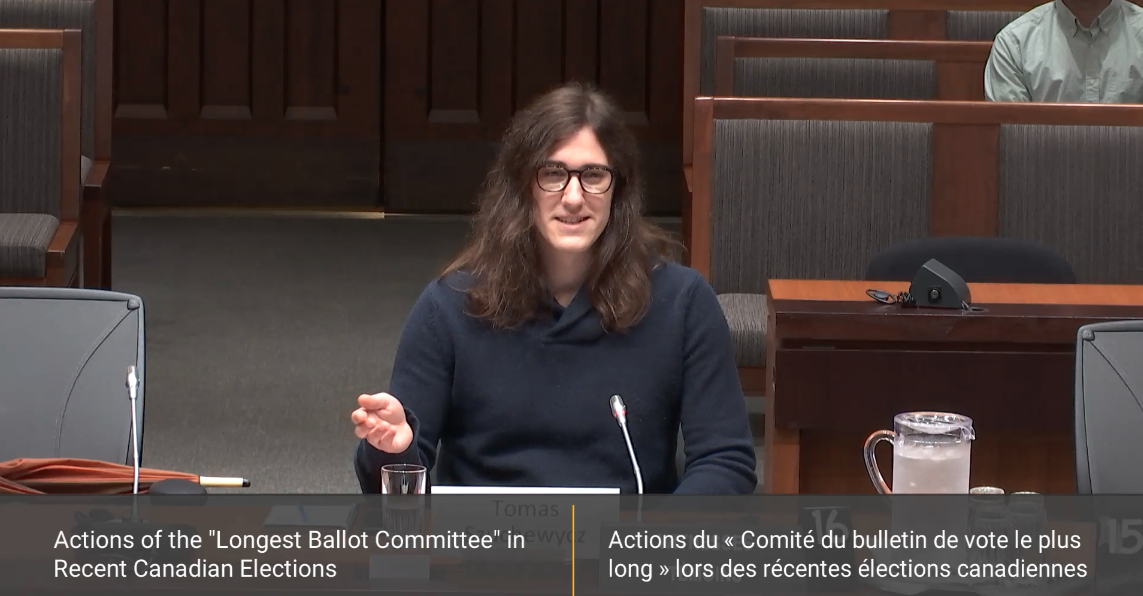

A representative of the movement to flood federal election ballots with candidates as a way to advocate for electoral reform defended his actions before a House of Commons committee on Oct. 7.
Tomas Szuchewycz told MPs the Longest Ballot Committee (LBC) urges MPs to recuse themselves from writing election rules, which he calls a conflict of interest, and to instead “establish a permanent independent, nonpartisan body to oversee the full framework of election law.”
“By handing responsibility to an independent, nonpartisan body, voters could finally trust that the laws were written to serve the best interests of Canadians rather than to serve the best interests of the ruling parties,” Szuchewycz said at the Oct. 7 committee meeting.
Szuchewycz told MPs the laws that govern how parties are regulated, how ballots are designed, who is allowed to put their name forward as a candidate, and how votes get translated into seats are not protected from political interference like ballot counting and boundary drawing are.
Szuchewycz served as the official agent for many of the candidates affiliated with the Longest Ballot Committee in the Battle River—Crowfoot byelection in August and in the spring general election this year. The protest group signed up hundreds of candidates to run against Conservative Leader Pierre Poilievre.
The LBC was first created to protest against Canada’s first-past-the-post system, in which the party winning a riding takes all, with the voice of voters choosing other parties not being represented. The group targeted Poilievre’s Carleton riding in the federal election earlier this year.
Poilievre had represented the riding since 2004 but lost his seat to Liberal candidate Bruce Fanjoy, who garnered 50.6 percent of the vote compared to the Tory leader’s 46.1 percent.
Eighty-five of the 91 candidates listed on the ballot were linked to the LBC, resulting in a significantly prolonged counting process compared to earlier elections.
Several MPs at the Oct. 7 committee meeting questioned whether the LBC’s actions were meeting the group’s objectives of achieving electoral reform or were just complicating the election process.
‘Gumming Up’ Elections
Conservative MP Michael Cooper accused Szuchewycz of collecting signatures from electors without specifying which candidate the signatures were for. He said Szuchewycz was promoting online that signatures were already collected and all interested candidates had to do was sign up. Szuchewycz admitted he was collecting signatures from electors to nominate “any and all candidates.”
Meanwhile, the chief electoral officer testified last week that the LBC’s actions affect voters’ access to vote. It especially hurts and blocks “the ability of seniors and folks with disabilities to be able to cast their ballot,” Tory MP Grant Jackson said.
“Those who are born with additional needs and the seniors who built this country should not have barriers put in their way by a political stunt that has no motivation or request from the public to change our electoral system,” Jackson said. People had a more difficult time casting their ballot, had to wait in longer lines, and did not have the ability to vote in private since they required assistance as a result of the LBC, he added.
Szuchewycz said he was not aware of any documented cases of people being prevented from voting because of too many candidates on the ballots.
Bloc Québécois MP Christine Normandin and Liberal MP Élisabeth Brière asked Szuchewycz whether he thought the LBC was achieving its objectives of electoral overhaul. Szuchewycz said his invitation to the committee was evidence the LBC has been “very successful,” adding the group has received “lots” of media attention.
Cornell University Dean of the College of Arts and Sciences Peter Loewen told the committee the LBC’s efforts “violate the spirit of our competitive elections.”
“Elections should be contested between people with real intentions of entering Parliament, who have flustered some minimum level of local support through signatures, unique signatures, and who are ready to actively compete against others,” Loewen said during his testimony. “The ballot is much more than a petition, and so it should require more than shenanigans to get on it.”
While the longest ballot movement is linked to the satirical Rhinoceros Party of Canada, which was founded in 1963, Loewen said the LBC is less about making fun of the electoral process and more about “gumming up” the process.
He said it’s a good idea to make it harder for “unserious” candidates to get on a ballot and that changes to election rules should be done “carefully, transparently, and with as much consensus and outside validation as possible.”
Szuchewycz told MPs the LBC’s objective of achieving election reform would protect MPs who are often met with suspicion when they propose changes to election law since they have partisan interests.
Noé Chartier contributed to this report.
 Friends Read Free
Copy
Facebook
Tweet
Friends Read Free
Copy
Facebook
Tweet