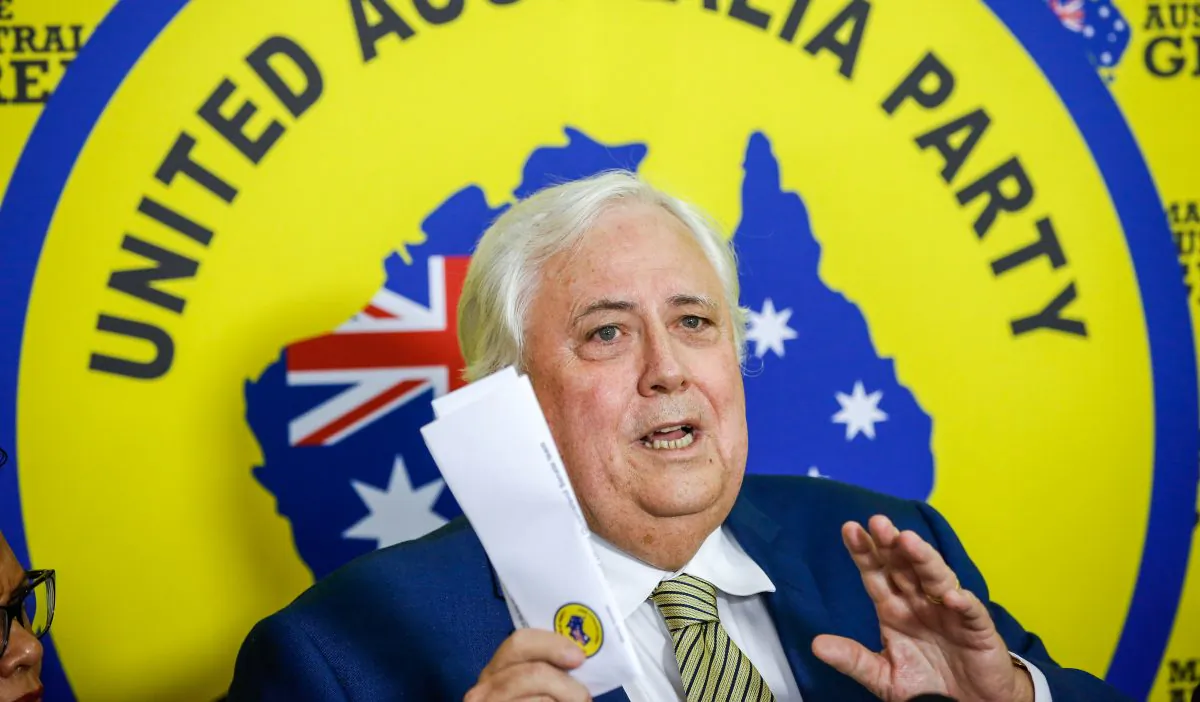

Mining billionaire and major political backer Clive Palmer has denied claims from political analyst Steve Bannon that his 2019 federal election campaign was influenced by the former advisor to U.S. President Donald Trump.
The claim was made in text messages released by the U.S. Department of Justice (DOJ) as part of the Epstein files.
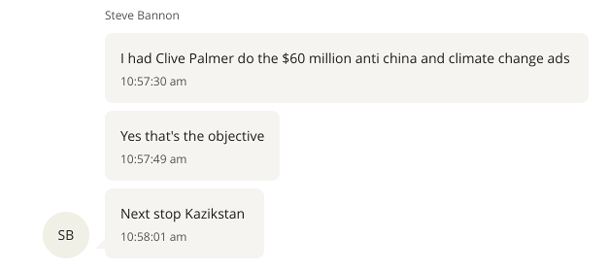
“I had Clive Palmer do the $60 million anti-China and climate change ads,” Bannon claims, adding, “Next stop Kazikstan [sic],” where he was due to address the second day of the annual Eurasian Media Forum.
Epstein responds, “Mongolia more interesting in some regards. I can set a meeting with the pres in his yurt. No kidding. It sits on border, [he] knows [China’s President] Xi [Jinping] very well and is receptive.”
Bannon was chief executive of Trump’s first election campaign and spent seven months working for the administration in 2017. He now hosts the podcast, the “Bannon’s War Room,” commenting on the political scene.
Reports have since uncovered that Epstein was working with Bannon on political planning in Europe and U.S. campaign messaging from 2018 to 2019.
After he left the White House, Bannon built a new career as a political advisor, helping right-leaning movements gain ground in France, Italy, and elsewhere. He told the ABC’s Four Corners programme that he wanted to bring a “populist revolution” to Australia.
“I absolutely see Australia is going to be a hotbed of populism,” he said. “Just knowing the cussedness and grit of the Australian people. This revolution is global … it’s coming to Australia.”
Palmer stood for the Senate at the 2019 election, but neither he nor his United Australia Party won any seats.
The party secured only 3.4 percent of the vote, but spent $60 million on advertising, most of it negative campaigning aimed at Labor, which eventually lost to the Coalition.
On election night, Palmer said he had decided to “polarise the electorate” by running anti-Labor ads in the final weeks of the campaign, rather than attempting to win seats for his party.
One such ad referred to Labor leader Bill Shorten as “Shifty Shorten” and another, in Western Australia, claimed the McGowan government had sold an airport to China for $1.00.
In an interview with the Sydney Morning Herald during the campaign, which took place about a week before Palmer went from promoting the United Australia Party to attacking Labor, Bannon described the campaign as dull, and said he was surprised at the lack of reference to China.
“There should be a really intense debate about this. They are trying to hold the election on national security, and it should be tied to China,” he said. “The insurgent parties should be generating the intensity, and they’re not.”
However, on Feb. 1 in response to the release of the Epstein files, Palmer’s media spokesperson, Andrew Crook, dismissed the claim that this strategy was directed by Bannon and pointed out there is no evidence of any communication between the two men.
The Epoch Times attempted to contact Palmer for comment.
 Friends Read Free
Copy
Facebook
Tweet
Friends Read Free
Copy
Facebook
Tweet