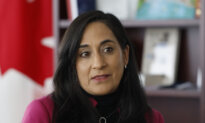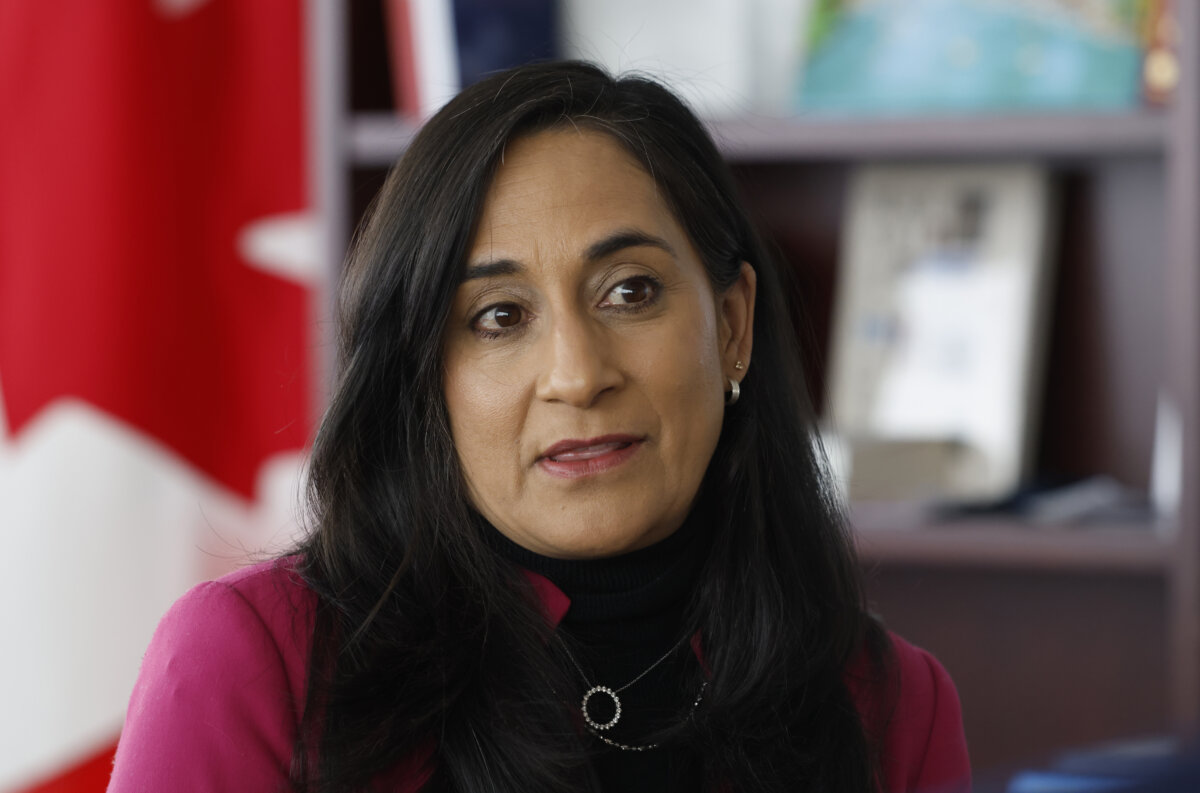
Foreign Affairs Minister Anita Anand promoted a partnership between Canada and other middle powers during an address to Canada’s ambassadors, arguing that increased cooperation would reduce their reliance on global “hegemons.”
Speaking at a meeting of Canada’s ambassadors and high commissioners in Ottawa, Anand said that a partnership of Canada, the European Union, Australia, Japan, and South Korea has a larger combined GDP than the United States. She also said the countries’ total trade volume triples that of China.
“Purpose-built coalitions can make a difference, so that we, as middle powers, can drive prosperity together,” Anand said, adding that the countries should not be “relying on hegemons” for economic growth.
Prime Minister Mark Carney previously outlined Canada’s focus on strengthening cooperation among middle powers during a Jan. 20 address at the World Economic Forum in Davos, Switzerland. The prime minister gave a speech urging countries not to comply with “great powers,” and said the rules-based international order had undergone a “rupture.”
Carney urged middle powers to deepen cooperation in response to pressure from unspecified major powers, which he said have begun “using economic integration as weapons, tariffs as leverage, financial infrastructure as coercion, [and] supply chains as vulnerabilities to be exploited.”
The speech led U.S. President Donald Trump to withdraw his invitation for Carney to join the U.S.-led Board of Peace, which aims to secure enduring peace in conflict-affected regions, including an initial focus on Gaza reconstruction efforts.
Anand told the audience that the diplomats would talk about the “implementation of our new foreign policy under a new prime minister and a new government” over the next few days. She outlined the economic, diplomatic, and humanitarian dimensions of Canada’s new strategy to the audience.
The foreign affairs minister said Canada is pushing to reduce its dependence on the United States by doubling non-U.S. trade over the next 10 years, and it has already seen a 17 percent growth in non-U.S. exports in 2025. Anand said Ottawa has signed more than 20 economic and security agreements with other countries and signed 56 agreements on critical minerals with over 10 countries.
When it came to defence, Anand said Canada will meet the NATO target of 2 percent of GDP on defence spending in 2026, and is on track to reach the 5 percent benchmark by 2035. She noted the government has pledged $82 billion toward the Canadian Armed Forces, defence procurement, and Arctic sovereignty.
Anand also noted Canada has committed$25.5 billion in aid for Ukraine in its war against Russia. She also said Canada has increased its humanitarian aid to Cuba, Haiti, Sudan, the Gaza Strip, and Lebanon.
Trump’s administration has strongly criticized Canada’s defence policies, culminating in the Pentagon last month unexpectedly suspending its participation in the Permanent Joint Board on Defence (PJBD). The U.S. cited Canada’s failure to make “credible progress” in military readiness and defence capabilities, and called for a clearer, more heavily resourced Arctic and continental security strategy.
Conservative Leader Pierre Poilievre has criticized the government’s foreign policy, citing a lack of progress in key trade negotiations with the United States. In remarks on June 1, Poilievre made reference to Carney’s Davos speech, where he said if countries were not “at the table,” then they were “on the menu.”
“Mark Carney has been hiding from the negotiating table for the last six months, while the Mexicans have been eating our lunch … and right now, because Carney’s been hiding from the negotiating table, he’s made all of us on the menu,” Poilievre told reporters in Ottawa.
While the United States and Mexico have been moving forward with Canada-United States-Mexico Agreement (CUSMA) talks, Canada and the United States have not made the same level of progress. U.S. Trade Representative Jamieson Greer said in May that while significant trade issues with Canada remain, he has been in regular contact with Canadian trade officials.
 Friends Read Free
Copy
Facebook
Tweet
Friends Read Free
Copy
Facebook
Tweet