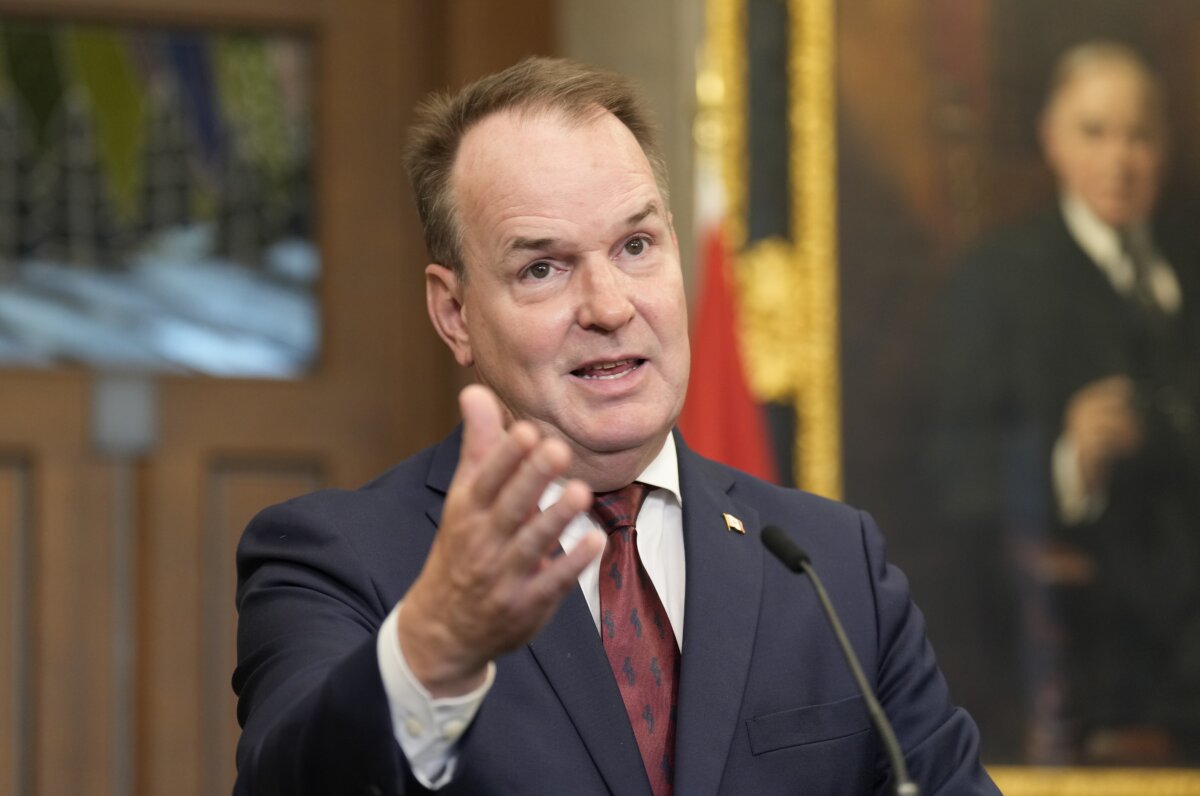

A crucial vote of confidence in the minority Liberal government over its budget will take place in the coming weeks, and Minister Steven MacKinnon said he is concerned about the current state of affairs.
“When I see opposition parties play political games in a cavalier fashion with the future of the country, with our budget, it worries me a lot,” MacKinnon told reporters before a cabinet meeting on Oct. 21.
In his capacity as government House leader, MacKinnon is responsible for reaching out to opposition parties to gather support and negotiate to advance his party’s agenda.
His comments came after the Conservatives and the Bloc Québécois recently made public their expectations and demands for the upcoming fall budget, to be introduced on Nov. 4.
Tory Leader Pierre Poilievre has called for tax cuts and wants the deficit to be kept under $42 billion. This is the figure that had been projected for the next fiscal year in the 2024 Fall Economic Statement. Poilievre said government deficit spending is driving inflation and making life unaffordable for Canadians.
“You claim that big deficits are investments. That is exactly the alchemy Trudeau promised: that deficits would spark investment and growth,” Poilievre wrote in an Oct. 20 letter sent to Prime Minister Mark Carney. “The result was the worst per-capita growth in the G7 and a more than 10% drop in investment per worker.”
MacKinnon has called the Tories’ demands “ludicrous” and said the $42 billion deficit figure is “unattainable.” The minister had said last month, without going into details, that the deficit will be “substantial.” The Parliamentary Budget Officer (PBO) has projected a deficit of $68.5 billion.
MacKinnon also said the Bloc Québécois is “hard to follow” in its statements and requests, after the Bloc first said it can’t support the budget and then released a list of conditional demands.
Bloc Québécois Leader Yves-François Blanchet said on Oct. 1 that the projected deficit is “unbelievable” and “looks like madness,” and that he doesn’t see how his party could support the budget.
Last week, the Bloc issued a list of 18 demands for the budget, six of which it said were “unavoidable” in order to gain its support. Those include increased transfers to provinces in health care and infrastructure.
Oppose Austerity
The minority Liberals are a few seats shy of a majority and will need the support of the NDP to pass their budget if the Tories and the Bloc decide to vote against it.
Regarding obtaining the NDP’s support, MacKinnon said that in general, he and other cabinet members, including the prime minister and the finance minister, have been having discussions with the other party leaders and “will continue to listen to what they have to say.”
As for the NDP specifically, MacKinnon said, “you’ll have to ask them.”
Interim NDP Leader Don Davies said earlier this month that his party has not made any specific requests to the Liberal government for the upcoming budget. Davies said, however, that the NDP would not support a budget focused on austerity measures.
“We’ve been very clear that we will oppose any attempt at imposing austerity on Canadians at a time when we think we need to invest,” Davies repeated on Oct. 21.
Carney has previously said there would be austerity measures in the budget, as Ottawa seeks to make the government more efficient, while at the same time he said it will propose “generational investment” to respond to the current economic situation.
The NDP has seven seats in the House of Commons and the party’s search for a new leader is to be completed by the end of March 2026.
“We’re not afraid of an election,” said Davies, while adding he doesn’t think Canadians are ready for one. The NDP leader expressed concerns, however, about the tone struck by MacKinnon earlier that day.
“For Mr. MacKinnon to say he’s worried, well, that has me worried, because the government should be reaching out to all the parties and working collaboratively to make sure that they can get enough votes out of the budget passed,” he said.
MacKinnon also remarked that he doesn’t think Canadians are ready for another federal election after going to the polls in April.
After the tabling of the budget on Nov. 4, MPs will debate it in the House of Commons and then vote on it. Such votes are considered a matter of confidence and could lead to the dissolving of Parliament if the budget is rejected.
 Friends Read Free
Copy
Facebook
Tweet
Friends Read Free
Copy
Facebook
Tweet