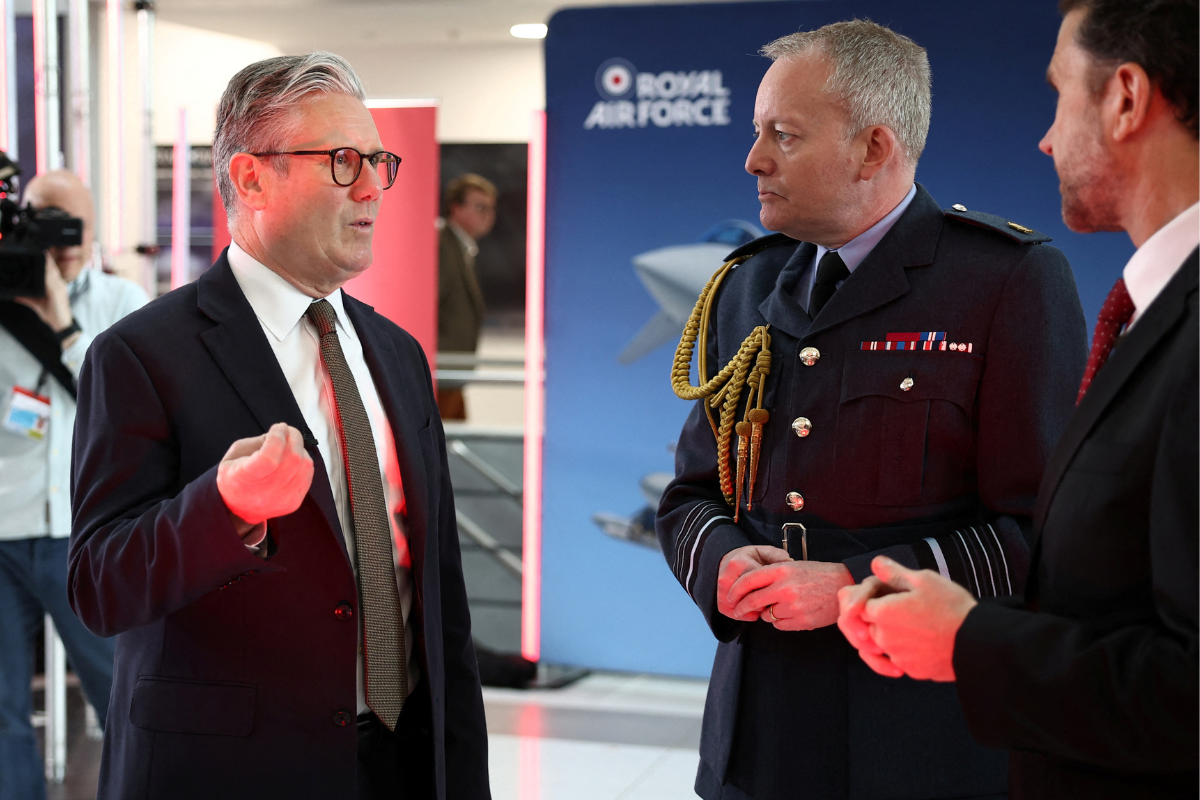

The UK needs “more people being ready to fight for their country” due to the growing risk posed by Russia, Britain’s military chief said on Dec. 15.
During his speech at the Royal United Services Institute (RUSI) think tank in London, Air Chief Marshal Sir Richard Knighton suggested that while there was only a remote chance of an attack by Russia, conflict is no longer the distant concept it had been in previous decades—and the threat is growing.
“Sons and daughters. Colleagues. Veterans … will all have a part to play. To build. To serve. And if necessary, to fight. And more families will know what sacrifice for our nation means,” Knighton said at the annual lecture.
He added that the UK’s response will need to go beyond strengthening the armed services, requiring a “whole of society response. The whole of Britain must step up.”
The air chief marshal said it will require a response that “builds our defence industrial capacity, grows the skills we need, harnesses the power of the institutions we will need in wartime and ensures and increases the resilience of society and the infrastructure that supports it.”
Knighton noted that indications of threat from Russia are not being felt in the UK as acutely as in NATO allies on mainland Europe, particularly in eastern border nations like Estonia.
In recent months, Europe and NATO have redoubled efforts to increase their defense and security, largely in response to the ongoing conflict on Europe’s doorstep. The Russia–Ukraine war will enter its fourth year this coming February, if a peace deal is not reached by then.
In October, the European Union drafted proposals for four flagship defense projects, including a drone wall and fortification of Europe’s eastern border, as part of measures to boost defense by 2030.
Almost all NATO allies committed in June to increasing defense spending to 5 percent of gross domestic product by 2035. Individual European nations, such as Germany, have also unveiled new plans to boost armed services recruitment.
“It is clear to our allies that the risk to NATO and to the UK from Russia is growing,” Knighton said.
“The Russian leadership has made clear that it wishes to challenge, limit, divide, and ultimately destroy NATO.”
No Plans to Attack NATO
The air chief marshal delivered the message the same day that the UK’s new head of the Secret Intelligence Service—commonly referred to as MI6—warned of an “aggressive, expansionist and revisionist Russia, seeking to subjugate Ukraine and harass NATO.”
Blaise Metreweli, formerly head of the UK’s domestic security agency MI5, said that alongside its war with Ukraine, Russia “is testing us in the grey zone with tactics that are just below the threshold of war,” including cyberattacks on critical infrastructure, drone activity over airports and military bases, and propaganda operations.
“The export of chaos is a feature, not a bug in this Russian approach to international engagement, and we should be ready for this to continue until Putin is forced to change his calculus,” she said.
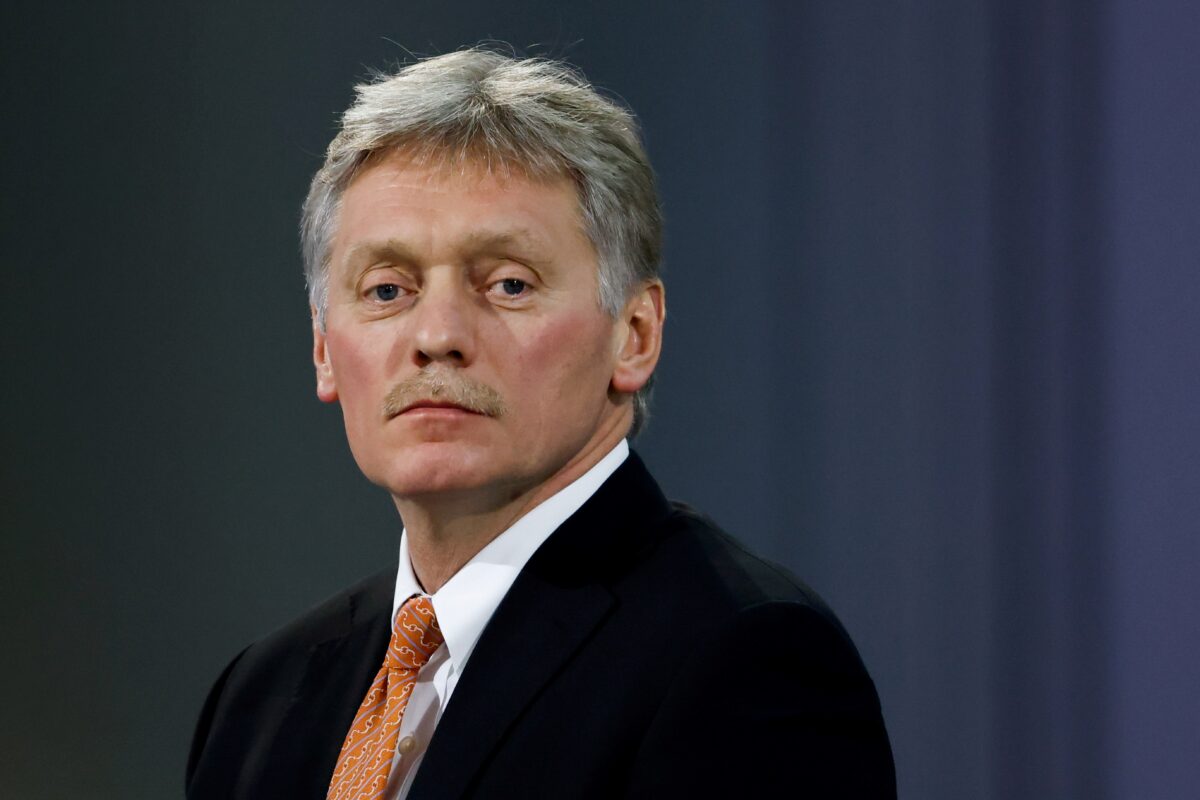
Russia has said it has no plans to attack NATO, recently stating its position in response to German Chancellor Friedrich Merz’s claim last week that Putin wants to restore the Soviet Union and attack the defense union.
Kremlin spokesman Dmitry Peskov, when asked about Merz’s remarks, told reporters on Dec. 9, “This is not true.”
Peskov said Putin does not want to restore the U.S.S.R. “because it is impossible, and he himself has repeatedly said this.”
“As for preparing for an attack on NATO, this is complete stupidity,” he said.
Reuters contributed to this report.
 Friends Read Free
Copy
Facebook
Tweet
Friends Read Free
Copy
Facebook
Tweet