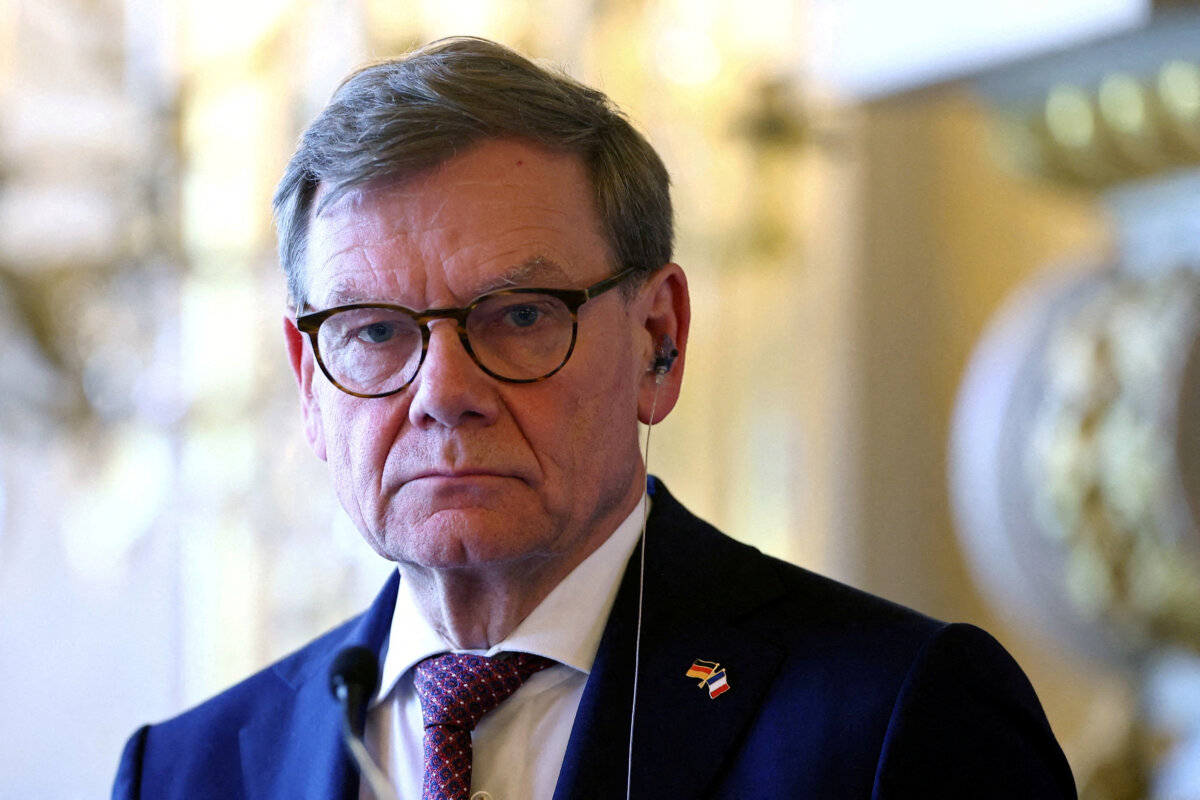

More progress is needed to convince Beijing to grant rare earth licences to German manufacturers, the German finance minister said on Dec. 8 during a visit to China.
“We have received signals, but there is still quite a lot of work to be done,” Foreign Minister Johann Wadephul told German broadcaster ZDF.
He said he had discussed disruptions to the supply of rare earths and semiconductors with the Chinese trade minister.
“In all of these areas, there has been uncertainty, and that needs to be eliminated,” Wadephul said.
China controls the supply of 17 rare earth minerals, vital to many industries, including electric vehicles, consumer electronics, and defense technologies.
Ahead of his trip, Wadephul said in a statement on Dec. 7 that China’s trade restrictions are a crucial issue for the German economy and would be discussed with ministers in Beijing.
“Trade restrictions on rare earths in particular are a major concern for our businesses, as are excess capacities in e‑mobility and steel,” the foreign minister said.
Wadephul also said that the security and prosperity of Germany and Europe “are closely tied to China.”
“It is therefore in our interest to engage in this dialogue—in direct and fair discussions,” he said.
Sourcing Concerns
The minister’s remarks come as the European Union is looking at ways to reduce dependence on China for rare earths and battery minerals.
On Oct. 14, EU trade ministers said they would work with the United States and other G7 nations to counter China’s tightening of rare earth export controls, days after Beijing said it would impose further restrictions.
Trade ministers from the bloc see China’s export controls on rare earths as a “critical concern” and called Beijing’s export controls “unjustified and causing a lot of problems for European companies and industry.”
On Dec. 1, a survey conducted by the EU Chamber of Commerce, a lobby group, found that Beijing’s export controls were forcing businesses to consider moving sourcing away from China.
The group published the results of a flash survey completed by 131 of its members, in which 75 companies (57 percent) said they expected to be or had been impacted by Chinese export controls. Of those, more than one in three (36 percent) said they plan to work with suppliers to develop capacity outside of China.
Reduce Dependence on China
On Dec. 4, the bloc’s executive branch, the European Commission, outlined plans to reduce its dependency on battery materials and rare earths from China.
“To strengthen its economic security, the EU will use existing tools irrespective of their original purpose and will deploy its toolbox more proactively when needed. It will also enhance its information collection and analytical capabilities to inform EU decisions and improve coordination with Member States and businesses,” the European Commission stated.
The new EU economic security doctrine includes new guidelines for screening foreign direct investment, taking economic security into account in trade defense investigations, and subsidizing projects that can reduce the EU’s dependence on single third countries.
According to a factsheet published by the European Commission, the EU depends on China for 90 percent of its permanent magnets, 95 percent of rare earth element extraction, and 100 percent of rare earth processing and recycling.
With projects implemented, the European Commission estimated that the dependency rates will be reduced to 80 percent, 42 percent, and 60 percent, respectively, by 2030.
Lily Zhou, Nicholas Zifcak, Reuters contributed to this report.
 Friends Read Free
Copy
Facebook
Tweet
Friends Read Free
Copy
Facebook
Tweet