
MPs are questioning how a Canadian national accused of spying while interning at NATO obtained security clearance despite a previous finding of fraud in a federal hiring process.
The concerns came as Privacy Commissioner Philippe Dufresne told a parliamentary committee that existing privacy laws do not generally prevent federal departments from collecting or sharing information as part of security screening.
Dufresne made the remarks Oct. 7 during testimony before the House committee on public safety and national security, which is examining Canada’s security-screening processes following the July arrest in Belgium of Canadian national Biwei Zhang in connection with espionage allegations related to her NATO internship.
“As a general principle, privacy is not an obstacle to national security. It is not a zero-sum game,” Dufresne said of the security-screening process. “We encourage departments to work with each other to keep each other informed,” he added.
Zhang, who was arrested this past July in Belgium, received Secret-level clearance to take part in a NATO internship, despite the Public Service Commission of Canada finding in 2023 that she had committed fraud during a 2019 federal hiring process for a Canada Border Services Agency position. The Federal Court dismissed her application for judicial review of that finding in 2024.
Dufresne said Section 4 of the Privacy Act allows federal institutions to collect personal information relevant to their programs, including for security screening. He also said his office has urged the government to ensure screening methods—including open-source inquiries, polygraph testing, and the maintenance of clearances—are effective and produce accurate information.
Dufresne said it was unclear whether legislative changes were needed to improve information sharing or whether better processes and transparency would be sufficient. He noted that he had not reviewed Zhang’s case and could not comment specifically on how her clearance was granted.
Conservative MP Frank Caputo, his party’s shadow minister for public safety, pressed officials from the National Security and Intelligence Review Agency (NSIRA) and the Office of the Privacy Commissioner on how Zhang was able to obtain a security clearance despite the previous fraud finding.
“Everything was knowable, right? It was, everything was there to be seen. She had lied on an application. There were red flags present,” Caputo said. “This was a matter of, I’ll be blunt, a failure at some level.”
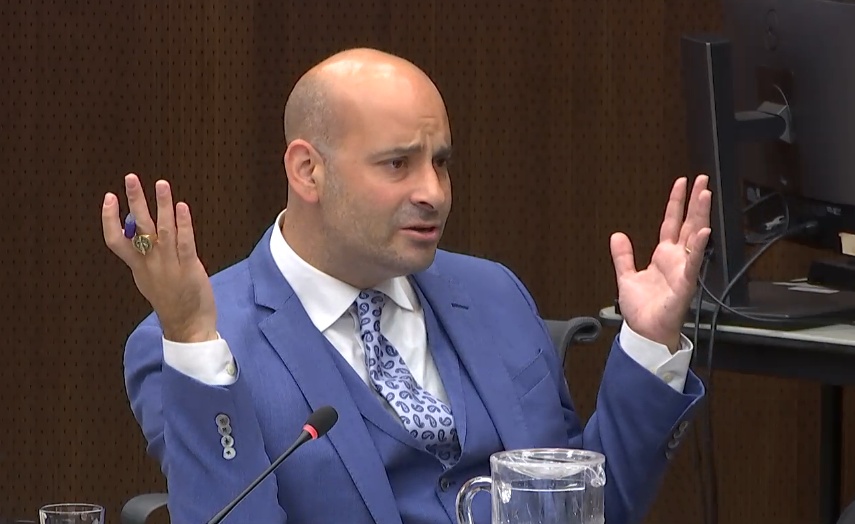 Conservative MP Frank Caputo asks questions about Canada’s security screening processes at a House public safety committee meeting on Oct. 7, 2026, in Ottawa. (ParlVu/Screenshot via The Epoch Times)
Officials said that there may have been inadequacies in the security screening process or follow-up and sharing of relevant information, but said they did not know whether Zhang’s clearance was granted because of a failure to follow existing protocols or because of flaws in the screening processes themselves.
Inconsistencies Identified
NSIRA Vice-Chair Craig Forcese also testified at the Oct. 7 committee meeting, saying investigations of complaints regarding the security screening process have identified some inconsistencies.
He said this included instances in which reports provided to departmental decision-makers left out information, or inaccurately summarized screening interviews conducted with applicants.
Forcese also said his oversight agency has identified delays in security screening and has repeatedly raised concerns about the reliability of polygraph testing used by the Canadian Security Intelligence Service (CSIS) and Communications Security Establishment (CSE).
“Our predecessor raised concerns about CSIS’s use of polygraph and the polygraph’s accuracy more than seven times,” he said, adding that NSIRA has also raised concerns about the method twice.
NSIRA has brought forward issues it identified with the reliability and legality of polygraph testing in the past with varying results. The Treasury Board rejected a 2023 recommendation to address polygraph concerns or stop using them in security screening, while the CSE adopted some improvement recommendations on polygraphs from NSIRA but said they would still use the tests for screening purposes.
Forcese said NSIRA doesn’t have authority to force government agencies to put its recommendations on improvements in place and can’t “compel anyone to do anything in terms of the outcomes of our reviews or investigations.”
“The practice has been that we will get responses to our recommendations, and we now have a protocol where we follow up thereafter as to whether our recommendations have been implemented,” he added.
Spying Allegations
Biwei Zhang, also known as Claire Zhang, was granted a Secret-level security clearance by Global Affairs Canada before starting an internship in July 2025 at NATO’s Supreme Headquarters Allied Powers Europe (SHAPE) military headquarters in Belgium.
She was arrested by Belgian authorities on July 24, who accuse her of espionage on behalf of a third country and of being part of a criminal organization. The allegations have not been tested in court.
Prior to her NATO internship, an online professional profile reviewed by The Epoch Times appeared to show that Zhang had held several positions within the Canadian federal government.
These included work as an economist with Statistics Canada, a data scientist with the National Research Council of Canada’s Digital Technologies Research Centre, and a systems engineer in satellite operations at the Canadian Space Agency.
Following Zhang’s arrest, Public Safety Minister Gary Anandasangaree had acknowledged there were some “gaps” in Canada’s security screening process.
“By and large, it is an unimpeachable record. Of course, there are gaps here, and I recognize that there are gaps, and that’s what I think we need to improve on,” he told MPs during Oct. 5 testimony before the House committee on Public Safety and National Security.
The minister said both the Canadian Security Intelligence Service (CSIS) and the RCMP have submitted recommendations to his office for reforms, which he is actively reviewing. He added that he was not certain whether Zhang still holds a security clearance and said the question should be referred to Global Affairs Canada.
The investigation into Zhang’s alleged crimes is ongoing, and Canadian officials say they are assisting Belgian law enforcement.
The Epoch Times reached out to Global Affairs Canada but didn’t hear back by publication time.
Matthew Horwood contributed to this report.
 Friends Read Free
Copy
Facebook
Tweet
Friends Read Free
Copy
Facebook
Tweet