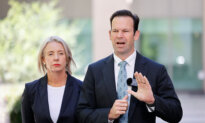
Newly elected National Party leader Matt Canavan has outlined his vision for Australia in what calls the “Patriot Agenda for an Australian Economic Revival.”
The vocal conservative-leaning senator proposed an “economic revolution,” in an address to the National Press Club on April 8.
“We won’t get revival by tinkering around the edges. Some of this will require the long-overdue slaying of sacred cows,” Canavan said. Among them was net zero, which their Coalition partner, the Liberal Party, abandoned last year.
The senator said the country should consider tariffs to protect key manufacturing industries—an idea flagged last year in The Epoch Times—which he said would bring about a “manufacturing renaissance” as part of what he called a “hyper Australia.”
“It’s a tool we already use through the anti-dumping regime, but we just do so in a pretty ad hoc, band-aid, knee-jerk fashion,” Canavan said.
Canavan said a more permanent strategy was needed to protect against countries like China that “steal our industries, take our jobs, and do so with a strategy that plays that over long term. So to keep those industries here, we should respond in kind.”
Canavan said he visited a mining equipment business called Jennmar in Mackay a few months ago that manufactures roof bolts that hold up ceilings in underground coal mines.
“They’ve always been Australian-made, made from steel milled in Whyalla, sent to Mackay,” the senator said. “They put a thread on it, put some plastic in it, and it goes into the coal mine industry … But in the past few months, they’ve started to see for the first time the importation of Chinese-made roof bolts that undercut them to a great degree.”
Previously, commercial lawyer Dan Ryan told The Epoch Times that for manufacturing to be viable in Australia again it needed to adopt the Trump administration’s strategy of reintroducing tariffs to protect key industries.
“You will never be able to produce a manufacturing industry of any consequence, as long as you have a trade agreement with China that allows 100 percent of their manufactured goods to come in here duty-free,” the former Australia-China Council board member told The Epoch Times.
National Works Program
Canavan also proposed a national works program to build dams, roads, rail, ports and space ports, along with new cities, which would allow young Australians to afford a home and access the same services as are currently available in capital cities.
He pointed to the regional town of Bowen in Queensland for its potential saying it was “meant to be the capital of North Queensland. It’s got these huge, wide streets [and is] a beautiful town, but it could be a lot bigger than it is.”
Only 11 Million Aussies to be Descended from Current Population
Canavan also wants to close the border to high level migration to free up infrastructure and housing stock. By the end of this century, he claimed, just 11 million Australians will be descended from those alive today.
“That will completely change Australia, because we actually do need to have people that are born here, raised here, to hand down the flame of what is great about this country. Yes, we’re welcoming. We take in migrants. I’m a product of that, but we also need to have children as well, otherwise we just won’t have a country.”
Senator Accuses Labor of Quietly Dropping Net Zero
Canavan also reiterated an ongoing argument against net zero, accusing the Albanese Labor government of “waving the white flag” and quietly dropping its pursuit of the agenda.
“They’ve already admitted that things aren’t working,” he said.
“In the past year alone, along with the Whyalla steel plant [in South Australia], they’ve also provided subsidies to aluminum, to zinc, to copper—more than $5 billion, and another $3 billion, probably, for the Tomago aluminium smelter in the weeks to come. This is protecting industry.
“We’re not doing free trade anymore, but we’re just doing [it] in probably the worst way.”
Just a week ago, Prime Minister Anthony Albanese brought forward the $5 billion Net Zero Fund—along with the $1 billion Economic Resilience Program and $150 million in concessional finance under the Forestry Growth Fund—as industries struggle with high fuel prices.
The initiatives were slated to be introduced mid-year, but Albanese said he’d brought them forward “to support new manufacturing investment and improvement of energy efficiency in hard-to-abate sectors.”
Meanwhile, Canavan also said factories like Rio Tinto’s aluminium smelters in Newcastle and Gladstone were operating for decades without subsidies, but net zero changed that.
“In fact, [they paid] taxes into the national Treasury, and it’s only been since they decided that they would turn their aluminium smelters to green energy that suddenly they’ve needed massive taxpayer support,” he said.
Canavan also argued that the current fuel crisis—supply strains and high prices—exposed Australia’s needs to invest in all types of energy.
“Coal and oil and gas and nuclear and, yes, renewables too. They need to be part of the mix as well, but it just has to be a balance. Now, it’s a great shame that we’ve had to go through a liquid fuel crisis for people to start to wake up to this, but I think they are,” Canavan said.
“All we have to do is unlock it. All we have to do is use our country again, and we will solve these problems.”
 Friends Read Free
Copy
Facebook
Tweet
Friends Read Free
Copy
Facebook
Tweet