
NATO Secretary-General Mark Rutte told European Union parliamentarians on Jan. 26 that they cannot defend Europe without the help of the United States.
“If anyone thinks here, again, that the European Union, or Europe as a whole, can defend itself without the U.S., keep on dreaming. You can’t. We can’t,” Rutte told the European Parliament’s defense committee in Brussels.
A majority of the EU’s 27 member states are members of NATO.
Rutte also said that the United States and Europe “need each other.”
He said that the United States “needs NATO” and needs a secure Arctic.
“They need a secure Euro-Atlantic, and they also need a secure Europe,” he said. “So the U.S. has every interest in NATO, as much as Canada and the European NATO Allies.”
Rutte, former prime minister of the Netherlands, cautioned against the notion of a European army, saying it could lead to duplication, and suggested that countries would need to find additional soldiers to outfit such a force, on top of recruiting for their own national militaries.
He said that European countries should continue to take responsibility for their own defense—as U.S. President Donald Trump has urged allies to do—but within the transatlantic security framework.
“For Europe, if you really want to go it alone, and those who you are pleading for that, forget that you can ever get there with 5 percent. It will be 10 percent,” Rutte said, referring to defense spending targets as a percentage of gross domestic product (GDP).
“You have to build up your own nuclear capability. That costs billions and billions of euros. You will lose, then in that scenario, you would lose the ultimate guarantor of our freedom, which is the U.S. nuclear umbrella. So hey, good luck.”
Senior European figures have, in recent weeks, proposed that Europe create its own army, including Spain’s minister for foreign affairs, José Manuel Albares.
Albares told Euronews on Jan. 22, “If we want to continue being a peaceful continent … we need to have the deterrence in our hand, and we need, firstly, a coalition of the willing of European security, secondly, an integration of our industries of defence, and in the end a European army.”
The idea of a joint European army has existed in one proposed form or another since the start of the Cold War to counter the Soviet Union, but NATO has remained the chief means for ensuring security on the continent.
Rutte Backs Trump
The more recent calls for a European army came as Trump said he wanted to annex Greenland for security reasons amid growing threats from Beijing and Moscow, but he has faced opposition from European leaders.
Last week, Trump said that the United States had negotiated access to Greenland. In a Jan. 21 post on Truth Social, the president said he had formed the “framework of a future deal” for the North American island and the broader Arctic region following a meeting with Rutte.
The NATO secretary-general backed Trump’s concerns about Greenland’s strategic security, telling a crowd at the annual World Economic Forum meeting in Davos, Switzerland, on Jan. 21 that Trump was right.
“When it comes to the Arctic, I think President Trump is right,” Rutte said. “Other leaders in NATO are right. We need to defend the Arctic.”
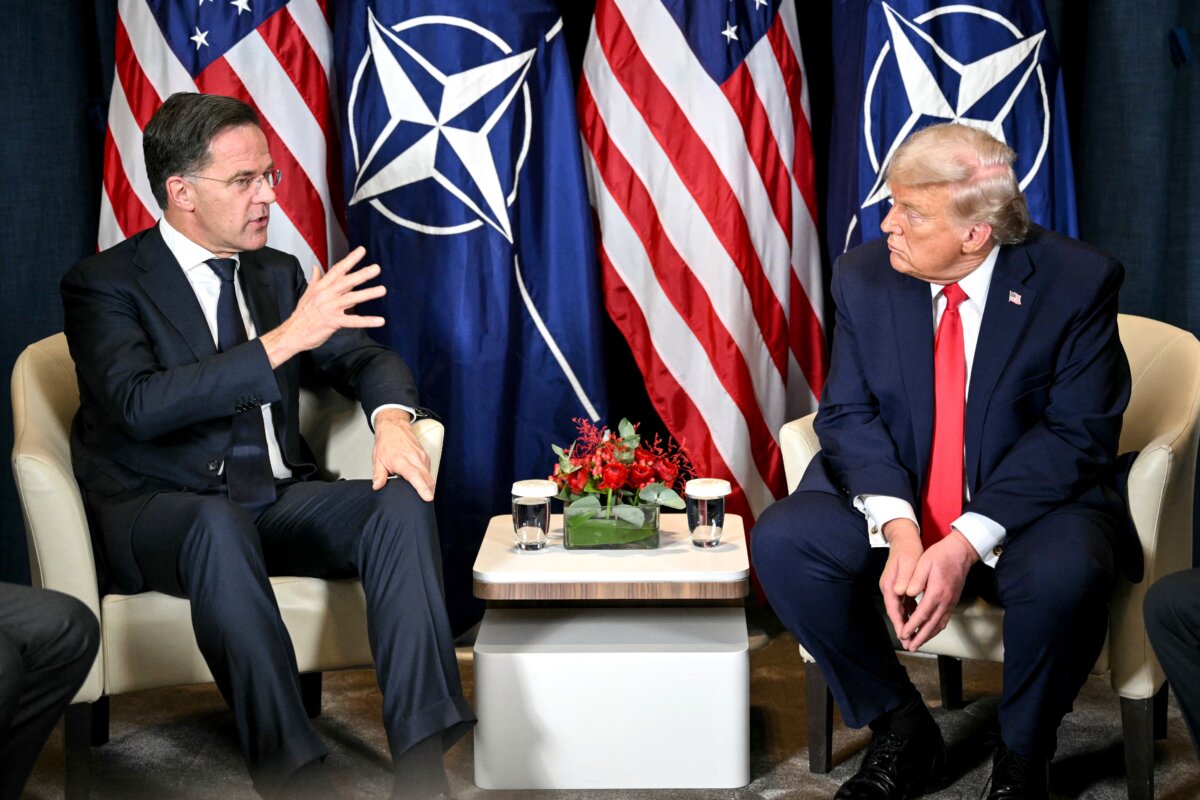
Rutte also told European parliamentarians on Jan. 26 that Trump was “doing a lot of good stuff,” saying that NATO countries “would never, ever, ever” have reached the 2 percent defense spending target by the end of 2025 without Trump.
The alliance agreed in 2025 to boost the defense spending target from 2 percent of GDP to 5 percent by 2035.
Rutte said Trump is “totally committed to NATO.”
“He had one big irritant, one big pebble in the shoe, which is there since Eisenhower, the fact that the Europeans were not paying up,” Rutte said, but he added that because NATO has increased its spending commitments, it is “equalizing with the U.S.”
“So that irritant is gone. So there is a total commitment by the U.S. to NATO Article 5, but also an expectation that Europeans and Canadians will pay more. And we are doing so.”
Article 5 states that an attack on one member of NATO is considered an attack on all the members.
The imbalance between what the United States and other allies spend on defense “has been constant,” according to NATO.
It stated: “The combined wealth of the non-US Allies, measured in GDP, is almost equal to that of the United States. However, non-US Allies together spend less than half of what the United States spends on defence.”
 Friends Read Free
Copy
Facebook
Tweet
Friends Read Free
Copy
Facebook
Tweet