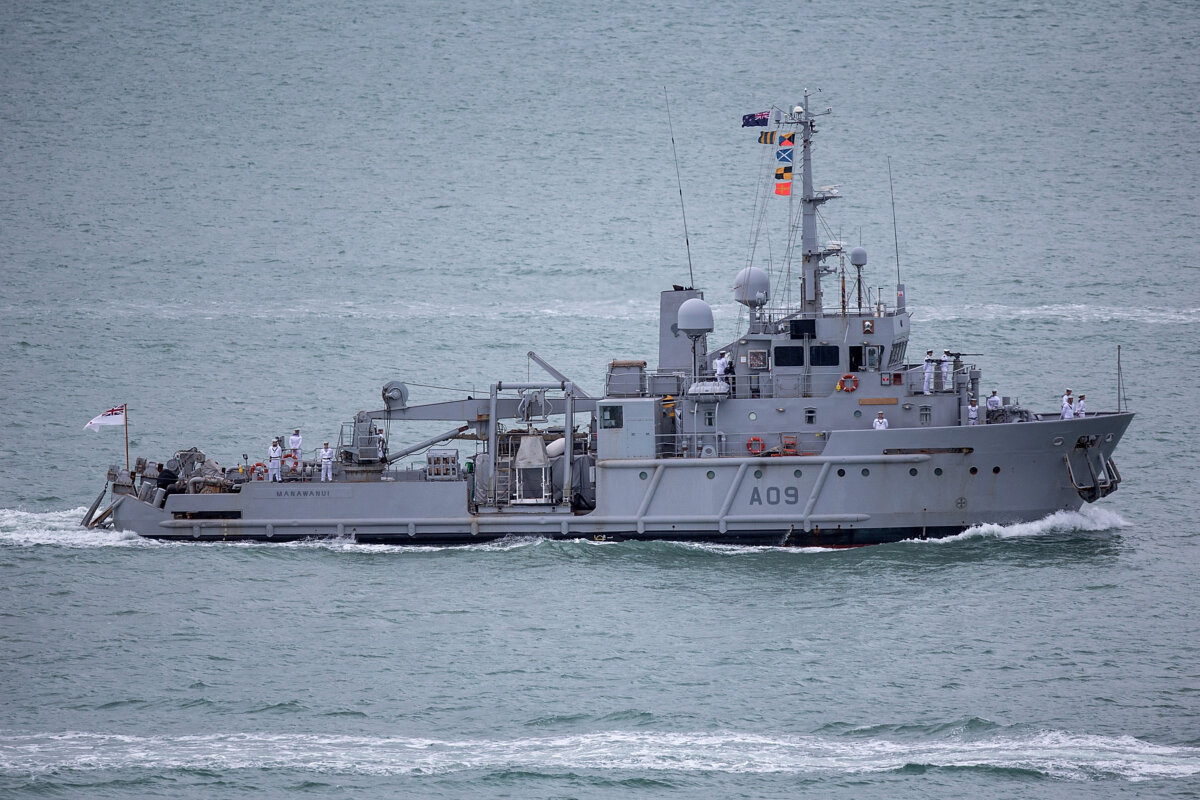

Three New Zealand Navy officers are to face a court-martial over their part in the grounding and subsequent sinking of a navy ship near Samoa in October 2024.
They are the ship’s captain, Commander Yvonne Gray, Lieutenant Commander Matthew Gajzago and an unnamed third officer. The ship that sunk was the HMNZS Manawanui. Pleas have not yet been entered, although Gray has indicated through her lawyer that she will plead not guilty and is not making any further statement as the matter is before the courts.
The charges, laid under the Armed Forces Discipline Act 1971, allege that errors were made on the bridge, which led to the vessel grounding on a known navigational hazard southwest of Tafitoala village on Upolu Island, before catching fire and sinking. All 75 crew and passengers were evacuated.
A large oil slick subsequently formed, and the New Zealand government paid $6 million in compensation over the incident.
The unnamed officer, who was on the watch at the time of the grounding, has been charged with negligently causing a ship to be lost by turning toward the reef and then failing to disengage the autopilot in time to prevent the grounding.
Gajzago, who was in command on the bridge, has been charged with negligently permitting a ship to be lost over his alleged lack of supervision of the other officer.
Gray is also charged with negligently permitting a ship to be lost or, alternatively, negligently failing to perform a duty on the bridge.
Praise, then Condemnation
In the immediate aftermath of the sinking, she was praised by the Chief of the Navy, Rear Admiral Garin Golding, for her decision to abandon ship, which he said had saved lives. Defence Minister Judith Collins also praised her leadership, calling the evacuation “something of a triumph, frankly.”
However, following a Court of Inquiry that found the incident was the result of human error, Golding said that, having mistakenly believed the ship was experiencing a thruster control failure, standard procedures should have prompted the crew to check that it was under manual control rather than in autopilot.
The Court of Inquiry delivered its final report (pdf) in March last year, finding multiple factors contributed to the incident, including deficiencies in training and experience, military hydrographic planning, orders and procedures, the operational risk matrix, force generation, operational release, and supervision.
The situation was further aggravated by the crew’s incorrect procedures and inadequate preparedness.
“The Court found deficiencies in the training and qualifications of key ship’s personnel involved in the incident, risks related to the survey task were not sufficiently identified, discussed and mitigated, and instructions or procedures were lacking,” said Court of Inquiry president Commodore Melissa Ross.
DEI Hire Debate
The appointment of Gray—a 20-year Royal NZ Navy veteran—to her first command was later criticised as a “DEI (diversity, equity and inclusion) hire” due to her being a woman, an assertion strongly refuted by Collins, who characterised those making it as “armchair admirals.”
However, Stuart Ballantyne, an experienced seaman and now chair of Seatransport, asked in an opinion piece, “Was Captain Yvonne Gray appointed on merit and experience?” and answered, “Clearly not, or her vessel would not have been skirting close to an island with a lee shore [where the wind is blowing the ship towards the shore].”
“Was the ship suitable for the task? Having been involved in the design of hydrographic ships, to choose a secondhand ship with a 26-metre air draught (height of windage above the waterline) for slow steaming operations in windy conditions was not an optimal choice for the task, but typical of the defence procurement bungling bureaucratic process.
“So would the combination of an inexperienced captain and a sub-optimal vessel be a recipe for a disaster? Yes! Now you have a clearer picture.”
Ballantyne concluded that it was Gray’s inexperience—not her sex—that contributed to the grounding. However, he noted that there were risks associated with DEI appointments in maritime roles.
“DEI policies in shore establishments may be unpleasant but are workable, however bosses there won’t put your life at risk. At sea it is an entirely different matter, and such policies should be unacceptable,” he wrote.
Gray’s lawyer has been approached for comment.
The date and location of a trial in the Court Martial are yet to be set.
 Friends Read Free
Copy
Facebook
Tweet
Friends Read Free
Copy
Facebook
Tweet