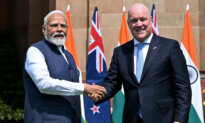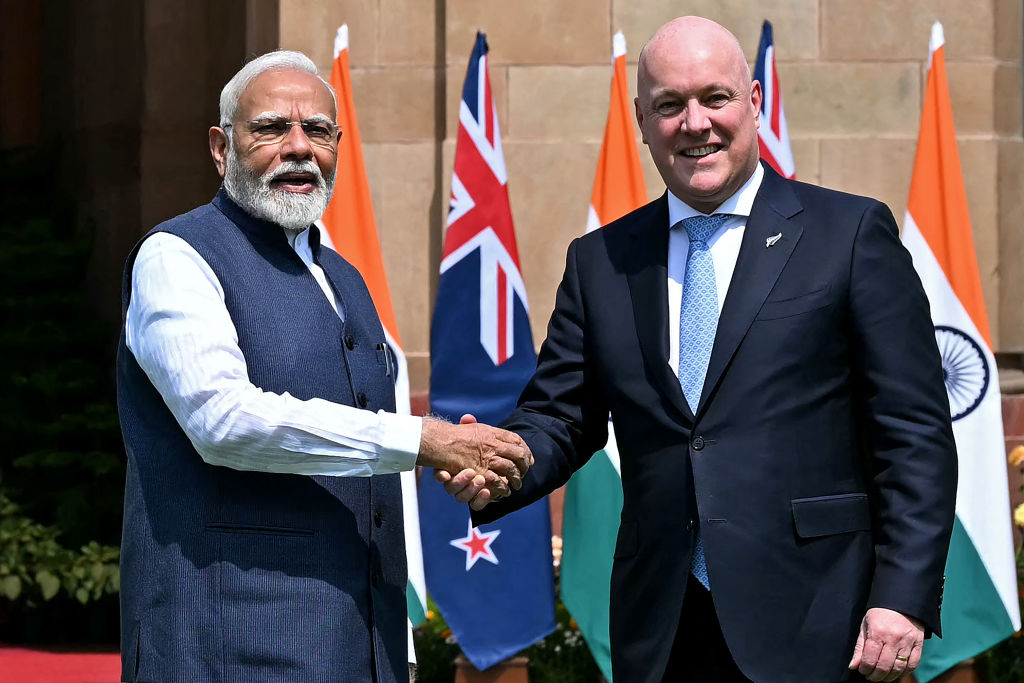

A free trade agreement (FTA) between New Zealand and India will go ahead after the opposition Labour Party agreed to vote it through Parliament at the 11th hour.
The deal is due to be signed in New Delhi on Apr. 27 amid firm opposition from the nationalist-leaning New Zealand First Party, which is part of a 3-way governing coalition with National and libertarian ACT parties.
Initially that meant the agreement was at risk of not being passed, leaving Prime Minister Christopher Luxon—who has said the FTA is a major win for the government—in a challenging position.
But Labour’s last-minute change of mind means Trade Minister Todd McLay, who had already left for India with a 30-person delegation, will be able to get it signed.
The agreement eliminates or reduces tariffs on 95 percent of New Zealand’s exports—among the highest of any Indian FTA.
Almost 57 percent of exports will be duty-free from the day the agreement comes into force, including lamb, wool, coal, leather, and most forestry and industrial products.
This will increase to 82 percent when the FTA is fully implemented, when it will expand to cover infant formula, seafood, and a kiwifruit quota almost four times the level of current exports.
The remaining 13 percent, including kiwifruit, apples, mānuka honey, wine, and some dairy, will benefit from sharp tariff cuts.
NZ First Concerned at Migration Levels, Investment ‘Clawback’
New Zealand First Leader Winston Peters—who is also the country’s foreign minister—took to social media to denounce the deal as a “disgraceful sellout.”
He said New Zealand was compelled to invest $33 billion in India over the next 15 years.
“Labour themselves have said this FTA is ‘high risk’ because if we don’t meet that threshold to India’s satisfaction, India will CLAW BACK whatever gains New Zealand thinks it has achieved,” Peters wrote.
“This is an utter unmitigated disaster of an agreement for New Zealand’s future.”
New Zealand First has been particularly concerned about the immigration provisions of the agreement, which was negotiated in December of last year but has not been made public.
“National and Labour need to explain to New Zealanders that under the immigration provisions of this FTA, the visa holders can still bring in their family members, in addition to the number of students being able to come to New Zealand being uncapped— those students are given a guarantee to work while they study, which will be taking Kiwi jobs from desperate Kiwis,” Peters said.
“This is supposed to be a free trade deal, not a free migration deal. How can they possibly support this? All of this is unprecedented in any other FTA our government has signed. We will continue to oppose this deal and fight against this disaster of an agreement.”
His NZ First colleague, Fisheries Minister Shane Jones, was more blunt in his comments warning of a “butter chicken tsunami” in relation to Indian immigration.
Jones claimed an influx of Indian immigrants would drive down the value of wages, “clog up our roads,” and “overwhelm our health and other frontline services.”
High net migration was one factor that pushed the housing price in New Zealand’s biggest city, Auckland, past the NZ$1 million mark before a recent drop.
5,000 Additional Visas
The FTA provides for around 1,667 annual three-year temporary employment visas (capped at 5,000 total) for skilled Indian workers in area in which there’s a shortage. It also offers 1,000 places on an annual working holiday scheme, which allows Indian students to work 20 hours weekly, with work rights extending 2 to 4 years after their studies end.
At a press conference at Parliament on April 23, Labour leader Chris Hipkin announced his support for the deal but said the investment target was “very unrealistic” and “almost impossible” to achieve.
“The deal cuts tariffs and increases market access for New Zealand exporters, and that is very welcome. But the $33 billion ($19.3 billion) investment target is unrealistic, and missing it could see benefits clawed back in 15 years,” he said.
“While Todd McClay says it’s all aspirational, India is already setting up oversight and has signalled it will enforce the clawback.
“This is not the deal Labour would have negotiated, but we value our relationship with India and the positive contributions of our Indian communities,” Hipkins said.
“We’re not going to stop the agreement proceeding because of it, but businesses need to be aware that that is a risk to them.”
Hipkins said Labour had secured several concessions in return for its support, including more labour inspectors “focused on migrant worker exploitation and serious and complex immigration offending” and progress on the Modern Slavery Bill currently before Parliament.
Asked about any immigration concessions, he said the deal was unlikely to increase the overall level of migration from India to New Zealand and that NZ First was “downright racist” in implying otherwise.
 Friends Read Free
Copy
Facebook
Tweet
Friends Read Free
Copy
Facebook
Tweet