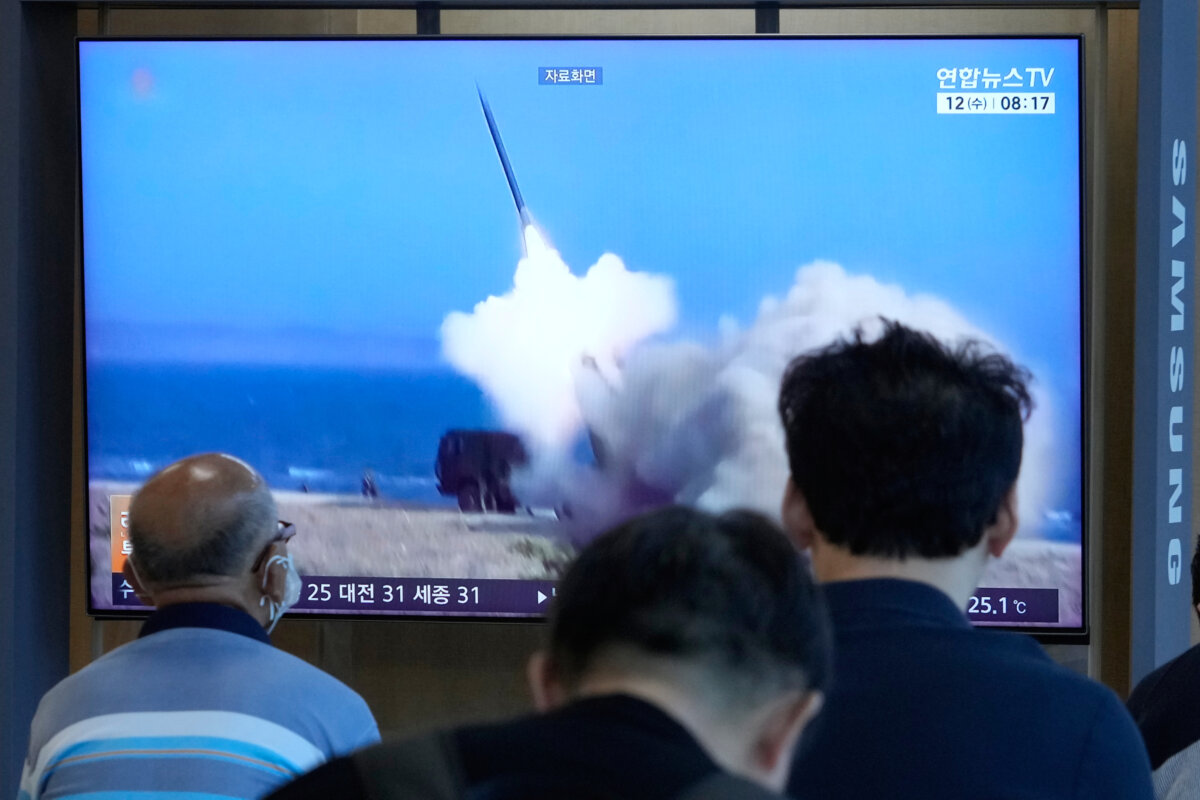

North Korea is suspected of having launched two short-range ballistic missiles off its coast, after accusing the United States of inflaming tensions following recent annual drills with allies in the region.
The Ministry of National Defense of South Korea said on Sept. 20 that Pyongyang had fired a ballistic missile on the afternoon of Sept. 20 toward the East Sea, followed by what is suspected to be another ballistic missile three hours later.
It said the first projectile, believed to belong to the Hwasong-11 series of ballistic missiles, was fired from the Wonsan area at about 3 p.m. local time and flew 280 miles.
The second projectile was also fired from Wonsan, at about 5:50 p.m., and flew 373 miles.
The South Korean Joint Chiefs of Staff said intelligence agencies from both South Korea and the United States were sharing and tracking developments regarding the latest launches and were sharing information with Japan.
“Based on current assessments, these events do not pose an immediate threat to U.S. personnel or territory, or to our allies,” the U.S. Pacific Command said in a post on X.
“The United States remains committed to the defense of the U.S. homeland and our allies in the region.”
Multiple Weapons Exercise
Last week, Pyongyang confirmed it had launched several missiles and other weapons on Sept. 12, including tactical ballistic missiles, cruise missiles, and rockets, as well as attack drones, as part of a live-fire drill.
Experts said the drills were a demonstration of North Korea’s ability to coordinate multiple weapons through one command-and-control system.
The launches were made the day after the United States, South Korea, and Japan concluded their five-day trilateral Freedom Edge 26 exercise.
The exercises are designed to improve how the three allies can operate and communicate quickly and effectively together, and they are focused on countering nuclear and missile weapons threats from North Korea.
Pyongyang has previously criticized the trilateral drills, calling them a reckless show of strength that demonstrates a confrontational stance against North Korea.
Pacific Vanguard
Pacific Vanguard 2026, another multinational exercise led by the U.S. Navy, took place between Aug. 29 and Sept. 10, according to the Japanese Maritime Self-Defense Force.
It was held in the vicinity of Guam and involved the navies of South Korea, Japan, Australia, Canada, and New Zealand.
North Korea’s Kim Yo Jong, the influential sister of leader Kim Jong Un, on Sept. 18 called the drills another threatening, U.S.-led “war game,” blaming them for “ever-worsening” tensions on the Korean Peninsula.
Kim Yo Jong said, according to North Korean state-run news agency KCNA, that if the security climate in the region is deemed to have been “seriously violated” by such military maneuvers, North Korean forces will “mobilize all means available to cope with it.”
Ulchi Scaled Back
Pacific Vanguard and Freedom Edge are two of a number of joint military exercises in which allies take part in the region.
Last month, the United States and South Korea wrapped up their annual all-domain exercise Ulchi Freedom Shield, in which the allies strengthened their joint response capabilities against a range of regional security threats.
Ulchi Freedom Shield had been scaled down on the order of U.S. President Donald Trump, after he said the drills were sending the wrong message to Pyongyang and referencing concerns over the cost to the American taxpayer.
Trump cited in an Aug. 16 Truth Social post his “very good relationship” with the North Korean leader, who views the drills as hostile and an invasion rehearsal.
As a result, the exercises ended six days earlier than scheduled, but Pyongyang said shortening the drill will not change what it called its “provocative, aggressive nature.”
Such rhetoric surrounding joint exercises between South Korea and its allies is typical of Pyongyang.
North Korea in the past has also conducted its own military tests or exercises in response to previous drills, including Ulchi Freedom.
South Korea and the United States have maintained that these exercises are defensive in nature and are designed not as a provocation, but rather to address security threats facing the Korean Peninsula.
Reuters contributed to this report.
 Friends Read Free
Copy
Facebook
Tweet
Friends Read Free
Copy
Facebook
Tweet