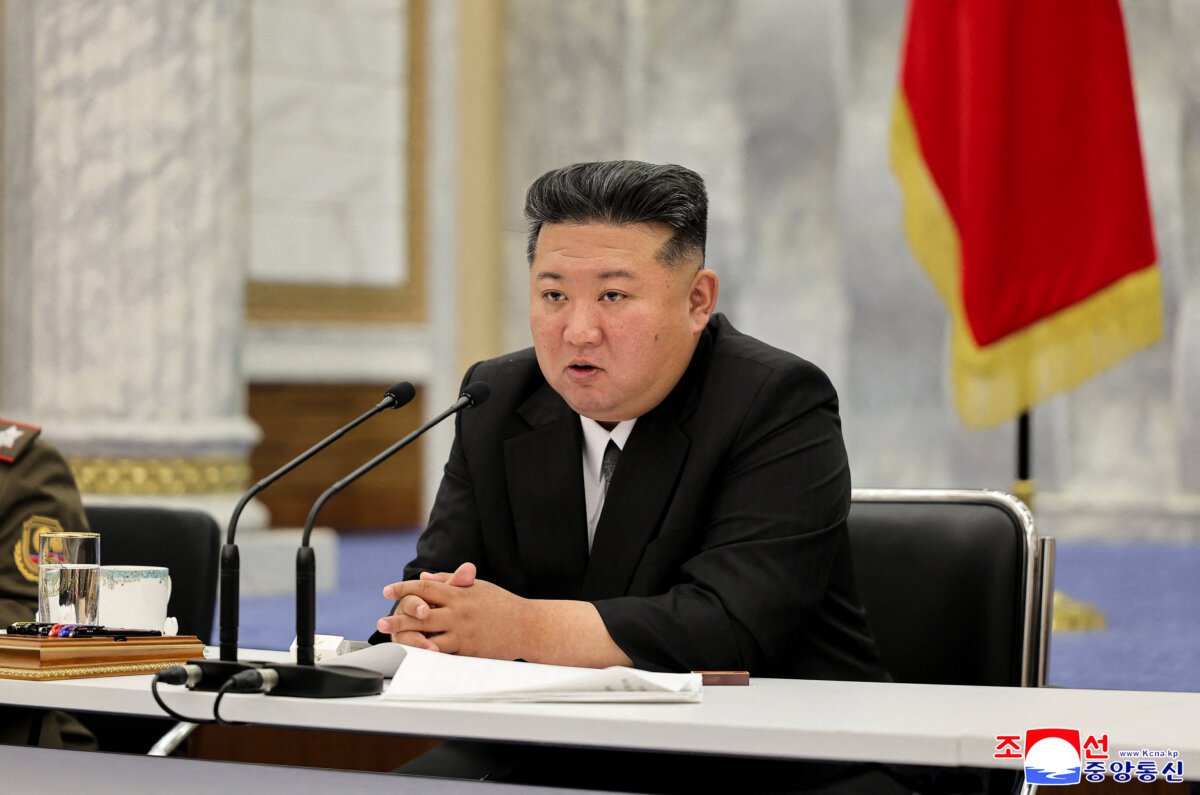

North Korea’s military relationship with Russia will “advance non-stop” North Korean leader Kim Jong-un said on Oct. 24, according to state media outlet Korean Central News Agency (KCNA).
Kim made the remarks in a speech at the groundbreaking ceremony for a memorial for North Korean soldiers who fought alongside Moscow’s forces in the Kursk region of Russia during the ongoing war in Ukraine.
“The DPRK-Russia friendship, which has increased its eternal vitality and the invincibility and power of which have been verified amid the grave tempest of history, is now rising to its historic peak,” Kim said.
“The years of militant fraternity, in which a guarantee has been provided for the long-term development of the bilateral friendship at the cost of precious blood, will advance non-stop with the ennobling soul of the great heroes, and more honorable pages of strength and victory will be added to the great chronicles of bilateral ties between the two countries, both just and powerful.”
He added that “Pyongyang will always be with Moscow.”
The event was the latest tribute by the communist state to its troops who fought alongside Russia’s armed forces.
Kim and Russian President Vladimir Putin signed a mutual defense pact in 2024, which stated that “in the event that either party is in a state of war as a result of armed aggression by individual or multiple states, the other side shall provide military and other assistance without delay by all means at its disposal in accordance with Article 51 of the U.N. Charter.”
This agreement has seen Pyongyang send soldiers, ammunition, and missiles to Russia as it continues its war against Ukraine.
The Pentagon estimates North Korea has deployed between 11,000 and 12,000 troops to fight in the war in return for economic and military technology assistance from Russia.
Seoul’s intelligence agency estimated in September that about 2,000 North Korean soldiers had been killed in the fighting.
The ceremony follows Pyongyang’s test-firing of multiple short-range ballistic missiles on Oct. 22, according to South Korea’s military.
The launches are the first since May and come a week before U.S. President Donald Trump and other world leaders are expected to attend the Asia-Pacific Economic Cooperation (APEC) summit in Gyeongju, South Korea, from Oct. 31 to Nov. 1.
The South Korean Joint Chiefs of Staff stated that the projectiles were fired from an area near Pyongyang, North Korea, early on Oct. 22 and flew about 350 kilometers (217 miles) toward the northeast. The missiles appeared to land inland, a military official said.
Japanese Prime Minister Sanae Takaichi said the launch posed no immediate threat to Japan’s security, noting that Tokyo was sharing information in real time with Washington and Seoul.
The missile test violates the U.N. Security Council resolutions that ban Pyongyang from using ballistic technology. It also marks the first launch since Lee Jae-myung took office as South Korea’s president in June, vowing to pursue dialogue with North Korea.
Trump’s Asia tour will include stops in Malaysia, Japan, and South Korea.
While in Malaysia, Trump will attend the annual meeting of the Association of Southeast Asian Nations (ASEAN) in Kuala Lumpur.
He is also expected to meet with Chinese Communist Party leader Xi Jinping during his time in South Korea.
Trump has signaled high expectations from the upcoming meeting with Xi, saying at a White House press briefing on Oct. 22 that he wants a “deal on everything.”
He has said he wants China to commit to buying soybeans, curbing exports of fentanyl precursor chemicals, and fair trading terms, including on rare earths.
Evgenia Filaminova and Reuters contributed to this report.
 Friends Read Free
Copy
Facebook
Tweet
Friends Read Free
Copy
Facebook
Tweet