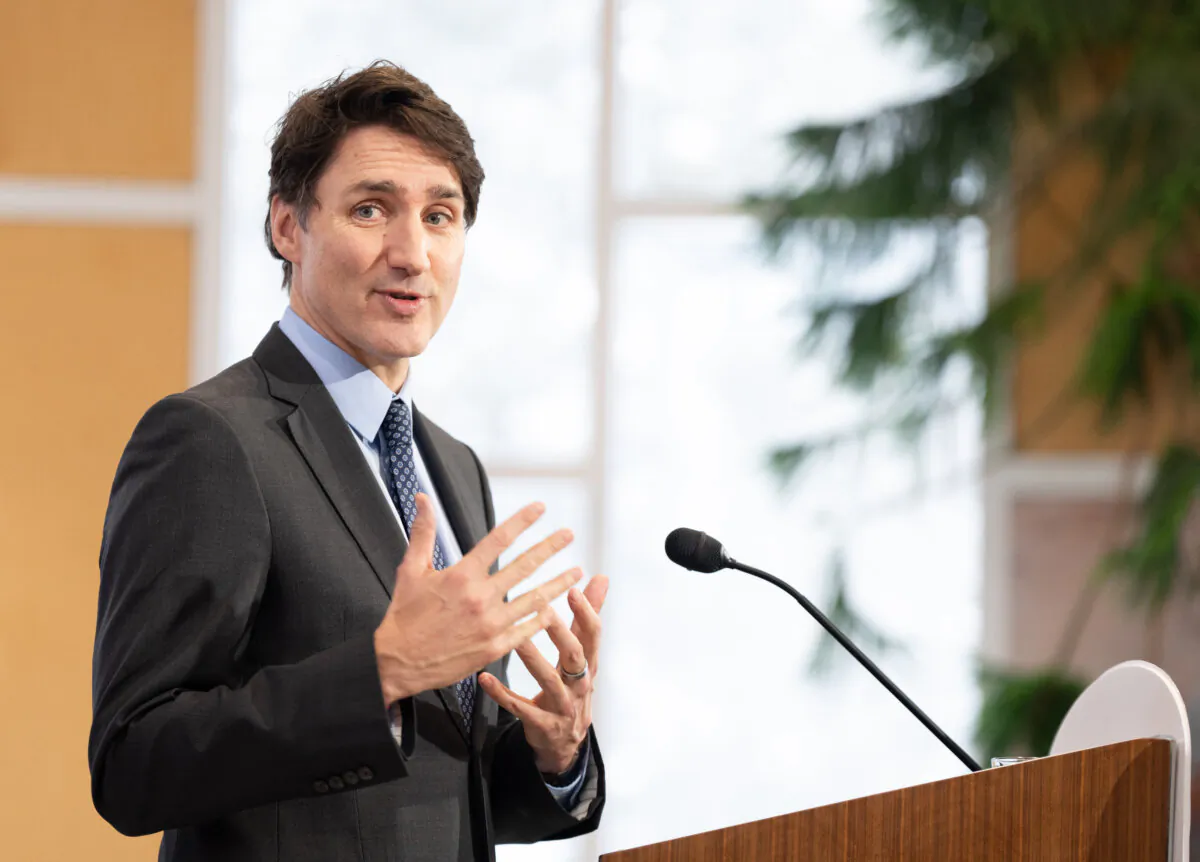

Ontario’s Ministry of the Attorney General has stopped a private prosecution of former Prime Minister Justin Trudeau for alleged obstruction of justice and breach of trust regarding accusations that he pressured his former justice minister to halt a criminal prosecution of SNC-Lavalin.
In February, watchdog group Democracy Watch had filed an application in the Ontario Court of Justice in Ottawa for approval from the court to proceed with the private prosecution of Trudeau over the SNC-Lavalin affair. A private prosecution is a criminal proceeding initiated by an individual private citizen or private organization instead of by a public prosecutor who represents the state.
On Sept. 29, Democracy Watch released a letter it received from John Corelli, Director of the Complex Prosecutions Bureau at Ontario’s Ministry of the Attorney General, who outlined the reasons for the decision to stop Democracy Watch’s application.
In the letter, Corelli says there is “no reasonable prospect the Crown could prove that Mr. Trudeau acted with the requisite criminal intent for either alleged offence.”
Democracy Watch criticized the decision in a statement, arguing that Corelli used the same “incorrect” legal standard that the RCMP used when deciding not to prosecute Trudeau for obstruction of justice. Democracy Watch said the Crown is only required to prove that an alleged offender acted “willfully” to frustrate the court of justice, and that proof of criminal intent is not required.
Democracy Watch co-founder Duff Conacher said in a Sept. 29 letter to Corelli that he should submit a “full and public explanation” of the reasons for using the legal standard as the basis for staying the proceeding.
SNC-Lavalin Scandal
SNC-Lavalin had faced charges of corruption and fraud in connection with around $48 million in payments made to Libyan government officials between 2001 and 2011. The Montreal engineering giant had hoped the charges could be resolved with a deferred prosecution agreement, which would spare the company a trial and possible criminal conviction.
In 2019, the federal ethics commissioner concluded that Trudeau violated Section 9 of the Conflict of Interest Act when he used his position of authority over then-Justice Minister Jody Wilson-Raybould to “influence” her to halt a criminal prosecution of SNC Lavalin by allowing for a deferred prosecution agreement. In April 2019, Trudeau removed Raybould from the party caucus after she accused Trudeau of pressuring her to secure a deferred prosecution agreement for SNC-Lavalin.
SNC-Lavalin, which rebranded to AtkinsRéalis in 2023, agreed to pay a $280 million penalty after pleading guilty to a fraud charge in 2019. The agreement resolved a criminal case related to the company’s past activities in Libya, with the construction division taking the guilty plea and the fine.
According to documents released by Democracy Watch in late 2023, the RCMP decided not to pursue a criminal investigation into Trudeau because it accepted the Liberal cabinet’s restricted disclosure order decreeing that the authorization to waive solicitor-client privilege would not extend to any information or communications between Wilson-Raybould and the director of public prosecutions concerning SNC-Lavalin.
After Democracy Watch filed its application in February 2024 to proceed with a private prosecution of Trudeau, Corelli requested in June 2025 that a judge oversee the next step in the application process, wherein evidence received from the RCMP would be presented and Wilson-Raybould and her former chief of staff would be questioned to see if there was enough evidence to proceed with a prosecution.
In his decision stopping the case against Trudeau, Corelli said he had concluded it is not “in the public interest to hear any evidence that may be adduced by the informant” and that new evidence was unlikely to become available since the RCMP did its own review.
Democracy Watch said the RCMP’s investigation was “incomplete” as it accepted that cabinet keep key records secret and only interviewed four out of 15 key witnesses.
Democracy Watch said the RCMP should not have investigated Trudeau because the force’s commissioner and deputy commissioner are appointed by and serve the prime minister, putting them in a “massive conflict of interest.” While Democracy Watch requested in May that Ontario’s Attorney General Doug Downey establish a committee made of people with no ties to political parties to review the evidence and make decisions concerning the prosecution, this did not happen.
Conacher said in order to ensure “integrity and impartiality” in anti-corruption cases, Parliament should make changes to increase the independence of the RCMP, or create a new, independent anti-corruption policy force, which Quebec has had since 2011.
The RCMP did not respond to The Epoch Times request for comment before publication time.
 Friends Read Free
Copy
Facebook
Tweet
Friends Read Free
Copy
Facebook
Tweet