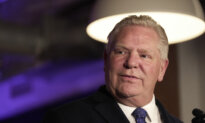

The Ontario government is joining a Supreme Court challenge by a firearms rights advocacy group against the federal government’s ban on approximately 2,500 types of what it calls “assault-style” weapons.
Alberta and Saskatchewan have also joined the legal challenge by filing notices of intervention before the Supreme Court on May 19.
The Supreme Court of Canada granted leave on March 19 to hear an appeal challenging the federal ban on firearms, which Ottawa classifies as suitable only for military use.
Ontario Premier Doug Ford’s government is joining the legal challenge as the federal government begins collecting prohibited firearms from Canadian gun owners as part of its Assault-Style Firearms Compensation Program, which is opposed by several provinces and police jurisdictions.
Firearms owners had until March 31 to fill out a declaration as part of the buyback program, and Public Safety Canada said the RCMP, local police, or mobile collection units will collect firearms from spring through early fall this year.
Gun owners across Canada declared more than 67,000 prohibited firearms to receive compensation, including 27,487 in Ontario, according to Public Safety.
The office of Ontario Attorney General Doug Downey confirmed the provincial government filed a notice of intervention before the Supreme Court on May 19, but told The Epoch Times it has “no further comment.”
A spokesperson for Ontario Solicitor General Michael Kerzner said the federal government’s buyback program doesn’t address the root causes of gun violence in Ontario.
“We share the concerns raised by the Ontario Provincial Police on the federal government’s approach to the gun buyback program,” the spokesperson said, according to the Toronto Star.
The spokesperson said local police resources should focus on “combating crime and keeping our communities safe,” rather than on collecting guns that were “previously lawful but are now prohibited.” He said guns smuggled illegally into Canada “continue to fuel local crime.”
The legal challenge centres on the May 2020 ban introduced by the Trudeau government, which prohibited more than 1,500 firearms models and variants through an Order in Council. The measure was enacted following the 2020 Nova Scotia mass shooting.
Previous Challenges
The Federal Court dismissed multiple lawsuits by various groups and individuals in 2023, including firearms owners, businesses, hunters, and recreational and sport shooters, who challenged the firearms ban.
The applicants had argued that the Order in Council outlawing the firearms was created through “incorrect, unreasonable” and “impermissible sub-delegation of authority,” that it breaches Section 7 of the Charter, and that it is inconsistent with the Canadian Bill of Rights.
Meanwhile, the Federal Court ruled that the government had not exceeded its authority granted by Parliament and the regulations do not infringe upon Canadians’ rights.
Gun rights advocacy group the Canadian Coalition of Firearms Rights (CCFR), along with several firearms dealers and gun owners, submitted an appeal to the Federal Court’s decision in late 2023, but the Federal Court of Appeal rejected the challenge in April 2025, saying the Federal Court had provided “thorough and persuasive” justifications in its decision.
The Supreme Court agreed in March to hear the CCFR’s challenge. The group has said its case centres on whether the federal government has the authority to bypass Parliament by using an Order in Council issued by cabinet to make decisions.
The CCFR argues that such orders are “executive instruments meant for implementation and administration, not for enacting broad, permanent changes that affect thousands of law-abiding citizens and ban billions in private property.”
Public Safety Minister Gary Anandasangaree told reporters on March 19 that the government is “very confident” it will prevail in the case.
Tracey Wilson, a spokesperson for CCFR, said the Ontario government’s backing of the Supreme Court challenge “sends a pretty clear message that despite Ford and Carney’s relationship, this is one thing they don’t agree on.”
“The more provinces that stack up behind us, the more it proves this is not the right thing to do,” Wilson said in a May 25 post on X.
Several provinces and territories have indicated they will not participate in the buyback program, including Alberta, Saskatchewan, Manitoba, Ontario, New Brunswick, Yukon, the Northwest Territories, and Nunavut. Quebec is the only province that has expressed support for the program so far.
The RCMP and Quebec’s provincial police force have said they will collect guns eligible for compensation, but numerous police services have said they will not help with the program.
 Friends Read Free
Copy
Facebook
Tweet
Friends Read Free
Copy
Facebook
Tweet