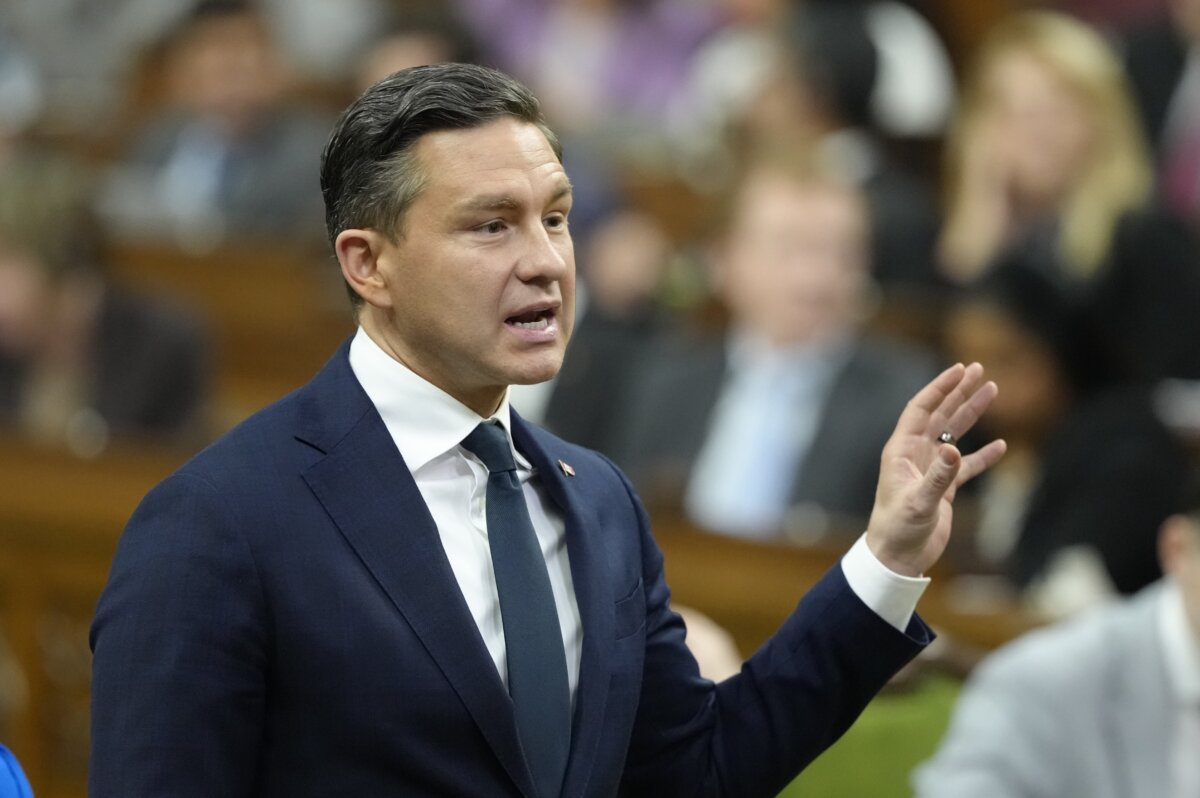

Conservative Leader Pierre Poilievre is calling on the federal government to remove all taxes on gasoline and diesel for the remainder of the year amid rising fuel prices due to the war in Iran.
Poilievre said during a press conference in Ottawa on April 2 that temporarily removing the GST and excise tax would save Canadians 25 cents per litre, amounting to about $1,200 a year for the average family of four.
The Conservatives noted in a press release that other countries have responded to rising oil prices by cutting taxes on energy. The Australian government announced they would cut their excise tax in half for three months, while Ireland recently announced it would cut its excise tax on diesel by 20 cents and on gasoline by 15 cents until the end of May.
The Conservative leader said that while the conflict in Iran had led to oil prices increasing, higher gas costs in Canada can be partially attributed to higher taxes. Poilievre noted that gas prices are currently an average of $1.78 in Canada versus $1.50 in the United States. “You cannot explain that through global factors alone,” he said.
Poilievre said excise taxes add 10 cents to each litre of gasoline in Canada, while the fuel standard tax adds an additional seven cents. He said that by lowering the cost at the gas pump, the government could lower the cost of “everything else,” given that every item Canadians buy is transported by transport trucks or trains using fuel.
Prime Minister Mark Carney was asked by reporters about gas prices on April 1, and said the government is “very aware of the sharp increase in gas prices.” Carney said Canada is calling for de-escalation of the conflict in Iran, but there is a “limit, obviously, for what we can do diplomatically to influence that.”
Carney said the Liberal government has worked to improve affordability for Canadians through cutting taxes for 22 million people and implementing new social programs. “We will look at this as the conflict evolves, and most importantly, at the impact on Canadians. Not saying that’s necessarily the final word,” he said.
The prime minister also added that Canada needs to broaden its energy infrastructure, including both renewable energy in Nova Scotia and an east-west pipeline from Alberta to the B.C. coast.
 Friends Read Free
Copy
Facebook
Tweet
Friends Read Free
Copy
Facebook
Tweet