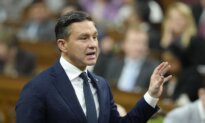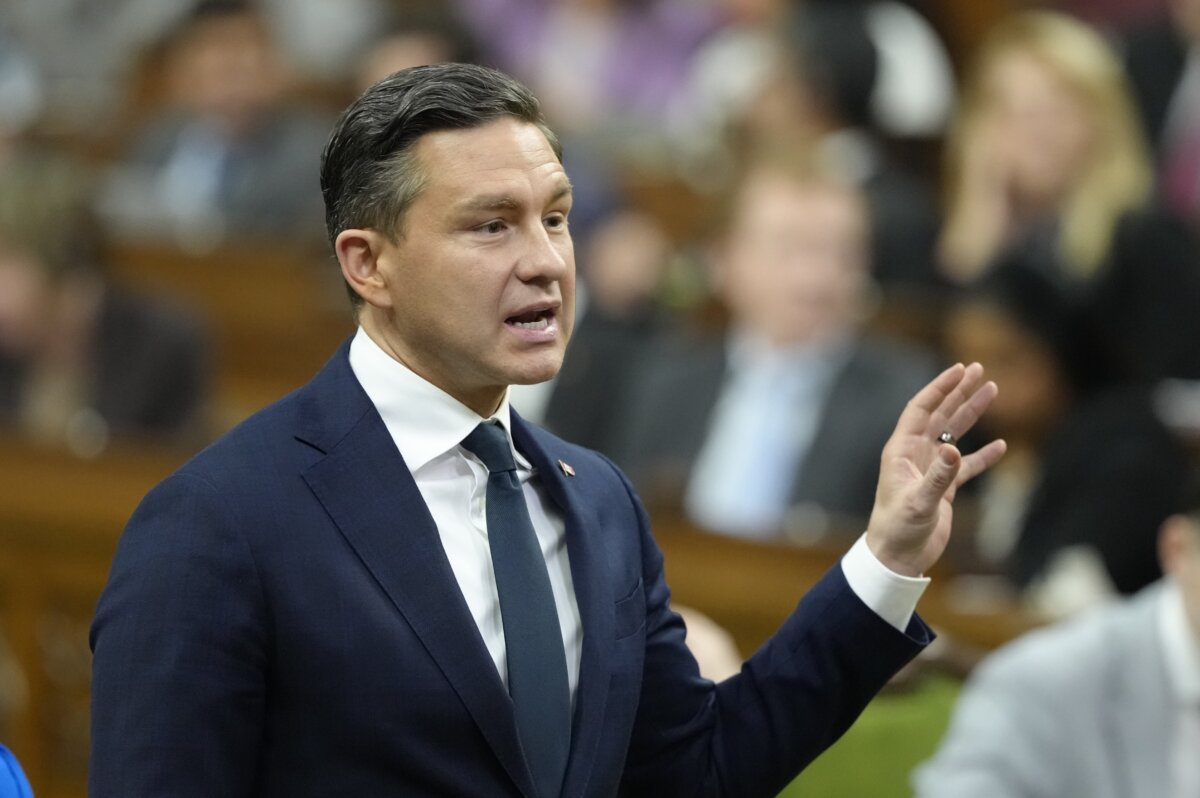

Conservative Leader Pierre Poilievre called on Prime Minister Mark Carney to introduce an emergency response to the increase in oil prices sparked by the U.S.-Iran war and asked for an urgent debate on the matter.
“We must unblock our oil and gas to fuel our friends abroad and power our paycheques at home,” Poilievre wrote in a March 6 letter demanding the Liberal government immediately introduce an “Emergency Energy Supply Plan.”
Poilievre said that he was also writing to House Speaker Francis Scarpaleggia to request an emergency debate on the topic, and asked Carney to “echo these calls and show up for the debate.”
The United States and Israel launched air and missile strikes on Iran on Feb. 28 after negotiations over Iran’s nuclear program broke down, with Iran responding by launching missile and drone strikes against Israel and U.S. military positions and other sites in the region.
Iran has also hit the oil infrastructure of several Gulf countries and effectively shut down the Strait of Hormuz, which carries roughly one-fifth of global oil shipments. The conflict has caused Brent crude oil to surpass US$90 a barrel as of March 6, with Qatar’s energy minister warning that could reach $150 a barrel. Washington has said it’s working on strategies to mitigate the rising costs.
Poilievre said Europe had spent the last few years trying to reduce reliance on Russian energy after it launched a war against Ukraine, and those European countries had turned to the Middle East for oil.
“Now that region has itself become increasingly unstable, leaving our allies urgently searching for secure sources of energy from friendly democratic countries. Canada should be the answer,” Poilievre wrote.
Poilievre wrote that the Canadian government’s policies have discouraged investment in energy and slowed production, citing a recent announcement by Canadian Natural Resources Limited that it will halt expansion plans in Alberta until Ottawa clarifies its rules around industrial carbon pricing.
Poilievre said Carney’s Emergency Energy Supply Plan should include measures repealing the Impact Assessment Act, oil tanker moratorium, and industrial carbon tax; pre-approving liquefied natural gas plant sites on the East Coast, and guaranteeing approval timelines of under six months for major energy infrastructure projects.
Carney has previously described Canada as an “energy superpower” in conventional and renewable energies. Carney signed an agreement with Alberta Premier Danielle Smith in November that could pave the way for a new West Coast oil pipeline if a private proponent comes forward.
Ottawa and Alberta also reached a tentative agreement on March 6 that would see the province take control of regulatory approvals for its major projects to pass them quicker.
Carney has not spoken of building new pipelines to connect Alberta to the East Coast. Bloomberg News recently reported that Australian natural gas is being shipped over 25,000 kilometres to the East Coast.
Premier Smith has also called for expanding Canada’s oil production and export capacity amid instability in the Middle East, saying “Alberta can be the answer to global energy security.”
Noé Chartier contributed to this report.
 Friends Read Free
Copy
Facebook
Tweet
Friends Read Free
Copy
Facebook
Tweet