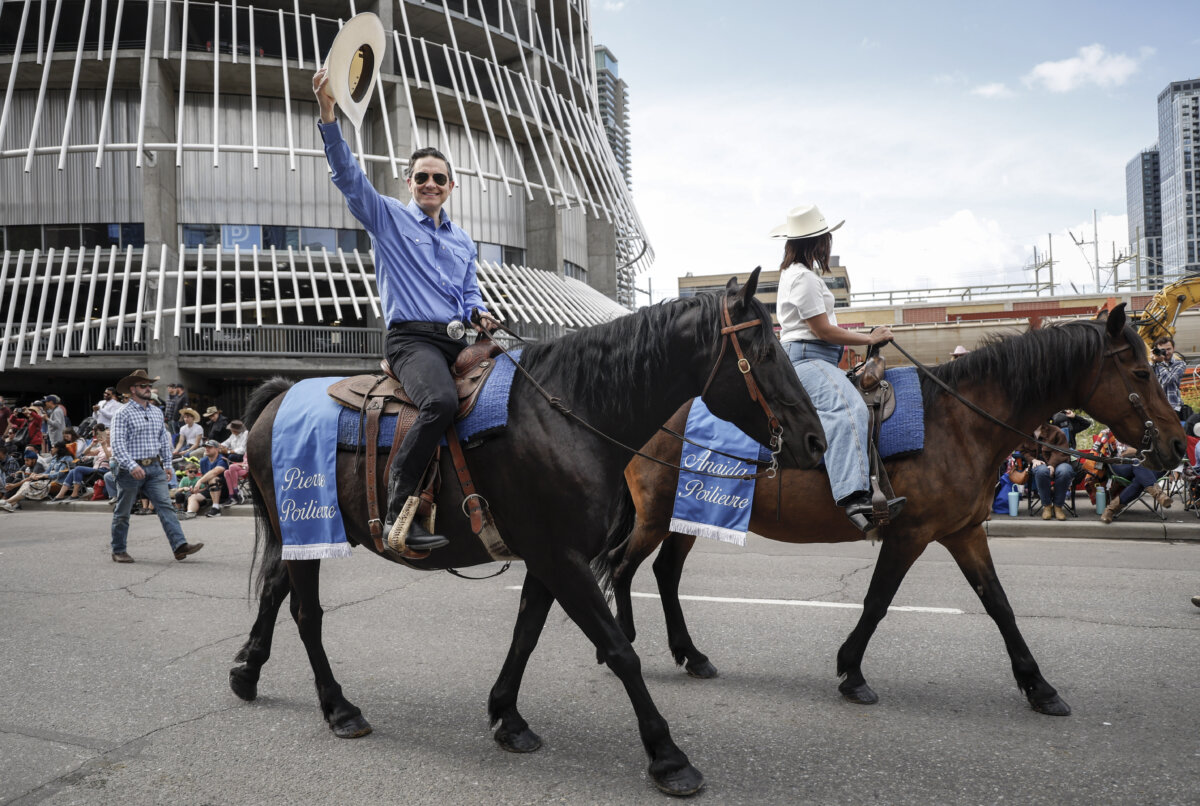

It will be déjà vu for Tory Leader Pierre Poilievre when he contends for a House of Commons seat next month, as a protest movement again loads up the ballot in his sought-after riding with dozens of candidates.
The Longest Ballot Committee announced its intention to target the byelection in the Alberta riding of Battle River-Crowfoot weeks ago. The group is well on its way to meeting its goal. Fifty-eight candidates tied to the group had officially been registered with Elections Canada as of July 16.
It’s still short, however, of the group’s objective to run 200 candidates in the byelection. The movement opposes the first-past-the-post system and is calling for electoral reform.
Candidates have until July 28 to file their nominations with Elections Canada.
Voters in the Ottawa riding of Carleton during the April 28 general election had 91 names to choose from on their ballots as the group targeted Poilievre’s long-held seat.
Poilievre lost to Liberal Bruce Fanjoy by 4,513 votes. Carleton was one of the ridings that has its boundaries redrawn after the results of the 2021 Canadian census.
Poilievre did not suggest this was a factor in his loss, and instead pointed to his plan to trim down the public service, a hard proposition in a government town.
“It was an Ottawa riding with a lot of federal public servants who disagreed with that approach,” he recently told CBC News, adding that he faced stiff opposition from public sector unions. He defended being “honest” about his intention during the campaign, as unions are currently pushing back against Prime Minister Mark Carney’s plan to make deep cuts to government departments.
Poilievre is now looking to get back to the Commons with the Aug. 18 byelection in Alberta. The vote was called after incumbent Tory MP Damien Kurek officially resigned his seat on June 17 so that Poilievre could run.
The Liberal Party and the NDP have yet to officially register their candidates.
Poilievre’s name will not be the only one associated with the Carleton riding vote that will appear on the ballot in the upcoming byelection. It seems some of the protesters from the previous election are registering in Battle River-Crowfoot as well.
One name that is a constant is Tomas Szuchewycz, who served as the official agent for Longest Ballot participants in Carleton and has the same role in this byelection. It’s the agent’s job to manage the campaign’s finances and report back to Elections Canada.
Several of the independent candidates tied to Szuchewycz have listed websites on the Elections Canada roll. Most link back to YouTube videos featuring folk and indie rock music produced by the band The Famous Sandhogs, with lyrics written by the protest candidates.
“My name is Preston Hoff and I grew up in the riding in Battle River Crowfoot, in Stettler,” sings the band in one video using footage of 1990s TV series Baywatch with actor David Hasselhoff. “And if you’re curious about my politics … I’m as progressive as [expletive.]”
“An MP’s sweet pension could have been Damien’s due,” says another song by candidate Diane Prentice, in reference to Kurek, who would have been eligible to receive his pension in October after six years of service.
The Epoch Times contacted the Longest Ballot Committee for comment but didn’t hear back by publication time.
Poilievre recently criticized the protest movement during a town hall in Stettler, a town of the Battle River-Crowfoot riding. “We need to get rid of this long ballot,” he said, according to Yukon News, adding there’s “no justification for it.” Poilievre reportedly suggested increasing the number of signatures required to be able to run as a candidate.
Tory MP Ned Kuruc, from Hamilton, Ont., recently sponsored a House of Commons petition calling on Parliament to modify the electoral law to “prevent coordinated mass candidacies designed to disrupt the voting process.” The petition closed on July 12 with 31,840 signatures.
The petition says long ballots have created accessibility issues for voters with disabilities. Ballots in targeted ridings have run a metre long.
Concerns have also been expressed by Chief Electoral Officer Stéphane Perrault, who said larger ballots will result in smaller font size. Perrault has previously suggested to MPs that to deal with the issue, the law should be changed to prevent a single individual from being able to sign candidacy papers for multiple candidates.
Nomination papers for Largest Ballot participants have “largely identical signatures,” Perrault told a House committee in November 2024.
 Friends Read Free
Copy
Facebook
Tweet
Friends Read Free
Copy
Facebook
Tweet