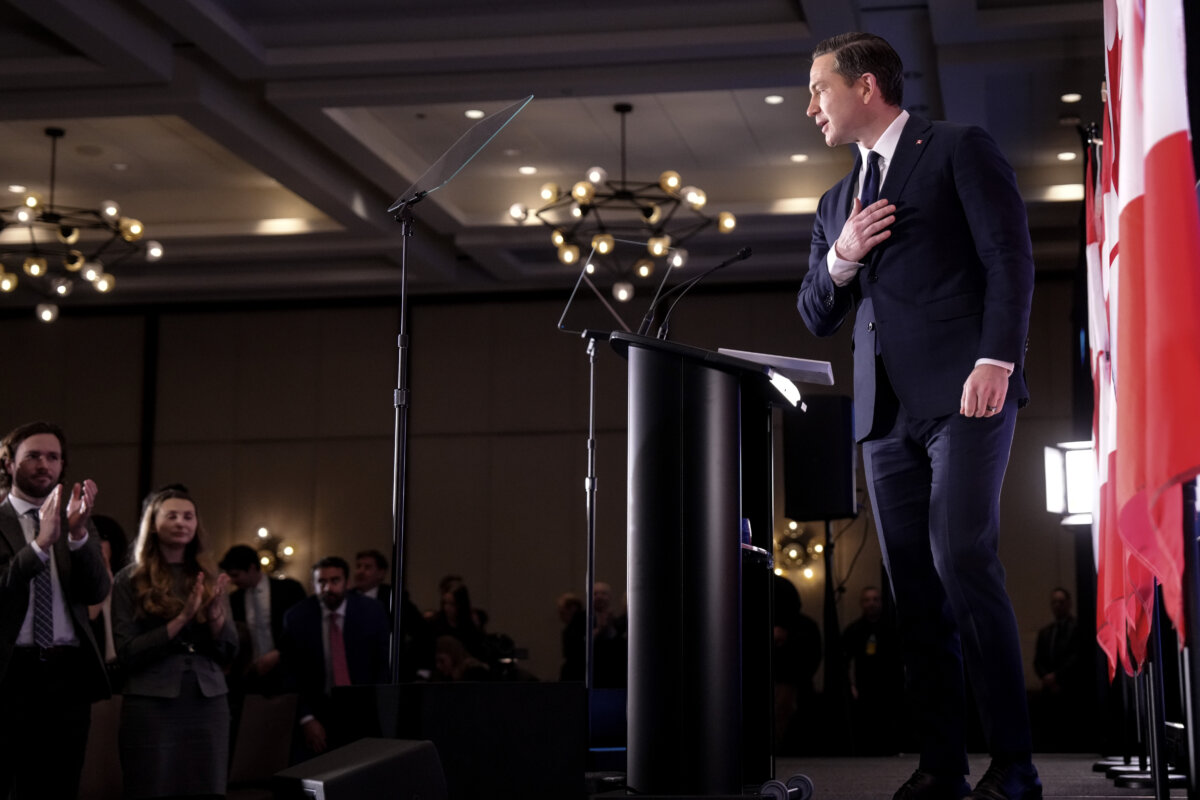

Conservative Leader Pierre Poilievre laid out his vision for negotiating a better trade relationship with the United States in comments this week at the Economic Club of Canada, while also criticizing Ottawa’s pivot towards Beijing.
Poilievre said Canada’s wellbeing is deeply connected to its relationship with the United States, arguing that Ottawa should bolster domestic economic strength to improve its leverage ahead of the upcoming review of the Canada-United States-Mexico Agreement (CUSMA). He also cautioned that China is “not a substitute” for the United States
“Canada’s prosperity and security are inseparable from a stable relationship with the United States, and that is why we should not declare a permanent ‘rupture’ with our biggest customer and closest neighbour in favour of a strategic partnership for a ‘new world order’ with Beijing,” Poilievre told attendees during his Feb. 26 speech in Toronto.
Proposals
Poilievre said that Canada should “become stronger at home” by getting rid of impediments to homebuilding, boosting defence capacity, speeding up resource development permitting and regulations, and removing red tape.
“All of these steps will make us stronger at home, so that we have unbreakable leverage abroad, including in our negotiations as we face the review of CUSMA,” Poilievre said.
He said because of slow permit timelines, high taxes, and regulatory uncertainty “the worst tariffs imposed on Canada today are those imposed by the government here.”
Poilievre reiterated his past calls to scrap the industrial carbon tax and said Ottawa needs to speed up approval of major projects such as Alberta’s soon-to-be-proposed crude oil pipeline from Alberta to the B.C. coast. He also said Canada should expand and expedite oil, gas, and critical mineral development and overhaul its defence procurement process to strengthen the military.
Poilievre said Canada currently has the second-slowest permit approval times among OECD countries but he wants that to change so that Canada becomes “the fastest place in the developed world to get a permit.”
Poilievre called for a new strategic energy and mineral reserve to be made part of the country’s critical minerals strategy. The reserve would be used to stockpile resources on Canadian soil that would boost Canada’s geopolitical leverage and ensure that key allies such as the U.S. have a strong incentive for keeping tariff-free trade with Canada.
The Tory leader echoed his focus on building up Canada’s domestic economy by changing policies during a question and answer session following his delivered remarks.
“We cannot control what the president says or does,” he said. “We can control what we do on this side of the border and our own national interest.”
Canada-US Relations
Poilievre was critical of U.S. trade measures, but emphasized the generally positive view most Americans have of Canadians. He said the bilateral relationship with the U.S. remains central to Canada’s long-term wellbeing.
Poilievre also said he finds it acceptable to “talk and trade where prudent” with China but this should not be confused with trying to substitute the country as a large-scale trading partner instead of the United States.
The Tory leader also reiterated his calls to scrap Canada’s temporary foreign worker program with exceptions for agricultural workers, saying the wider program drives down wages for young Canadians.
Poilievre said one of the best ways to pursue a positive path forward is for an all-parties working group to be established ahead of the CUSMA review. He emphasized that a can-do attitude from Canada is key, rather than reacting emotionally to trade tensions with the United States.
“The most effective response to uncertainty is not outrage—it is results,” he said.
Canada-China Deal
Poilievre’s comments come in the wake of a series of new deals Ottawa and Beijing signed in January. These include the federal government agreeing to cut tariffs on Chinese electric vehicles (EVs) from 100 percent to 6.1 percent for up to 49,000 vehicles in the first year in return for China cutting the retaliatory tariffs it had placed on Canadian agricultural products and seafood.
The two countries also signed a number of memoranda of understanding on closer ties in law enforcement, energy, trade, tourism, and agriculture.
Carney said that the deepened Canada-China framework “sets us up well for a new world order.”
This was followed by Carney’s remarks at the World Economic Forum annual meeting in Davos, Switzerland, on Jan. 20 in which he said there has been a “rupture” to the “rules-based international order” which he said requires middle powers such as Canada to collaborate together and seek out new trading partners.
Carney went on to criticize the current geopolitical situation in which he said unspecified “great powers” are trying to subordinate middle and lesser powers via economic integration, an apparent reference to tariffs from the Trump administration.
Carney announced last October that his government’s goal was to double Canada’s non-U.S. exports in the next decade.
 Friends Read Free
Copy
Facebook
Tweet
Friends Read Free
Copy
Facebook
Tweet