
Alberta Premier Danielle Smith says she’s open to revisiting the province’s industrial carbon pricing system as part of ongoing talks with Ottawa about federal regulations and Alberta’s resource development.
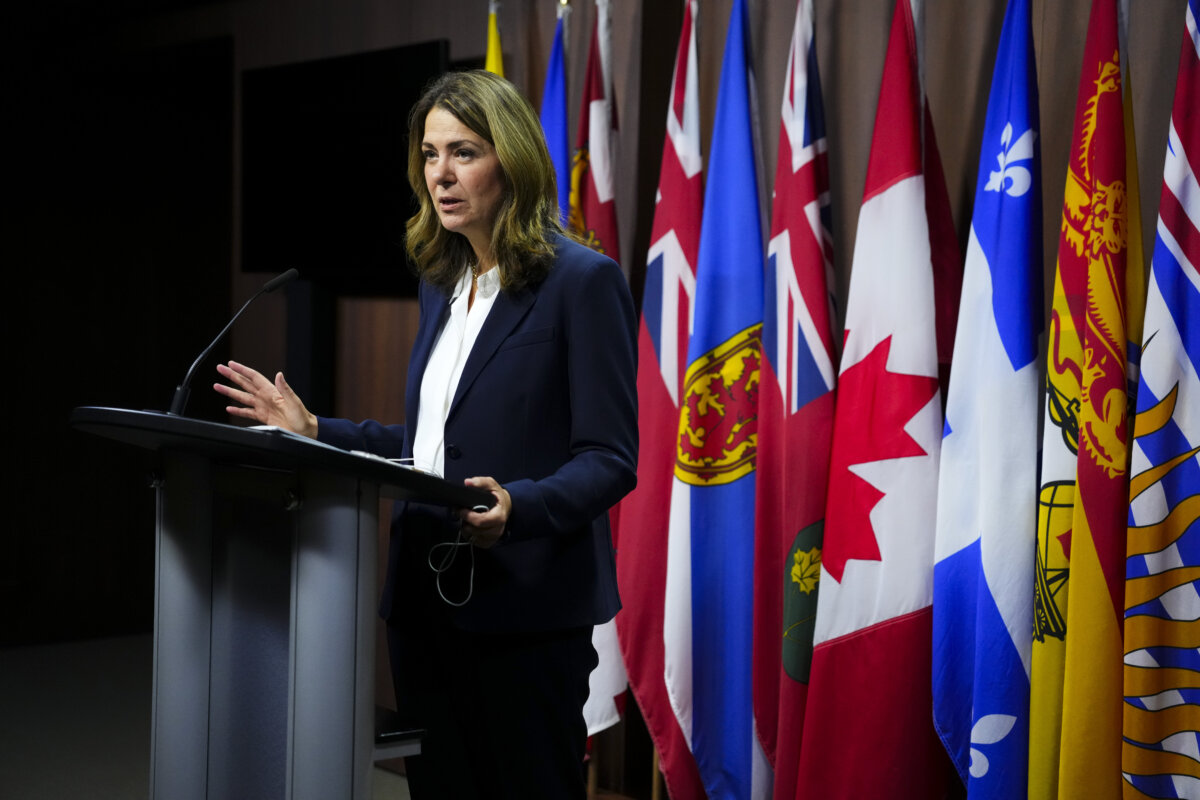
Smith made the comments during an Oct. 7 press conference in Ottawa, a day after meeting with Prime Minister Mark Carney ahead of his visit to Washington. Smith was asked whether she had gotten any assurances that Ottawa would not trigger the federal backstop if Alberta’s industrial carbon price program doesn’t comply with federal regulations.
“That’s part of why we are having a conversation about how we adjust some of the programs,” Smith said.
“We want to maintain the carbon pricing at the provincial level,” she added, noting that her province has had carbon pricing since 2007 and that “it has worked for us.”
She said the province’s decision to freeze industrial carbon pricing at the current rate of $95 per tonne strikes a balance between maintaining industry competitiveness and encouraging investment in clean technology, but that “those are things that are open for discussion.”
She said she expects to reach an agreement with Prime Minister Mark Carney by mid-November on how Ottawa will address what she calls the “nine bad laws,” the federal policies she says hinder Alberta’s energy production. One of them concerns the industrial carbon tax, which Smith wants returned to provincial oversight.
The premier announced the indefinite freeze of the industrial carbon tax in May, saying the cost for businesses had become “too high to bear.” The carbon pricing on industry was set to rise to $110 next year and up to $170 in 2030.
“If [industrial carbon pricing] gets too low, then you aren’t going to have an investment, but if it gets too high, there’s going to be no one to pay it, because they’re also going to go out of business,” she said on Oct. 7.
“So you have to find where the right spot is, and we happen to think that $95 is the right spot, having talked to our industry players on that.”
Alberta has its own industrial carbon tax, called the Technology Innovation and Emissions Reduction Regulation. Ottawa allows provinces and territories to manage their own systems, while establishing a national benchmark.
A federal backstop rate is supposed to be implemented if provinces fall behind, but it remains to be seen if Carney plans to enforce the higher price, especially since he hasn’t taken action against Saskatchewan, which dropped its industrial carbon price completely earlier this year.
During the Liberal leadership race, Carney pledged to remove the consumer carbon tax while making industrial carbon pricing more stringent to ensure “big polluters pay.”
Smith raised concerns about Carney’s plan at the time, saying that increasing the industrial carbon tax to offset the removal of the consumer carbon tax would have negative economic impacts on the province.
Immediately after being sworn in as prime minister in mid-March, Carney set the rate of the consumer carbon tax, or fuel charge, to zero. The federal government also removed the requirement for provinces and territories to impose such regimes.
The Conservatives want the feds to also remove the industrial carbon tax, saying it hinders the industry and makes Canada uncompetitive for business.
Noé Chartier and The Canadian Press contributed to this report.
 Friends Read Free
Copy
Facebook
Tweet
Friends Read Free
Copy
Facebook
Tweet