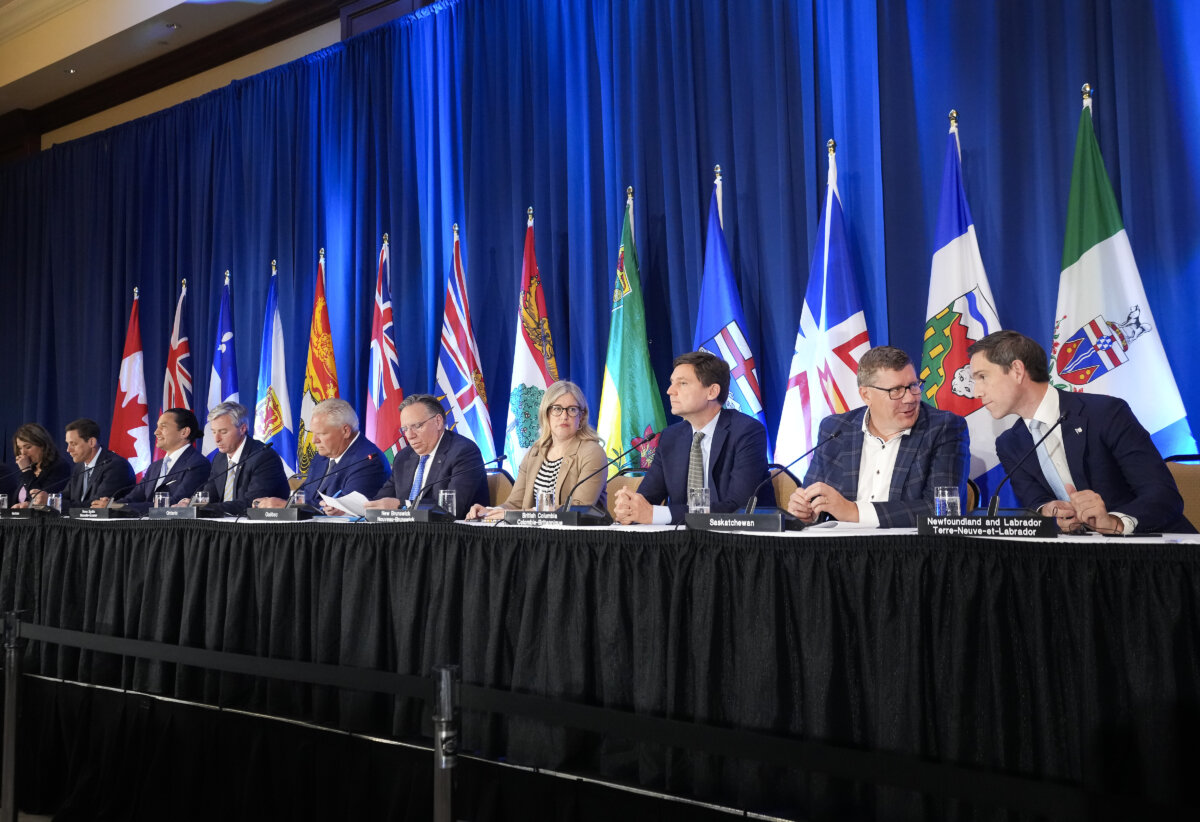

Canada’s premiers have outlined their top priorities for discussions with Prime Minister Mark Carney during their meeting next week, including infrastructure funding and the state of Canada’s trade relations with the United States.
The prime minister is set to host a virtual first ministers meeting with Canada’s provincial and territorial leaders on Nov. 17, and the premiers have laid out their priorities for the meeting in a letter to Carney.
“Canada’s relationship with the United States has changed significantly since the last time First Ministers met,” Prince Edward Island Premier Rob Lantz wrote on behalf of the premiers in the Nov. 11 letter. Lantz is the current chair of the premiers’ association, known as Council of the Federation.
The letter said that collaboration with the first ministers is “imperative” to sharing information, coordinating internal trade, supporting impacted workers and businesses, and “responding to the evolving dynamic with our largest international trading partner.”
The upcoming meeting will be the latest in a series of meetings between the premiers and Carney since he became prime minister earlier this year.
“Premiers appreciate your commitment to convene regular meetings of First Ministers,” Lantz wrote to Carney. “In the best interest of our country, it is critically important that we continue to have these regular meetings.”
The premiers said they are looking forward to discussions surrounding common interests at the upcoming meeting, such as “the need for adequate, flexible federal infrastructure investment,” as well as the provinces’ and territories’ positions on their respective major projects.
Carney is set to announce the second set of major projects deemed to be in the national interest, which will be recommended for approval under the Major Projects Office (MPO), on Nov. 13. The prime minister announced the first five major projects to be submitted to the MPO for evaluation on Sept. 11, which included projects in British Columbia, Saskatchewan, Ontario, and Quebec.
The meeting between Carney and the premiers comes weeks after U.S. President Donald Trump halted trade negotiations with Canada over an anti-tariff advertising campaign sponsored by the Ontario government. The campaign used portions of a 1987 address from late U.S. President Ronald Reagan praising free trade, including with Canada.
Trump said the ad misrepresented Reagan’s address and was meant to interfere with a U.S. Supreme Court hearing into his administration’s use of tariffs. Trump also said he would impose an additional 10 percent tariff on Canada after Ontario didn’t pull the ad immediately, but this has yet to materialize.
Prior to the ad controversy, momentum had appeared to be building in trade talks between Canada and the United States following Carney’s White House visit on Oct. 7.
Trade talks with the United States are expected to be a topic of discussion at the first ministers meeting next week as the premiers press for an update on the state of relations and negotiations between the two countries.
China, India Relations
Trade relations with China and India are also a priority for discussions with the prime minister at next week’s meeting, the premiers say.
Carney met with Chinese leader Xi Jinping in South Korea on Oct. 31, at the Asia-Pacific Economic Cooperation (APEC) summit. It was the first meeting between Canadian and Chinese leaders since former-Prime Minister Justin Trudeau visited Beijing in 2017.
Following Carney’s meeting with Xi, Carney said relations with Beijing were at “a turning point,” which would create “a path to address current issues.” In his comments in recent months, Carney’s tone appears to have shifted since the election campaign earlier this year, when he called China the “biggest security threat” facing Canada.
Relations with Beijing deteriorated in 2018, when the RCMP arrested chief financial officer Meng Wanzhou of the Chinese multinational technology company Huawei in Vancouver on a U.S. extradition warrant related to fraud charges. In apparent retaliation, China detained Canadians Michael Kovrig and Michael Spavor for more than 1,000 days.
Meanwhile, Ottawa say “momentum” is building in Canada-India relations following meetings between Carney and Indian Prime Minister Narendra Modi, and between Foreign Affairs Minister Anita Anand and her Indian counterpart.
Relations between Canada and India soured in 2023 when Trudeau accused Indian government agents of being involved in the assassination of pro-Khalistan activist Hardeep Singh Nijjar in British Columbia. India has denied any involvement.
A reset of relations between the two nations began in earnest when Modi visited Canada in June for the G7 Leaders’ Summit. The countries have since reappointed high commissioners, held high-level talks, and agreed to a “joint roadmap” for cooperation.
Matthew Horwood, Noé Chartier, and The Canadian Press contributed to this report.
 Friends Read Free
Copy
Facebook
Tweet
Friends Read Free
Copy
Facebook
Tweet