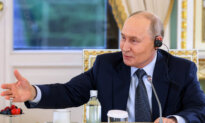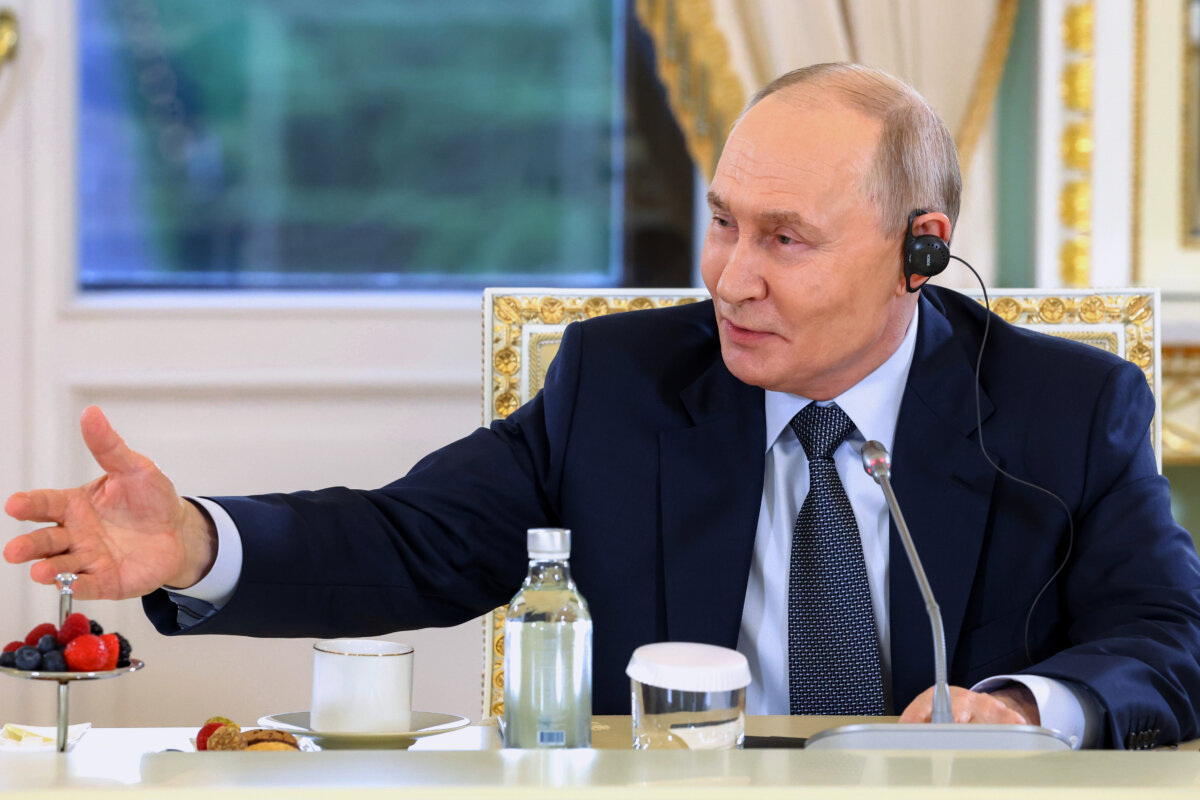
Russian President Vladimir Putin hosted Southeast Asian leaders in Kazan, Russia, on Wednesday as Moscow sought to deepen ties with ASEAN and rally support for a “multipolar world order” challenging US dominance.
The two-day meeting, being held on June 17 and 18, is set to consider ways to expand Russia’s “strategic partnership” with the Association of Southeast Asian Nations (ASEAN) nations that include Brunei, Cambodia, Indonesia, Laos, Malaysia, Myanmar, the Philippines, Singapore, Thailand, East Timor, and Vietnam.
Kremlin foreign affairs adviser Yuri Ushakov said the regional bloc has maintained relations with Moscow as a “dialogue partner” and engaged Russian officials in annual top-level meetings.
Ushakov said that the participants are set to underline their adherence to “forming a just and democratic multipolar world order based on the principles of international law and the United Nations Charter.”
A “multipolar world order” is a global system promoted by Russia and the Chinese Communist Party (CCP) in which multiple states hold significant power, enabling them to challenge alleged U.S. hegemony.
Ushakov said there was “fruitful, equal and constructive dialogue” between Russia and ASEAN.
The summit in Kazan, on the Volga River, marks the 35th anniversary of Russia-ASEAN relations.
In a message to participants in a business forum held on the sidelines of the summit on June 17, Putin said he was confident it would “create new opportunities for expanding mutually beneficial trade, investment, and industrial cooperation, while also strengthening direct dialogue between our business communities.”
Russia and ASEAN nations “jointly stand for forming a just world order, defend the principles of sovereign equality of states, (of) non-interference into internal affairs,” Putin said at a formal reception for heads of delegations Wednesday evening.
“All our states follow their own models of development and don’t impose their views on anyone. And this is, indeed, our strength,” he said.
“Russia is ready for continuing active joint work with ASEAN member states with the goal of strengthening strategic partnership, in the interests of ensuring security, well-being, and prosperity of our countries and peoples, as well as the Eurasian region as a whole.”
Another bilateral meeting on the sidelines of the summit was with Turkish Foreign Minister Hakan Fidan, who met with his Russian counterpart, Sergey Lavrov, in Moscow on Tuesday.
Putin said that Russia’s ties with Turkey were “developing steadily,” with contacts between the countries being “truly friendly and being filled with new meaning.”
Fidan said the two had multiple issues to discuss.
Moscow claims that a multipolar world is highly possible and is actively advancing the idea as a central foreign policy objective.
Kirill Babayev, director of the Institute of China and Contemporary Asia (ICCA) at the Russian Academy of Sciences, told TASS on June 18, on the sidelines of the forum, that the “global majority” is advocating for a multipolar world.
The term “global majority” was first coined by Rosemary Campbell-Stevens, a British social justice activist, who uses the pronoun “we/us” to refer collectively to people indigenous to the Global South.
Campbell-Stevens says the language helps those she trains “move out of the Black paradox that we can find ourselves trapped in while living under the white gaze.”
However, the United States remains firmly positioned as the preeminent global superpower.
According to a January report by senior fellow for U.S. Foreign Policy Robert D. Blackwill at the Council on Foreign Relations (CFR), an “ever more formidable, authoritarian China remains determined to replace the United States as the leading nation in Asia and eventually the world.”
“Given the United States’ longtime material, institutional, and ideational strengths, American grand strategy involves projecting its great power for the survival of world order,” he said.
He added that strategists “chronically underestimate the American capacity to decisively mold world order.”
He noted that the United States commands roughly the same share (26 percent) of global gross domestic product (GDP) as it held in the early 1990s.
It also fields the world’s most powerful military, devoting $849 billion to defense in 2025.
It also “possesses global diplomatic reach, if deftly exercises and its treaty alliances and close partnerships in Asia, Europe, and the Middle East remain intact,” he said.
“And its power outmatches all the emerging nations combined, which in any case harbor sharply differing views on many global issues,” Blackwill said.
The Associated Press contributed to this report.
 Friends Read Free
Copy
Facebook
Tweet
Friends Read Free
Copy
Facebook
Tweet