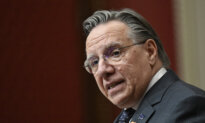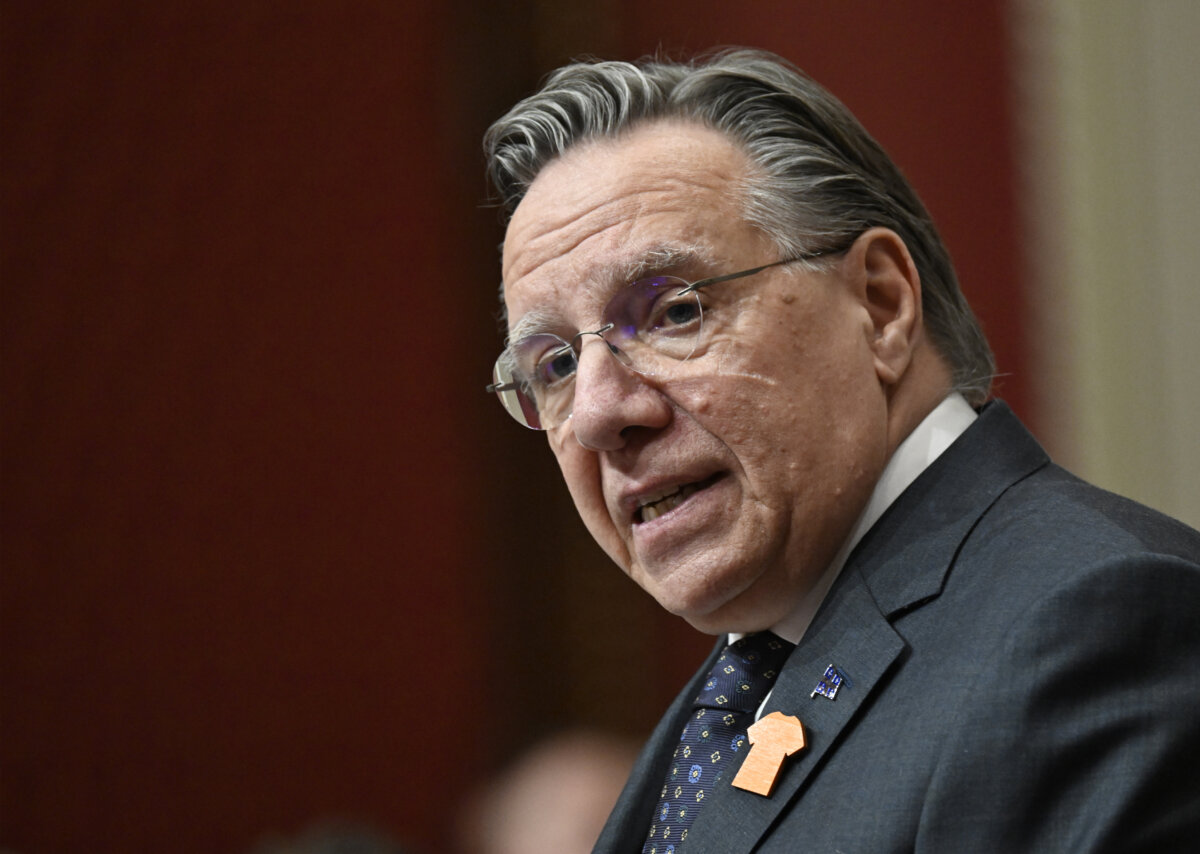

Quebec Premier François Legault has announced he will step down as both premier and leader of the governing Coalition Avenir Québec (CAQ).
Legault made the surprise announcement in Quebec City on Jan. 14, following months of declining poll numbers and ahead of the provincial election scheduled for October.
He said he will formally resign after the party selects a new leader, adding that the decision was made in the best interests of both the CAQ and the province. Legault acknowledged that many Quebecers are calling for a change, including a change in leadership.
“I really want the next election to be about the great challenges facing Quebec and not only about a simple desire for change,” Legault said in a speech.
The premier said some of those challenges include restructuring the economy to provide good jobs for future generations and stopping the decline of the French language in the province, particularly in the Montreal area.
Legault’s party benefited from Quebec voters’ appetite for change in the 2018 election, winning a majority despite being a relatively new political force. The CAQ’s victory ended the decades-long alternation in power between the Liberal Party and the Parti Québécois that had defined provincial politics since the 1970s.
Quebecers gave the CAQ an even stronger mandate in the 2022 election, with the party winning 90 out of 125 seats.
That election came on the heels of Legault imposing some of the strictest COVID-19 restrictions in Canada, which included vaccine mandates and passports, curfews, and a threat to impose a tax on the unvaccinated, which didn’t materialize.
Legault used a portion of his resignation speech to highlight the challenges of going through that period during his first mandate.
“I tried seven days a week to save a maximum number of lives in Quebec,” he said. “I tried to make decisions, even if we had incomplete information.”
Highlighting another aspect of his record, Legault said he worked to boost economic growth in the province to reduce the wealth gap with the rest of Canada, saying the results are one of his proudest achievements.
When Legault came to power in 2018, Quebec was the seventh province in GDP per capita with $47,340. In 2024, Quebec had displaced Manitoba in sixth position with $49,520. By comparison, the top province, Alberta, has a GDP per capita of $71,040, while Ontario is in fourth place at $54,810.
Legault said covering the wealth gap is not the goal “in and of itself, but it’s a necessary means to be able to pay for social programs and to be more independent in Canada.”
Voter satisfaction with the Legault government began dropping some months after the 2022 election, and by late 2023, the Parti Québécois (PQ) had overtaken the CAQ in the polls.
The situation for Legault did not improve following scandals for the party. This included cost overruns of at least $500 million in the province’s auto insurance board’s new online platform. Legault launched a public inquiry into the matter.
Legault had recently lost his health minister Christian Dubé, who resigned in December over the new doctor compensation scheme. Doctors pushed back on Dubé’s planned reforms, threatening to worsen the physician shortage in the province. The government eventually backed down, and Dubé said he could not lead negotiations with doctors after having championed the reforms.
The PQ is now in a solid position for the 2026 election, marking a reversal of its fortune after seeing its seat count decrease significantly in the past three elections. The PQ won 30 seats in 2014, 10 in 2018, and three in the 2022 election.
The PQ currently leads in voters’ intentions with nearly double the support attributed to the CAQ. Polling aggregate website Qc125.com gives the PQ 36 percent of the votes compared to 18 percent for the CAQ.
The Quebec Liberal Party was also looking for more gains in the coming election amid the loss in CAQ support.
The election of new leader Pablo Rodriguez in June 2025, a former Trudeau cabinet minister, gave the Liberals a boost, but the party was dogged by allegations of improper campaign financing later in the year. Rodriguez has denied any wrongdoing. He resigned on Dec. 18 amid a police investigation.
The Quebec Liberals have launched the race to select a new leader this week. The CAQ will also begin the same process shortly.
PQ Leader Paul St-Pierre Plamondon, currently leading in terms of polling favourability, reacted to Legault’s resignation announcement by noting his “sincere” efforts to better the interests of the province and Quebecers.
“Despite our profound differences on the causes of our collective difficulties and on the future of Quebec, François Legault was always sincere in his desire to improve the plight of the Québécois nation,” he said in a Jan. 14 X post.
St-Pierre Plamondon has pledged to hold a third referendum on Quebec’s independence if the PQ forms government.
 Friends Read Free
Copy
Facebook
Tweet
Friends Read Free
Copy
Facebook
Tweet