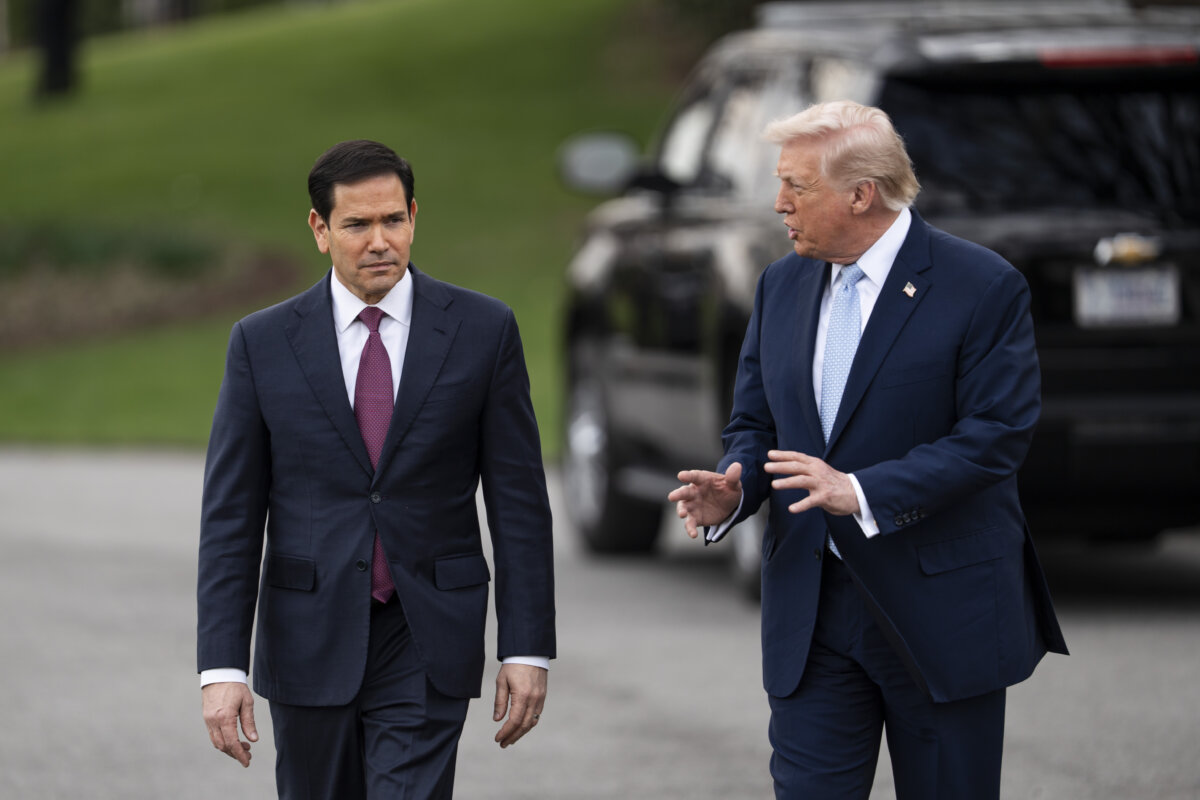

U.S. Secretary of State Marco Rubio landed in Italy on Wednesday for a three-day mission aimed partly at resetting relations with the Holy See and repairing the cooling political bond between the Trump administration and Italian Prime Minister Giorgia Meloni.
Three Italian and European analysts told The Epoch Times that Rubio is well-placed to ease the immediate tensions, but that the strategic costs that have accumulated in recent weeks may be harder to repair.
Rubio said his current meeting had been scheduled prior to Trump’s earlier criticism of Pope Leo XIV last month.
President Donald Trump renewed his criticism of the pope on Monday after weeks of public disagreement. When the pope criticized U.S. strikes on Iran, Trump described the first American pontiff as “WEAK on Crime, and terrible for Foreign Policy” on Truth Social, and accused him of “catering to the Radical Left.”
Meloni called Trump’s criticism of the pope “unacceptable.” The U.S. president responded on Fox News that the Italian leader herself was “unacceptable” and that their relationship was “no longer the same.”
The analysts said the Italian leader’s response reflected mounting domestic pressure ahead of her reelection bid in 2027.
A Bet That Has Yet to Pay Off, Analysts Say
Over the past year, Meloni was hosted at Mar-a-Lago, urged European leaders to avoid escalation when Trump suggested that the United States should take over Greenland to ensure national security, and presented herself as a transatlantic bridge.
However, the strategic dividends for Italy remain thin, analysts told The Epoch Times.
One of them, Daniele Scalea, president of the Machiavelli Foundation, Italy’s leading conservative think tank, described the outcome as “little of concrete value.”
“Italy was not spared from tariffs, did not obtain significant additional flows of American capital, nor particular openings of the American market, nor favorable treatment on [liquefied natural gas], or American commitment to stabilize the North African and Sahel area, which is critical for us,” Scalea said.
The United States, Scalea said, missed an opportunity to reward what he said was a politically costly alignment. “The Trump administration could have been less transactional and instead concretely rewarded the political closeness, which for Meloni has been costly in the EU, and in some respects also internally, given that the dominant narrative has made Trump unpopular in Italy.”
Edoardo Secchi, an economic and strategic adviser and president of Club Italie-France, made the same observation.
Meloni’s invitation to Mar-a-Lago amounted to international recognition but not to a strategic position, Secchi said. “Cordial personal relations do not make a foreign policy,” he said.
The Iran War
Trump, who previously called Meloni a “great leader,” has said he was surprised by her refusal to send forces to help keep open the Strait of Hormuz amid the U.S.–Iran war. “I thought she had courage, but I was wrong,” he told the Italian newspaper Corriere della Sera.
The White House has called into question the loyalty of its allies, as several government leaders have criticized the war, on which they said they were not consulted.
“The Meloni government shares all the Israeli-American criticisms of Iran but did not share the choice of the attack,” Scalea said. “It is a fairly standard line for Italy and Europe, which has commonality of views with Washington but believes in diplomacy at all costs.”
Olivier Roy, professor at the Robert Schuman Centre for Advanced Studies at the European University Institute in Florence (Italy), said that “Europeans are by nature inclined to negotiation rather than war.” He added that European capitals do not consider this war to be in their strategic interest.
The Squeeze Inside Italy
What weighed on the dossier in Italy, in Scalea’s account, is the as-yet inconclusive outcome. “What really weighed was that the U.S. did not win the war quickly and decisively, leading to disruption in the Strait of Hormuz that has tangible effects on Italians’ pockets and thus discontent among ordinary people towards the United States, perceived as those who ‘made a mess’ even though the responsibility is actually Iranian.”
Meloni’s shift in tone reflects domestic pressure, he said.
Last month, voters rejected her flagship referendum on overhauling the Italian justice system, the centerpiece of her legislative agenda. Italian Finance Minister Giancarlo Giorgetti has said that a sustained closure of the Strait of Hormuz, through which much of Italy’s energy imports flow, could tip the country into severe recession. Meloni faces reelection in about a year.
Scalea tied these factors directly to her recalibration. “The failure of the reform … was a clear signal of weakness for the center-right, which has heightened some internal tensions. This has made it much more difficult for Meloni to resist mounting media pressure to distance herself particularly from the U.S. and Israel.”
Troops, NATO, and the Mediterranean
After Italy’s refusal to support U.S. efforts in Iran, Trump suggested he could remove troops from Italy. Meloni said Monday she would not support this decision.
Scalea said Italy’s dependence on U.S. military defense is significant.
“Italy needs the United States a great deal, because without American military cover, especially air defense and nuclear deterrence, it would find itself vulnerable,” he said. “This would mean having to enormously increase military spending, while the already modest current level is poorly tolerated by a population that is fundamentally pacifist to the point of appeasement and ignorant of geopolitical reasoning.”
Secchi questioned whether such a withdrawal is in America’s interests.
“Europeans have their own armies, and there is the French nuclear umbrella. But do the United States truly intend to disengage militarily from Europe, and in doing so, curtail their own interests and strategic influence?” he asked.
Italy, he added, “retains a central position in the American security architecture in the Mediterranean. It already played a leading role during the Cold War.”
Rubio the Right Man to Lower the Temperature, Analysts Say
The three analysts agreed that the visit will likely lower the immediate temperature.
Roy expected the surface diplomacy to function well. “He comes to calm the game, and he will do it well. The pope knows he will not influence Trump’s policy. But he is also receptive to a verbal de-escalation. This kind of polemic is not in the Church’s style.”
Scalea was more confident on the Italian leg. “I have absolute confidence that the mission will succeed and will represent an important step in mending relations. The Italian government certainly has the will to maintain a solid alliance with the United States, so this is merely a matter of smoothing out the differences.”
Scalea suggested that Rubio’s messaging for Europe has been helpful, in contrast with Trump’s recent statements, which Scalea described as “aggressive and purely transactional.”
“If the U.S. had instead valued the positive and collaborative message of [Vice President JD] Vance and Rubio, things would have gone differently. In fact, there is much common ground among Europeans for a message like that of the alliance of civilizations and the outstretched American hand to save Europe from suicide.”
Looking further out, he said that more political involvement from the United States in Europe would benefit both Italy and the conservative cause: “In a long-term perspective, if the U.S. became more active in Europe on the political and economic plane, Italy could benefit by finding, as it has often done, a counterweight to the overwhelming power of the Paris-Berlin axis.”
Rubio was received by Pope Leo XIV at the Vatican on Thursday.
The audience underscored “the strong relationship” between Washington and the Holy See and their “shared commitment to promoting peace and human dignity,” U.S. State Department spokesman Tommy Pigott said.
In a statement, the Holy See Press Office described the talks as “cordial,” noting that both sides renewed “their shared commitment to cultivate good bilateral relations between the Holy See and the United States of America.”
Rubio is scheduled to meet with Meloni on Friday.
 Friends Read Free
Copy
Facebook
Tweet
Friends Read Free
Copy
Facebook
Tweet