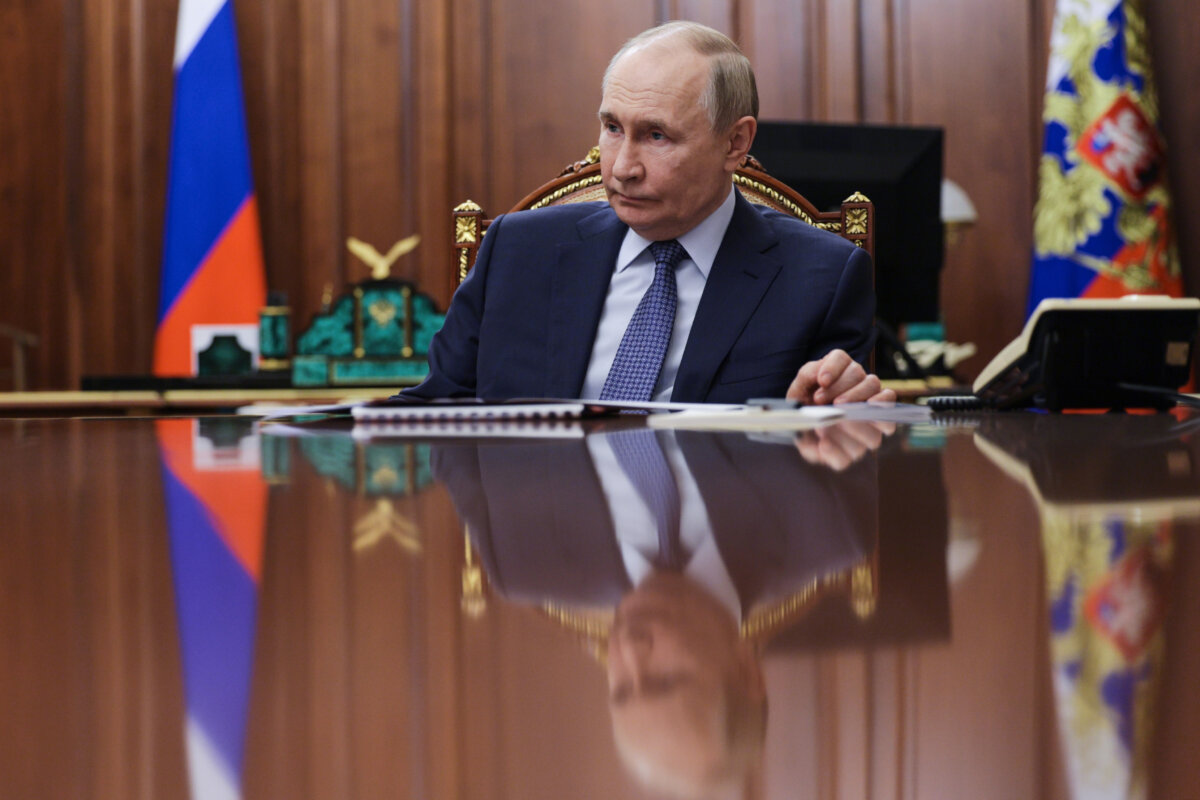

Russia successfully tested a Poseidon nuclear-powered and nuclear-capable super torpedo, Russian President Vladimir Putin said on Oct. 29.
Some military analysts say the weapon is capable of devastating coastal regions by triggering enormous radioactive ocean swells.
Putin said the test took place on Oct. 28, while he was visiting a Moscow hospital treating soldiers wounded in the Ukraine war.
“Yesterday we conducted one more test of another promising system, the Poseidon unmanned underwater vehicle, also with a nuclear power plant,” he said, describing the test as “a tremendous success,” according to Russian state media agency TASS.
“For the first time, we managed not only to launch it from a submarine using its booster motor but also to turn on the nuclear power plant, which powered the vehicle for a certain period of time. There’s nothing like it in the world; its rivals are unlikely to appear anytime soon, and there are no existing interception methods.”
He further said Poseidon’s power exceeded that of even the Sarmat intercontinental-range missile, which is known as SS-X-29, or Satan II.
The weapon, known to NATO as Status-6 or Kanyon, is essentially a massive, nuclear-powered torpedo, measuring approximately 65.6 feet in length and 5.2 feet to 6.5 feet in diameter, with a weight of about 100 tons.
Much larger than conventional torpedoes, it is effectively a hybrid of a torpedo and an autonomous underwater drone, equipped with a compact nuclear reactor that gives it an estimated range of roughly 6,200 miles.
It can rest on the ocean for weeks or even months before being activated to attack coastal cities or naval facilities. With a top speed estimated at between 50 knots and 100 knots (57 miles per hour to 115 miles per hour), it may be significantly faster than conventional submarines or torpedoes. Its ability to operate at depths greater than 3,000 feet makes it very difficult to detect with standard sonar systems.
The test of the Poseidon follows Russia’s test of its Burevestnik cruise missile carried out on Oct. 21 but only publicly announced by Putin on Oct. 26.
The Burevestnik is a nuclear-powered cruise missile that Moscow has claimed possesses unlimited range and the ability to evade existing missile defenses.
Both tests follow Russia’s resistance to Western pressure for a cease-fire in Ukraine, and Putin has strongly warned the United States not to provide Ukraine with long-range Tomahawk missiles capable of hitting Russian oil facilities.
Following the launch of the Burevestnik, U.S. President Donald Trump said on Oct. 27 that Putin should be ending the war in Ukraine instead of testing the missile, noting that the United States had a nuclear submarine positioned off Russia’s coast.
“It doesn’t have to go 8,000 miles,” Trump told reporters aboard Air Force One when asked whether Moscow was saber-rattling with the test.
“I don’t think it’s an appropriate thing for Putin to be saying, either, by the way: You ought to get the war ended. The war that should have taken one week is now in … its fourth year; that’s what you ought to do instead of testing missiles.”
After Trump’s comments, Kremlin spokesman Dmitry Peskov said the Burevestnik test should not affect relations between Moscow and Washington.
“There is nothing here that could or should further strain relations between Moscow and Washington, especially since they are already at a minimum,” Peskov said, according to TASS.
The Russian tests come as the New Strategic Arms Reduction Treaty (New START), the nuclear arms pact between Washington and Moscow, is set to expire on Feb. 5, 2026.
Signed in 2010, it caps deployed long-range weapons and allows inspections to ensure that both sides comply.
Without it, the world’s two largest nuclear powers would face each other with no binding limits for the first time in decades.
Mike Fredenburg and Reuters contributed to this report.
 Friends Read Free
Copy
Facebook
Tweet
Friends Read Free
Copy
Facebook
Tweet