
British officials said that two Russian military aircraft “repeatedly and dangerously” intercepted an unarmed reconnaissance aircraft over the Black Sea last month, which a senior minister said risked escalating tensions.
The Ministry of Defence (MoD) said in a May 20 statement that an RAF Rivet Joint was intercepted by two Russian jets in separate incidents in April while conducting routine flights in international airspace over the Black Sea, in incidents that the department described as dangerous.
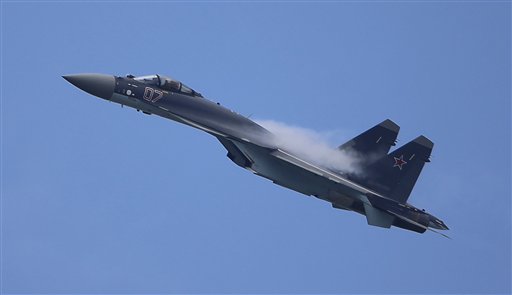
The MoD said that one Russian Su-35 fighter jet flew close enough to the Rivet Joint to trigger the surveillance craft’s emergency systems, including the disengagement of the autopilot.
In another intercept, an Su-27 conducted six passes in front of the Rivet Joint, flying as close as around 20ft from the RAF craft’s nose.
“This incident was the most dangerous Russian action against a UK Rivet Joint since 2022, when a Russian plane fired a missile over the Black Sea,” the MoD said.
British Secretary of State for Defence John Healey said the incident was “another example of dangerous and unacceptable behaviour by Russian pilots, towards an unarmed aircraft operating in international airspace.”
“These actions create a serious risk of accidents and potential escalation,” he said.
He added that the incidents “will not deter the UK’s commitment to defend NATO, our allies and our interests from Russian aggression.”
The MoD said this week that its representatives, along with those from the British Foreign, Commonwealth, and Development Office, called on the Russian Embassy in London to condemn the pilots’ actions.
The Epoch Times contacted the Russian Embassy but did not receive a response by the time of publication.
NATO’s Eastern Flank
According to the RAF, the RC-135W Rivet Joint is a reconnaissance aircraft that uses advanced sensors to intercept and analyze electronic and signals intelligence. It has been used in supporting both NATO and British coalition missions.
The MoD said in its statement that the craft was carrying out the routine flights as part of the UK’s work alongside allies “to secure NATO’s Eastern Flank.”
NATO’s Eastern Flank comprises the members along the defence union’s easternmost border, stretching from the Baltic Sea in the north to the Black Sea in the south.
Since Russia invaded eastern Ukraine in 2022, NATO has strengthened its readiness to defend the alliance “with more combat-ready forces along the eastern flank and the most comprehensive defence plans since the end of the Cold War,” the organization said.
In September 2025, NATO launched Operation Eastern Sentry, a military operation aimed at strengthening this zone.
NATO said in a Sept. 12, 2025, statement that the operation would involve both traditional military capabilities and novel approaches, including “elements designed to address challenges associated with drones.”
Escalating Tensions
Tensions between NATO allies and Russia are perceived by both sides as increasing.
Earlier this week, a senior Russian diplomat said that the chances of a clash between Russia and NATO are rising, with a risk of “potentially catastrophic” consequences.
Deputy Foreign Minister Sergey Ryabkov told TASS that there was an “escalatory narrative” from Europe about “the looming threat of a high-intensity war” with Russia.
“As a result of this escalation of tensions, including blatantly provocative moves in the nuclear sphere, strategic risks are increasing, as is the danger of a head-on clash between NATO and our country, with potentially catastrophic consequences as a result,” Ryabkov told the Russian state-run news agency on May 19.
NATO has also expressed concerns about escalating tensions with Russia.
During a Chatham House speech in London last year, NATO Secretary-General Mark Rutte said, “Russia could be ready to use military force against NATO within five years,” and urged the defense alliance to strengthen itself and be ready to respond to an expanding range of threats.
“We are all on the Eastern flank now,” Rutte said on June 9, 2025.
“The new generation of Russian missiles travels at many times the speed of sound. The distance between European capitals is only a matter of minutes. There is no longer East or West—there is just NATO.”
 Friends Read Free
Copy
Facebook
Tweet
Friends Read Free
Copy
Facebook
Tweet