
News Analysis
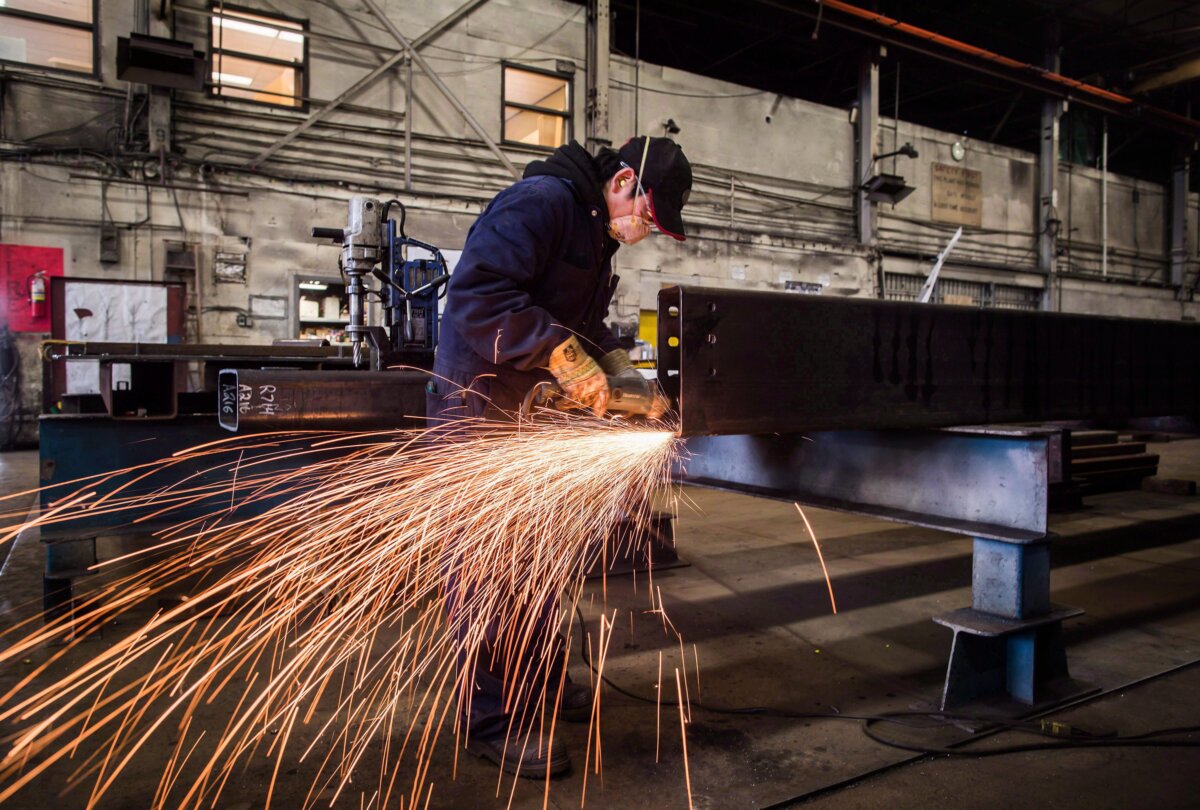
On factory floors across Canada, aging machinery hums in plants that are investing less and producing fewer goods than competitors. While other advanced economies upgrade and automate, Canada’s manufacturing sector has been losing ground for years, and experts warn it’s set to get worse without major policy changes.
Lagging productivity, heavy compliance burdens, provincial fragmentation, and trade instability are squeezing the manufacturing sector and clouding long-term planning, according to several experts The Epoch Times spoke to. Compounding those pressures is chronically low capital investment that has slowed modernization and weakened competitiveness.
“Our businesses are literally rusting out,” David Leis, CEO of the Frontier Centre for Public Policy, told The Epoch Times.
He argued that years of red tape, weak competition, and neglect have left many firms slower to modernize and less able to compete globally. In these conditions, productivity stalls, investment hesitates, and manufacturers gradually lose ground to more agile international rivals.
Although trade tension with the United States has drawn attention to Canadian manufacturing recently, the sector has been eroding for years.
The S&P Global Canada Manufacturing Purchasing Managers’ Index, a gauge of manufacturing health, slid sharply during the pandemic to a record low of 33 in April 2020 from a multi-year high of 56.2 in May 2018. By late 2022, the index remained below 50 and stayed there for much of 2024. Anything below 50 marks contraction, while above 50 means growth.
While the index has risen slightly in the past two months, it’s still barely above stagnation level, at 51 in February.
Lack of Investment
Real investment in industrial machinery and equipment dropped to its lowest level on record last year, and Bank of Canada data shows U.S. labour productivity running roughly 40 percent higher than Canada’s.
Leis says a key factor behind the decline of Canada’s manufacturing sector is a lack of investment, which he said is significantly lagging behind the United States.
He says that manufacturing competitiveness is firmly tied to capital investment in machinery, automation, software, upgrades, and plant expansion.
“If capital has a choice between investing in Canada or investing in a low-regulation state in the United States, the choice is increasingly obvious,” he said.
Real investment in industrial machinery and equipment in Canada fell to its lowest point ever recorded in the second quarter of last year, according to a report from the National Bank of Canada.
The bank described Canada’s widening productivity gap with the United States as “appalling,” warning that the country’s declining performance could render its manufacturing sector increasingly “irrelevant” within global supply chains.
The National Bank’s report faulted “years of excessive regulation” and “a chronic lack of ambition by successive governments” to build domestic value-added manufacturing.

If firms don’t invest, productivity lags, leading to rising costs. Plants then decide to close, reduce hours, or relocate, says University of Calgary economist Garret Fellows.
“If there’s insufficient capital investment, conventional economics predicts that labour productivity will fall or at best it will grow more slowly, which is exactly what is happening if we compare Canada to the rest of the G7 economies,” Fellows said in an interview.
Fellows said repeated moves by U.S. officials to raise tariffs on goods from Canada, and wider uncertainty surrounding the U.S.-Canada trade relationship, are further hampering improvement in the Canadian manufacturing sector in multiple ways.
Washington has imposed a range of tariffs on specific Canadian industries, covering products such as steel, aluminum, and automobiles.
“The U.S. is by far our biggest trading partner and uncertainty in that relationship has impacts for economic growth and investment on both sides of the border,” Fellows said. “Companies don’t want to spend on capital that supports trade which is in jeopardy.”
Business Development Bank of Canada (BDC) Chief Economist Pierre Cléroux agreed, saying the 2025 manufacturing slowdown is related to the trade dispute.
“Canada’s manufacturing slowdown over the past year largely reflects a more difficult trade environment and tariff-related uncertainty,” he said.
Tax and Regulations
On top of the trade turmoil, many manufacturers are hampered by regulatory, tax, and domestic trade barriers that prevent growth and discourage capital investment, according to Laure-Anna Bomal, an economist at the Canadian Federation of Independent Business (CFIB).
Interprovincial trade barriers coupled with extensive compliance requirements and regulations are a major constraint on manufacturing growth, she added.
“We’re really talking here about excessive permitting delays, environmental reporting, labour regulations—really everything that will increase administrative time and cost, but truly at an excessive level,” Bomal said.
She pointed to a 2025 CFIB survey of manufacturers showing that 70 percent reported tax and regulatory costs are their primary concern, followed by pressures on insurance, wages, and input costs.
Although the federal government has introduced legislation to substantially reduce federal aspects of interprovincial barriers, many provincial restrictions remain in place.
Leis, of the Frontier Centre for Public Policy, said Canada’s broader policy environment is hostile to capital, especially compared to many low-red-tape U.S. states.
“Decision-makers are in almost a policy bubble. They think that they can capture people’s money. You can’t,” he said. “Money flows downhill, like water.”
Differing rules, standards, and procurement practices, as well as transportation restrictions, can make it easier for firms to expand into the United States than to a different Canadian province, he said.
Innovation
Stephen Veldhuis, a professor at McMaster University’s Manufacturing Research Institute, said the main challenge faced by Canadian manufacturing is innovation.
He said Canada should raise value through improving products and innovating while reducing the resources consumed by adopting automation and smarter practices.
Leis said overall weak performance among many Canadian industries discourages the investment and research required to innovate and raise value.
“Our Competition Act needs a wholesale change enabling competition across this country, whether it’s in telecom, whether it’s in banking, whether it’s in other service areas of our economy,” he said.
“One of the reasons why the Canadian economy has got such relatively low productivity is because in many sectors of our economy we don’t have full competition.”
He notes roughly one in four Canadians works for the government and a further 11 percent work for a Crown corporation. This inflates the public sector and further discourages competition and real economic growth, he added.
Defence Spending and Nation-Building
Prime Minister Mark Carney has promised to build up Canada’s economy in the face of trade uncertainty and geopolitical instability.
The Building Canada Act passed last year proposes to streamline and speed up the approval process in a number of areas including ports, railways, energy corridors, and critical minerals development.
Carney has also pledged to boost defence spending to 2 percent of GDP by this year and accelerate the approval process for projects deemed in the national interest.
The National Bank’s 2025 report said a large increase in military spending could help drive “reindustrialization” but it must be done quickly and in concert with “a competitive tax regime, a sweeping reduction in red tape, and clear laws” on resource development.
The Conservatives have said Canada needs to cut federal and provincial taxes, eliminate the industrial carbon tax, and remove a number of regulations, including the Impact Assessment Act and the oil tanker ban on B.C.’s north coast.
In this respect, Veldhuis said higher defence spending could be a boon to manufacturing, but only if innovation and domestic supply align with procurement processes.
“The military drives a lot of the funding, and then the applications are oftentimes dual use,” he said, citing examples like drones, robotics, AI, and the internet that can also generate civilian economic breakthroughs.
But Veldhuis said policies that promote the purchase of Canadian products must be strengthened, along with policies motivating Canadian manufacturers to make “the most innovative” goods, rather than just the cheapest.
The BDC’s Cléroux said military spending and large infrastructure investment should help boost manufacturing in the coming years.
“Looking ahead, manufacturing activity is expected to benefit from increased investment in large infrastructure projects and defence, which should help stabilize and gradually strengthen the sector,” he said.
Moving Forward
Overall, experts see two main types of problems in Canadian manufacturing. The first type includes problems at least partly outside of the government’s control, including geopolitical instability and trade tensions.
The second type includes long-standing structural issues within Ottawa’s and provincial control, including regulatory burdens, interprovincial trade barriers, weak competition, and low capital investment.
While the government may not be able to resolve global conflicts, it does have the capacity to, for example, spark “transformative change” in domestic policy related to manufacturing instead of “tinkering” at the margins, Leis said.
He lists lifting regulatory burdens and interprovincial trade barriers as steps in that direction. Leis also said the government should enable major energy projects such as cross-country pipelines.
Veldhuis, meanwhile, emphasized the need for more investment in innovation and better adaptation to technology so that Canadian manufacturing is more competitive.
 Friends Read Free
Copy
Facebook
Tweet
Friends Read Free
Copy
Facebook
Tweet