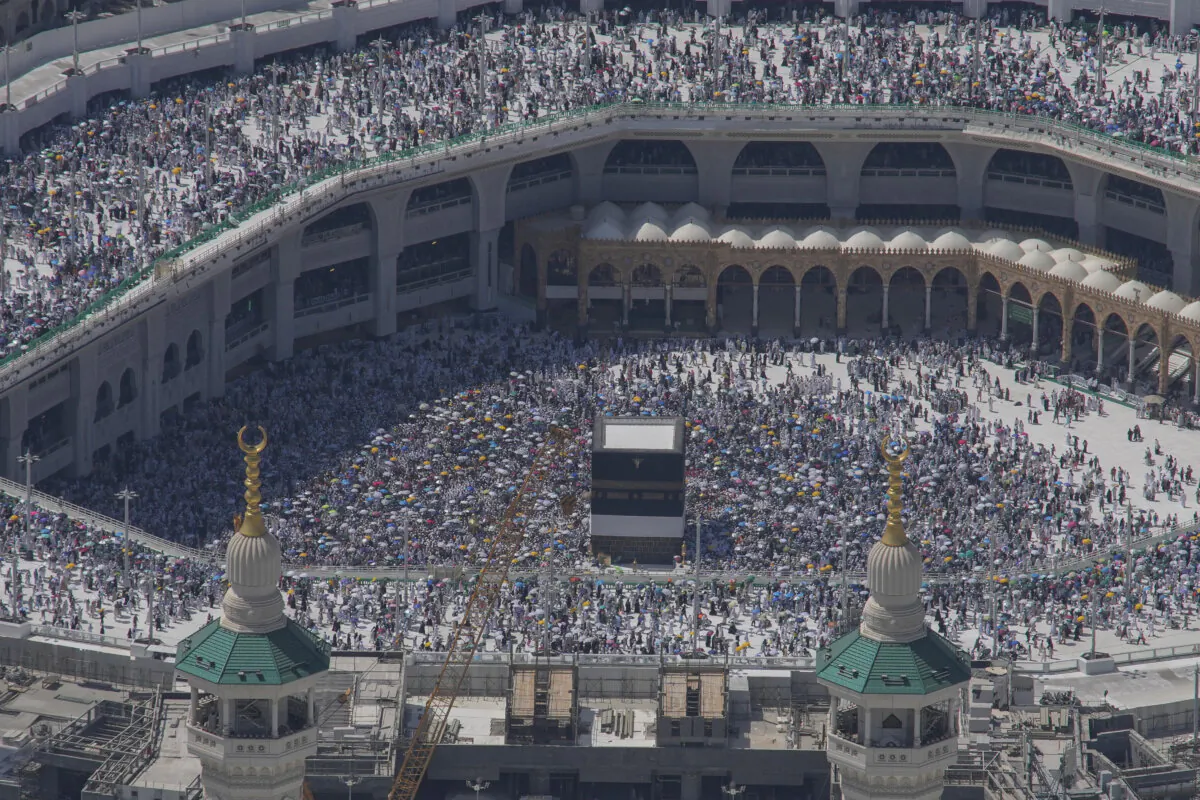

Saudi authorities on Tuesday issued an alert for the Muslim holy city of Mecca amid the latest wave of Houthi attacks.
Residents were told to shelter indoors as similar short warnings covered other cities in the Arabian Peninsula kingdom after days of Houthi strikes.
Mecca is Islam’s holiest city and the site of the annual Hajj pilgrimage, drawing millions of Muslims each year.
In a Sept. 15 post on X, Saudi Civil Defense said at 12:18 p.m. local time that a warning had been issued to Mecca City under its National Early Warning Platform, which sends alerts about “potential danger” via the cellular broadcast service.
Residents were told to go immediately to the nearest safe place, stay inside a room away from windows, keep off balconies and roofs, and, if outdoors, to enter the nearest building or take cover behind a solid barrier. People were also told not to leave until the danger had passed.
The warning was very short-lived, with the all-clear message posted by Saudi Civil Defense at 12:24 p.m. local time.
“The danger has been lifted from the city of Mecca, the Honorable,” the Saudi Civil Defense said, seven minutes later in a post on X.
The Mecca posts did not name an attacker. The same alert cycle covered Jeddah, Taif, Yanbu, Abha, Jazan, and AlUla, where the Saudi Civil Defense also said the danger had passed.
The Saudi Press Agency reported on Sept. 15 that Saudi Crown Prince Mohammed bin Salman Al Saud addressed the Cabinet and “condemned in the strongest terms the continuation of the terrorist Houthi militia in its sinful and deliberate attacks on civilian objects and civilians in the Kingdom.”
Recent Houthi attacks have included strikes against Saudi energy infrastructure and civilian areas in Jazan, Abha, Khamis Mushait, and Najran, according to Saudi authorities.
The Saudi Press Agency said a Sept. 12 projectile attack in Jazan injured two people and damaged a mosque, buildings, and vehicles.
Houthi military spokesperson Brig. Gen. Yahya Saree said in a Sept. 14 post on X that the group had attacked military facilities at King Khalid Air Base in Khamis Mushait.
Saudi officials disputed that characterization, saying civilian locations had been targeted instead.
Saudi military spokesperson Gen. Turki al-Malki said on Sept. 14 that missile and drone attacks on Khamis Mushait, Abha, and Taif injured 13 civilians and damaged seven homes and two vehicles.
Saudi Arabia on Sept. 11 announced that it shut down its East-West Pipeline “as a precaution” after several attacks were reported a day earlier.
According to a recent report by the British think tank Chatham House, the Houthis’ recent capture of the strategic port city of Mocha in southwestern Yemen, along with their advance along the coast of the Bab al-Mandab Strait, represents the “most consequential change in territorial control in Yemen for years.”
The Sept. 11 Houthi takeover of Perim Island, also known as Mayyun Island, gives the Iran-backed terrorist group greater control over the strait, a key waterway. The capture was confirmed by Houthi and Yemeni officials.
Farea Al-Muslimi, research fellow at Chatham House’s Middle East and North Africa Programme, wrote in a Sept. 14 article that the Houthi advance “gives them much greater ability to influence maritime shipping through Bab al-Mandab, the narrow passage connecting the Gulf of Aden to the Red Sea and ultimately the Suez Canal.”
Evgenia Filimianova and Timothy Frudd contributed to this report.
 Friends Read Free
Copy
Facebook
Tweet
Friends Read Free
Copy
Facebook
Tweet