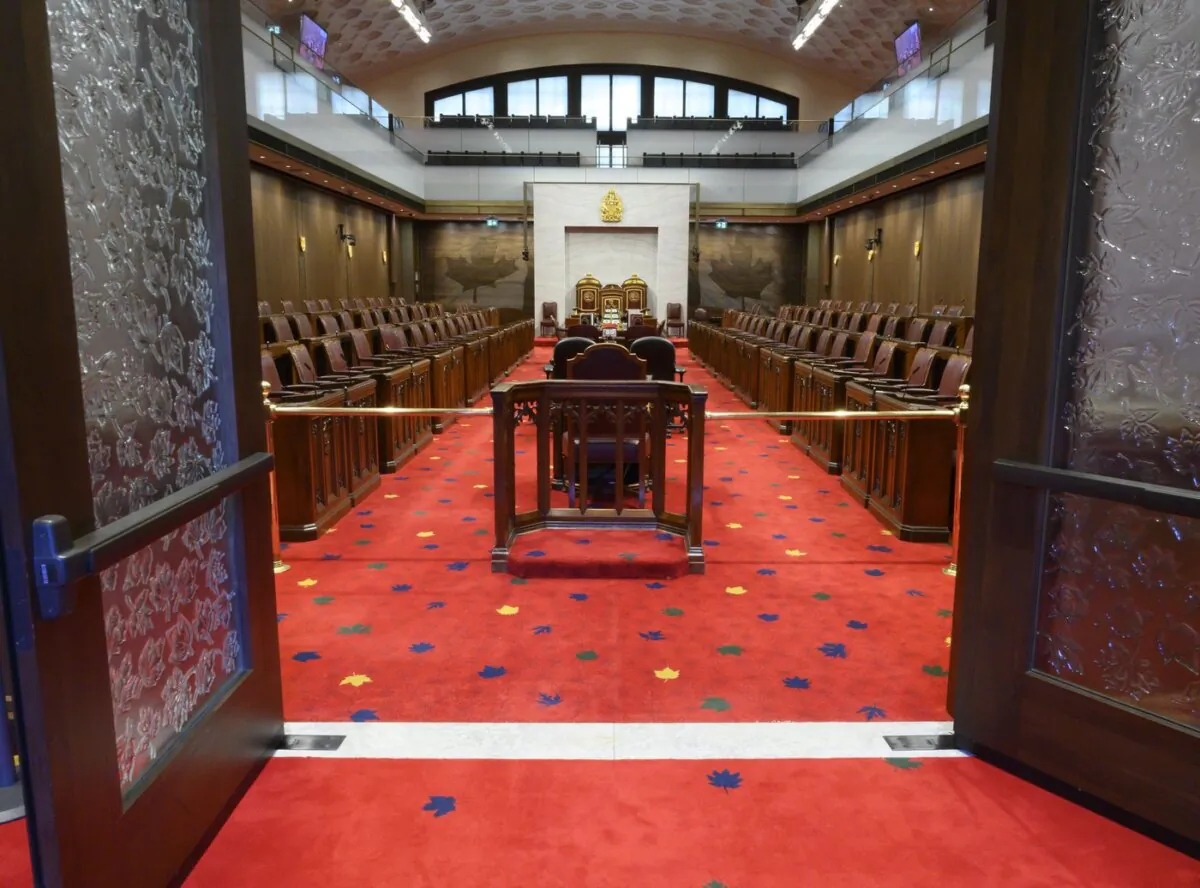

Senators criticized aspects of the government’s bill One Canadian Economy Act as Intergovernmental Affairs Minister Dominic LeBlanc testified in front of the Senate, raising concerns about excessive ministerial powers, risks to indigenous rights and provincial autonomy, and the speed with which the bill is moving through the House of Commons.
During the Senate pre-study of Bill C-5, LeBlanc said the legislation would enable “nation-building initiatives that will power our economy,” following consultation with indigenous peoples, provinces, and territories.
The Liberal government recently put forth a notice to push Bill C-5 through the House of Commons by the end of the week, as Prime Minister Mark Carney said during the election he would pass legislation bringing down federal impediments to interprovincial trade and speeding up the process for approving major energy projects before Canada Day.
Bill C-5 is meant to remove the federal impediments to interprovincial trade barriers by allowing goods and services that meet comparable provincial or territorial rules to be treated as compliant with federal trade requirements, which would reduce delays and costs for businesses.
The second part of the legislation would support major projects of national interest, contingent on consultation with provinces, territories, and indigenous peoples. The bill creates a single assessment for projects and improves coordination of permitting alongside the provinces and territories, aiming to reduce approval times from five years to two.
Speaking to senators on June 17, LeBlanc said the federal government wanted to “do away with some traditional delays” and focus on delivering for Canadians through the legislation.
“This is a time when the national interest calls for the federal government to step up to catalyze investment and accelerate the federal approvals for projects that are of national significance, in the national interest, and Bill C-5 is our response to this hinge moment,” he said.
Liberal MP and Minister of Crown-Indigenous Relations Rebecca Alty said major projects will only proceed under Bill C-5 with “meaningful consultation and accommodation” with indigenous peoples. She said the bill will not interfere with Aboriginal and treaty rights recognized and affirmed in Section 35 of the Constitution Act of 1982.
Conservative MPs this week voted along with the government MPs to quickly push the legislation through the House of Commons, while the Bloc Québécois, the NDP, and the Green Party opposed it.
Conservative MP Philip Lawrence called the proposed legislation a “small step in the right direction,” but said that it still “barely scratches the surface” of what the government needs to do.
Senators’ Concerns With Bill
Despite the Conservative MPs’ vote in favour of the bill in the House of Commons, the Conservatives in the upper chamber still had questions for the government.
Conservative Senator and Leader of the Opposition Leo Housakos said the legislation would give “unprecedented power to a single minister” to decide which projects are in the national interest and are approved. “But if the minister refuses, perhaps for ideological reasons, to give that designation, the project defaults to the old slow regime your government admits is not working,” he said.
Housakos questioned if the bill would “risk enabling politically motivated decisions that quietly block strategic projects and harm the Canadian objective.”
LeBlanc responded that he said would be the minister responsible for those decisions and is “not an ideological person.” LeBlanc also said he believed the bill “strikes the right balance” between speed and certainty for developers and providing oversight to meet the needs of indigenous and provincial governments.
Independent Senator Paula Simons also said she was concerned Bill C-5, which intends to speed up approvals for major projects, will be “putting the cart before the horse” by approving the projects before environmental assessments had taken place.
“I wonder what happens in a case where there’s been consultation with provinces, with municipalities, with First Nations … and then the environmental assessment turns out that this project could have a detrimental impact on nesting sites or breeding grounds,” she said.
Alty said the two-step process for projects involves an initial consultation with indigenous rights holders, while the second involves a full environmental assessment and another round of consultations. Alty added that the entire process would uphold the United Nations Declaration of the Rights of Indigenous Peoples.
LeBlanc added that environmental assessments will be key to approving the projects, and “if we concluded that the proponent was unwilling or unable to meet the reasonable conditions that we worked on together, then that project might not receive the final approval from the government.”
Senator Pamela Wallin said she was concerned with the Liberal government attempting to rapidly pass the legislation, and in effect having “usurped the rights and obligations of parliamentarians,” and said debate in the House of Commons had been “stymied.”
“This is not our general procedure here. We would usually send a bill to committee, we would have witnesses, we would take testimony, and we would apply a sober second thought to that bill,” she said.
LeBlanc said the Liberal government had made a “compelling case to Canadians” that the legislation is needed in the current moment. “Every day of the election campaign, the prime minister spoke about building big projects in the national interest … So none of this should surprise Canadians,” he said.
Liberal MP Nathaniel Erskine-Smith, who was the lone Liberal MP to vote against the motion fast-tracking Bill C-5 on June 17, said he wanted Parliament to have enough time to improve it and “respect democratic participation” in the process, and he was concerned there would only be around two days for experts and the public to testify before the committee.
Bloc Québécois Leader Yves-François Blanchet also accused the Liberals of putting a “gag order” on Parliament in debate around C-5, and said the Liberals were acting as if they had a majority government.
 Friends Read Free
Copy
Facebook
Tweet
Friends Read Free
Copy
Facebook
Tweet