
JOHANNESBURG—Relations between the governments of China and South Africa are flourishing, but manufacturers in Africa’s leading economy feel increasingly squeezed by what some describe as a “constant flood” of cheap Chinese imports.
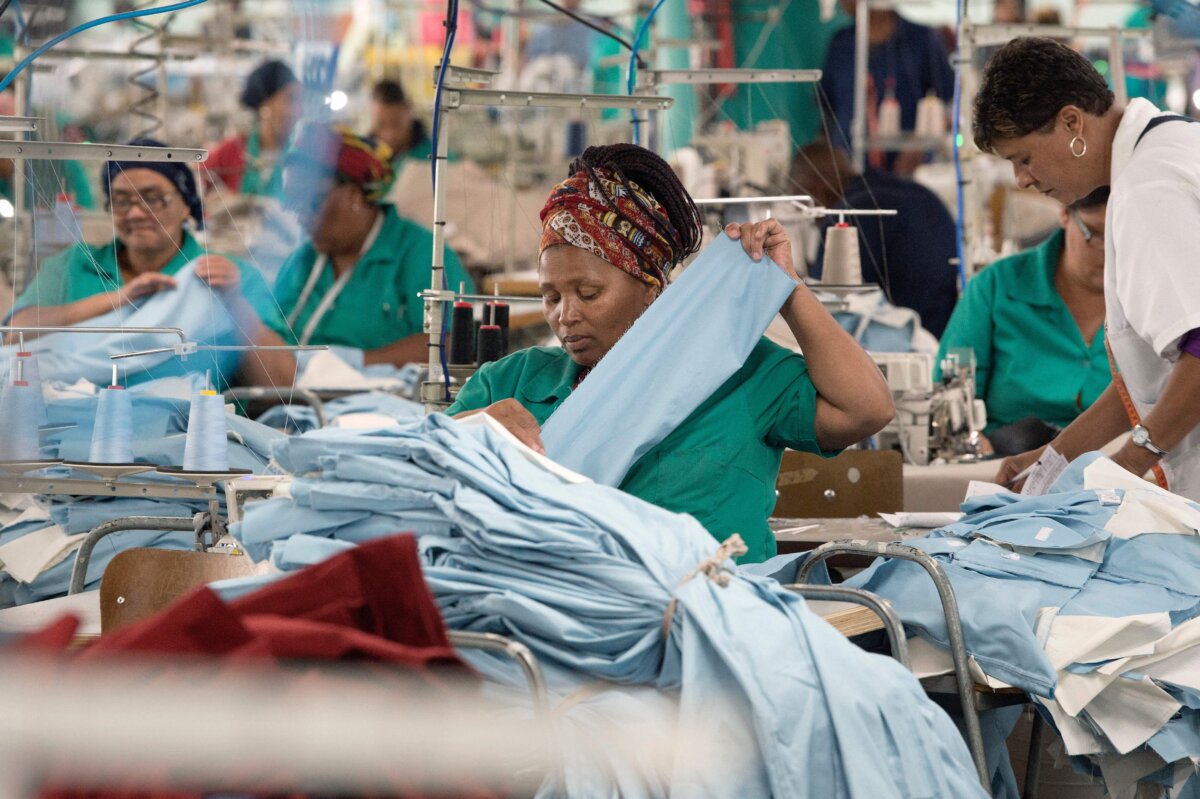
The crisis is especially serious in South Africa’s clothing and textiles sector, which trade unions and economic researchers say has declined remarkably over the past 25 years as China’s hold on the market has strengthened.
South Africa, once a rich tapestry of clothes and fabrics made from locally-sourced materials by ethnic groups such as the Zulu, Xhosa, and Tswana, is now being dressed by China, according to analysts studying the phenomenon, and South Africans are losing part of their cultural identity.
Local workers are appealing for protectionist measures, including higher tariffs on Chinese goods, even as Beijing touts its scrapping of duties on products it imports from Africa as a huge win for the continent.
Local trade unions accuse the co-governing African National Congress (ANC) of “bowing to Beijing,” as entire economic sectors buckle under the strain of a highly unequal trading partnership with China.
Meanwhile, President Cyril Ramaphosa’s ANC Party says China’s presence is “good for business.”
The ANC and the Chinese Communist Party are longtime allies, with the Chinese regime providing financial and military support to the ANC’s insurgency against apartheid.
The two are founding members of BRICS (Brazil, Russia, India, China, and South Africa), a bloc of emerging economies.
Since the ANC came to power in 1994, it has forged ever-tighter ties with Beijing, and China replaced the United States as South Africa’s biggest trading partner in 2008.
A recent study by Marvellous Ngundu, economic researcher at South Africa’s Institute for Security Studies, shows that the country’s trade deficit with China is deepening.
“It’s a trade imbalance that was to China’s advantage by almost $10 billion in 2023,” he told The Epoch Times.
“Between 2000 and 2023, there was an accumulated cash outflow of almost $115 billion from South Africa to China. Since 2014, South Africa’s imports from China have nearly doubled the value of its exports.”
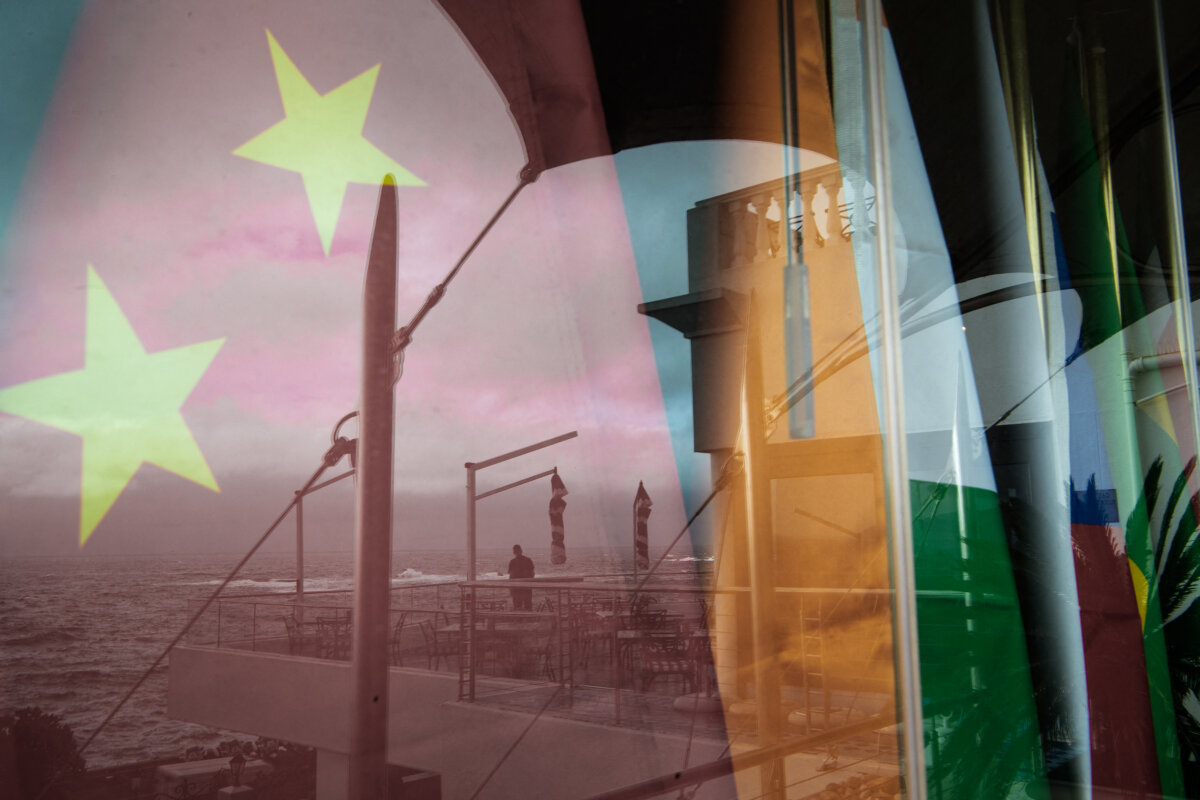 A view of a reflection on a window of a man staring at the sea in front of the national flags of the BRICS (Brazil, Russia, India, China, South Africa) countries in Cape Town, South Africa, on June 2, 2023. (Rodger Bosch/AFP via Getty Images)
Ngundu’s numbers show that South Africa’s total bilateral trade with China soared from $1.34 billion in 2000 to $34.18 billion in 2023.
In 2024, according to the researcher, this total ballooned to $52.4 billion, which represented almost 20 percent of China’s trade that year with the entire continent.
Out of this, South Africa’s exports to China were a mere $12.41 billion, Ngundu said.
“The relationship is hugely to China’s advantage because South Africa is exporting raw materials, such as iron and steel ore, to China, and is importing manufactured goods, including electronics, machinery, and textiles, from China,” he said.
Ngundu said he believes that it is “time for a reset” in South Africa’s trade relationship with China.
“Importing manufactured goods, particularly clothing, electronics, and other consumer products, crowds out South African industries,” he said. “Many small and medium enterprises struggle to compete with cheaper Chinese imports.”
Nowhere is this more evident than in the clothing and textiles industry, said Bonita Loubser, spokesperson for the Southern African Clothing and Textile Workers Union, which has 100,000 members in South Africa.
She told The Epoch Times that the current 45 percent duty on Chinese clothing imports is not enough to stop the “constant flood” of cheap products from the world’s second-largest economy.
“If I had my way, we would follow [U.S. President Donald] Trump and take this tariff to 100 percent,” Loubser said.
“It seems like the Chinese can make clothes for next to nothing. These cheap imports are bringing our clothing and textiles manufacturers to their knees, and many jobs are being lost.”
Data from the Observatory of Economic Complexity show that South Africa exported $1.08 billion worth of textiles in 2024, with only $228 million in clothing going to China.
The observatory said South Africa imported clothing and textiles worth almost $3.65 billion in 2024, with nearly half of this coming from China.
“This deficit shows South Africans are no longer dressing South Africans,” Loubser said. “The Chinese are dressing us, and something must be done about this—otherwise, we are going to wake up and our textile industry will be wiped out.
“We must stop this ‘bowing to Beijing’ mentality.”
Mike Morris, professor in the school of economics at the University of Cape Town, has been studying the effects of Chinese imports on the clothing and textile industry since the early 2000s.
He told The Epoch Times: “The pace at which the cultural erosion has occurred has been frightening. Officialdom will point to the economic benefits of the Chinese stamp, but it has come at a cost.
“I remember all the wonderful weaving and designs that came out of the Eastern Cape [Province], where the Xhosa made an array of fabrics and clothes from scratch.
“Now these same weavers and designers must wait for the ships to roll in from China before they can buy the materials needed for their work.”
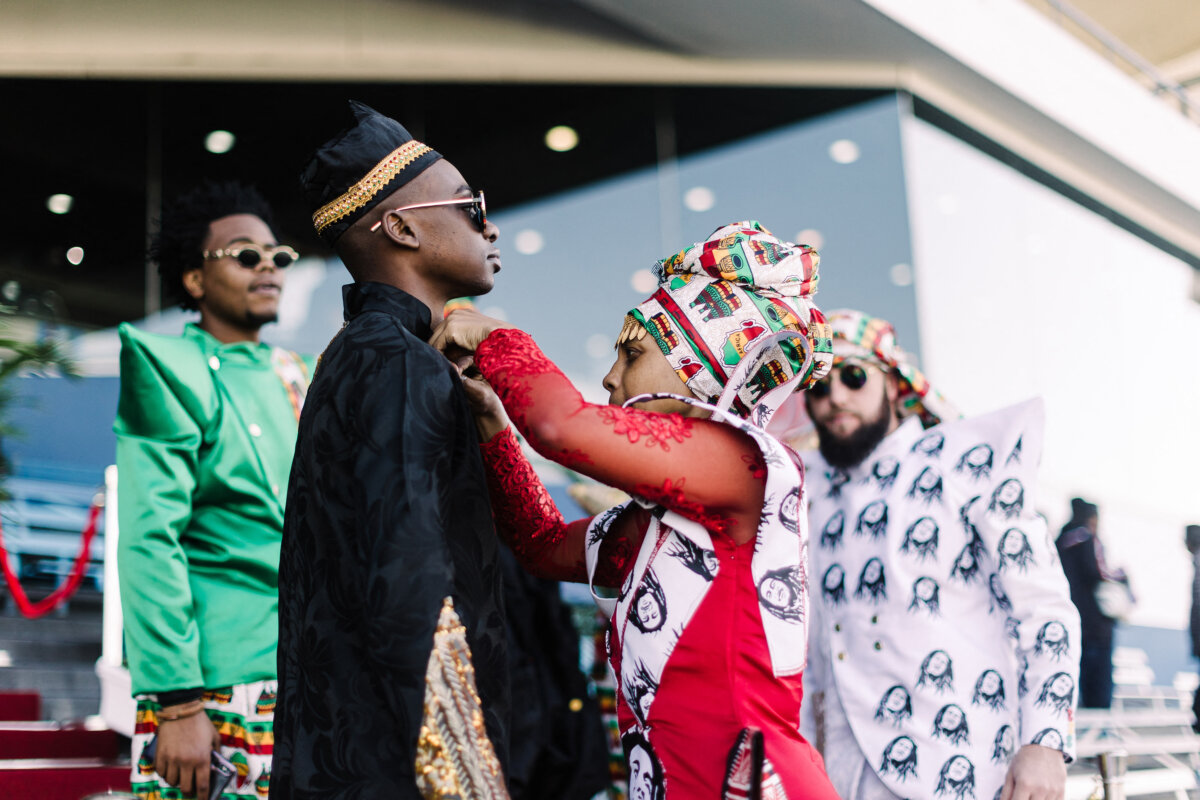 Models present creations by local designers during a fashion show in Durban, South Africa, on July 6, 2024. (Rajesh Jantilal/AFP via Getty Images)
Designers and clothing makers told The Epoch Times that they were embarrassed at the recent Allfashion Sourcing trade fair held in Cape Town when they had to tell potential buyers from Europe that three-quarters of the items on display were made with materials that originated in China.
“The Europeans want African-made fabric and African designs, not stuff made in China,” Bathini Kowane, owner of Bathini Designs, said.
“This goes for other buyers as well. But what do you do when you cannot source your material locally, when all the zippers and cloth and other extras are all made in China?”
Kowane said she was surprised at the “sheer numbers” of Chinese companies attending the event.
“I thought the exhibition was supposed to mainly showcase the best of local, but I suppose those days are gone,” she said. “I have nothing against the Chinese, but they wouldn’t be happy if we dominated their domestic exhibitions with African designs and fabrics.
“We have to come up with plans to cooperate in a way that encourages us as locals, and that’s also to the benefit of the Chinese.”
Event organizers told The Epoch Times that 71 of the 142 exhibitors attending were Chinese companies.
Scores of Beijing’s diplomats and government officials also roamed the exhibition corridors and stalls. On banners and in brochures, Chinese companies, including the Dongguan City Houjie Meizhen Footwear and Clothing Development Center, touted their capabilities.
“Established in 2016 as a privately owned enterprise, located in DongGuan City, China, we export footwear products from China to Europe, Australia, Japan, and South Africa,” the company stated.
“We have our own styling team that develops the designs, so we can quickly respond to the latest trends. We also work closely with customers’ designs to create an amazing range of products.
“No matter [whether] you are a starter or experienced in footwear business, we offer you better purchasing solutions for your business from China.”
Carol Viljoen, an exhibition attendee hoping to buy fabric for her business in Johannesburg, told The Epoch Times that the “sheer” Chinese presence made things “a bit intimidating.”
“It’s like this event is being held in China,” she said. “I don’t see Africa anywhere here, and it doesn’t feel right.”
Bongani Lukhele, spokesperson for South Africa’s Department of Trade and Industry, said the Chinese “roller coaster” cannot be stopped.
“The Chinese have over the years invested billions of yuan in our economy, and our view is that having China here is good for business,” he told The Epoch Times.
“That said, we must find a way to save our clothing and textiles sector, and we must find a way of preserving locally-made designs and material. We must collaborate with the Chinese to a degree that results in expanding local production.
“Maybe Chinese investments can set up hubs where clothing is made only from indigenous materials and then some of that gets exported to China.”
In his paper, Ngundu wrote that tariffs and quotas on Chinese imports that directly compete with local products are needed, along with import substitution policies.
“These could include incentivising investors and supporting local entrepreneurs to develop industries that produce goods currently imported from China,” he wrote.
Meanwhile, growing numbers of Chinese clothing companies are setting up shop in South Africa, bringing more competition for locals.
One of them is SAB, a subsidiary of Chinese global accessory giant WeiXing.
Cliff Shen, SAB’s sales manager, told The Epoch Times that his firm wants a place in the South African market because it is “new territory.”
“African economies are growing a lot, which means the continent is the place to be,” he said. “Of course, it is necessary for the Chinese and Africans to form partnerships that benefit all, and do not threaten locals.”
Loubser said she remains dubious.
“Until the Chinese make good on developing local industries and supporting local businesses, I say we go with tariffs,” she said.
“This might spur them on to delivering on their promises—that I’ve heard before, by the way.”
 Friends Read Free
Copy
Facebook
Tweet
Friends Read Free
Copy
Facebook
Tweet