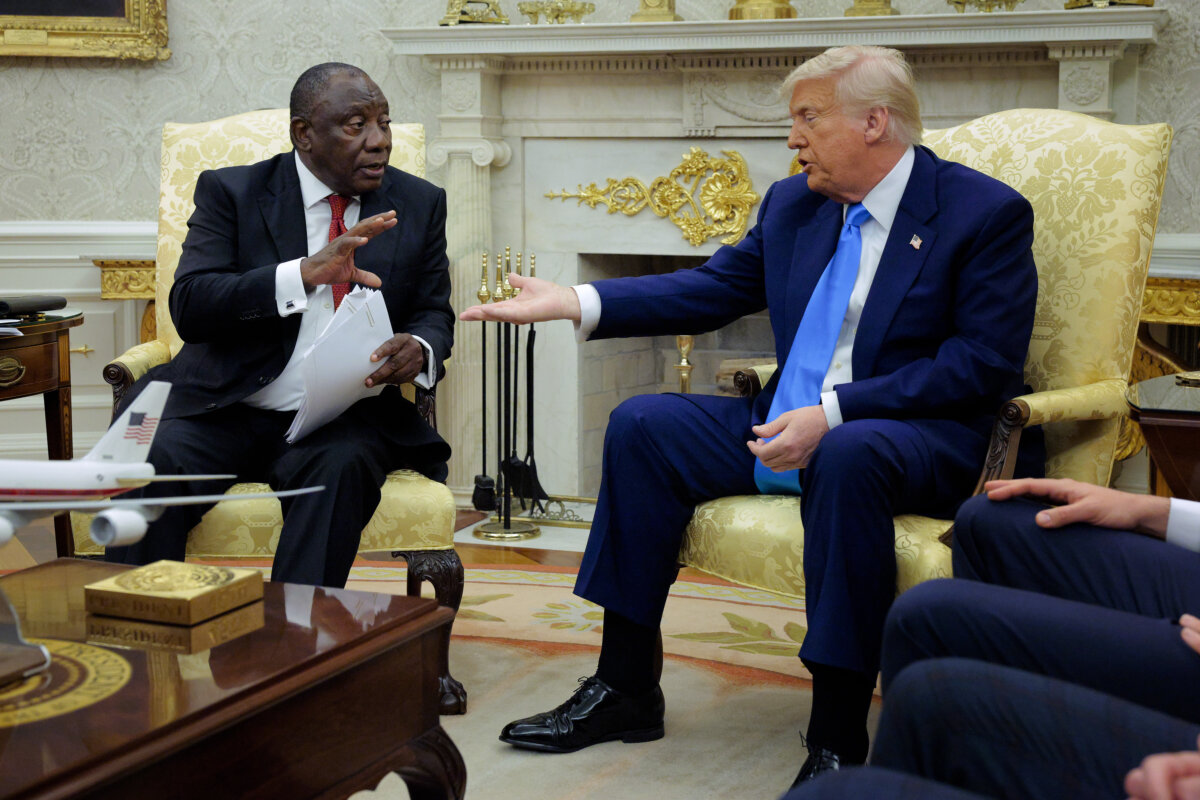

JOHANNESBURG—South Africa’s African National Congress (ANC), in power since apartheid ended in 1994, is being assaulted on two fronts, with salvos fired from inside the government as well as from the United States.
At home, sentiment is growing that unless the ANC scraps laws that the party’s secretary-general, Fikile Mbalula, calls “untouchable,” South Africa will not escape the worst effects of a high tariff imposed by U.S. President Donald Trump.
The ANC’s flagship diversity, equity, and inclusion regulations are a red flag to the Trump administration and are playing a role in a bipartisan push in the United States to implement targeted sanctions against key officials in Pretoria.
In South Africa, the second-largest political party, backed by several civil society organizations, is winning support for a plan to overturn the ANC’s race-based legislation that favors black citizens in employment and education.
Mbalula told The Epoch Times that the laws “make South Africa more equal” after apartheid gave preference to white people in almost all sectors of society.
The ANC, according to Mbalula, is convinced that the United States imposed a 30 percent tariff on imports from South Africa, the highest tax charged on goods and products from any country in sub-Saharan Africa, because of its affirmative action programs.
Washington said the tariff will correct a trade deficit with South Africa. South Africa has been the United States’ biggest trading partner in Africa for decades, but the relationship has soured since Trump retook the Oval Office in January.
Analysts say the loss of billions of dollars in trade with Washington and tens of thousands of jobs that depend on exports to the United States will inevitably result in intense public criticism of an ANC that’s already backpedaling.
Although South Africa’s economy is the largest in Africa, it’s almost stagnant. The official unemployment rate stood at 33.2 percent in the April–June period, up from 32.9 percent in the January–March period, according to Statistics South Africa.
Should the ANC erase its race-based legislation, political experts say it could lose the backing of key partners, especially the South African Communist Party and labor unions.
“Make no mistake, the ANC is at a crossroads and no matter which fork it takes, it is in trouble, with its very survival at stake,” said Susan Booysen, director of research at South African think tank Mapungubwe Institute for Strategic Reflection. “Workers and the deep rural constituencies are the only reasons the ANC managed to scrape into government after the last election.”
The ANC’s main opposition, the Democratic Alliance (DA), which supports free market principles, “senses blood,” she told The Epoch Times.
“The DA is on good terms with the Trump administration and it has visited Washington just as much, if not more, than the ANC since Trump reclaimed the White House,” Booysen said. “The DA and Trump are on most of the same pages, and that’s a thorn in the ANC’s flesh.”
Solly Mapaila, the general secretary of the South African Communist Party (SACP), told The Epoch Times that if the ANC “caves in to capitalist forces,” the SACP would reconsider its long-standing alliance with the ANC.
In May 2024, an increasingly unpopular ANC fell to its worst post-apartheid election performance, winning 40 percent of votes.
“Voters punished the ANC for corruption, poor delivery of basic services, high crime and deepening joblessness,” Booysen said. “Those crises persist, so the ANC remains in a precarious position.”
The ANC was forced into a fragile alliance with the DA to save party leader Cyril Ramaphosa’s presidency and its seat in Pretoria’s Union Buildings.
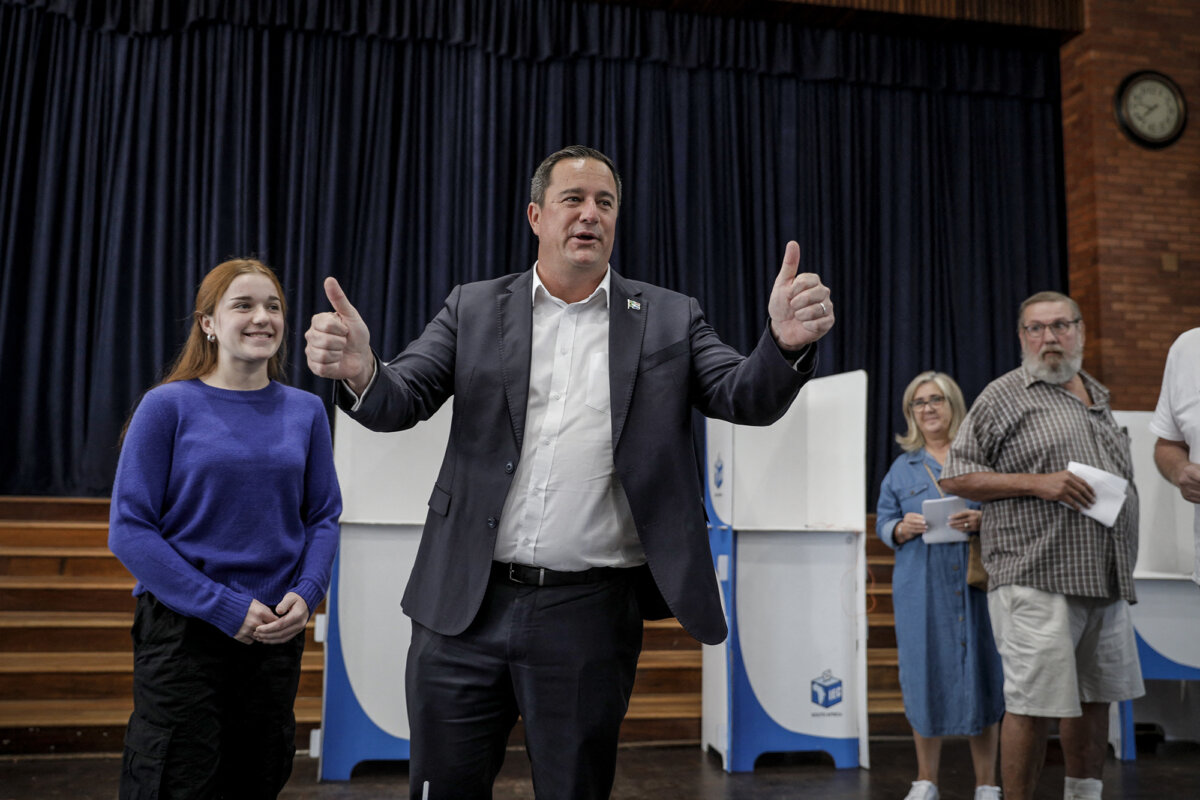
The DA said at the time that it only agreed to be part of a coalition government to prevent the ANC from aligning with radical leftist parties.
“Let’s just call it a stormy marriage,” Booysen said. “The DA and ANC don’t agree on much, but they seem to agree that giving extremists even a sniff of power will tip South Africa over the edge.”
This month, DA leader and South African Minister of Agriculture John Steenhuisen launched a plan to “turbocharge the economy” and get rid of the ANC’s Black Economic Empowerment Act, the Employment Equity Act, and the land Expropriation Act.
In a notice announcing the plan, the DA said the legislation has “increasingly served to entrench elite enrichment, deter investment, and block small businesses from accessing opportunities.”
Willie Aucamp, a senior DA official, told The Epoch Times, “Employment and access to education must be based on merit, not skin color.”
Economist Moeletsi Mbeki, brother of former President Thabo Mbeki, said that 30 years after the ANC launched its affirmative action plans, unemployment among black South Africans has increased.
“Millions of black people are on the streets, and we have people telling us that black economic empowerment is working. It’s working, alright, but only for a few rich black politicians,” he told The Epoch Times. “BEE [Black Economic Empowerment Act] prevents people from becoming entrepreneurs. BEE must disappear.”
Another prominent black South African academic, William Gumede of the University of the Witwatersrand in Johannesburg, has spent years studying the Black Economic Empowerment (BEE) Act and its effects.
He told The Epoch Times the policy is a “model of corruption.”
According to Gumede, at least one trillion rand (almost $57 billion today) has been pocketed by less than 100 individuals connected to the ANC since 1994.
“Now in South Africa, we have what is actually a few people setting up companies so they can get multimillion rand [BEE Act] contracts,” he said. “So the same people get rich over and over again, and they call that black economic empowerment. I suppose they are correct, in their twisted way.”
Mbalula said Mbeki and Gumede “are part of a misguided minority.”
“We’ve had a few problems in the past with certain programs, but we deny that it is only ANC leaders who are [BEE Act] beneficiaries,” he told The Epoch Times. “I can show you many government projects where we empower young black entrepreneurs.”
The ANC’s justifications for certain programs and policies aren’t going down well in Washington.
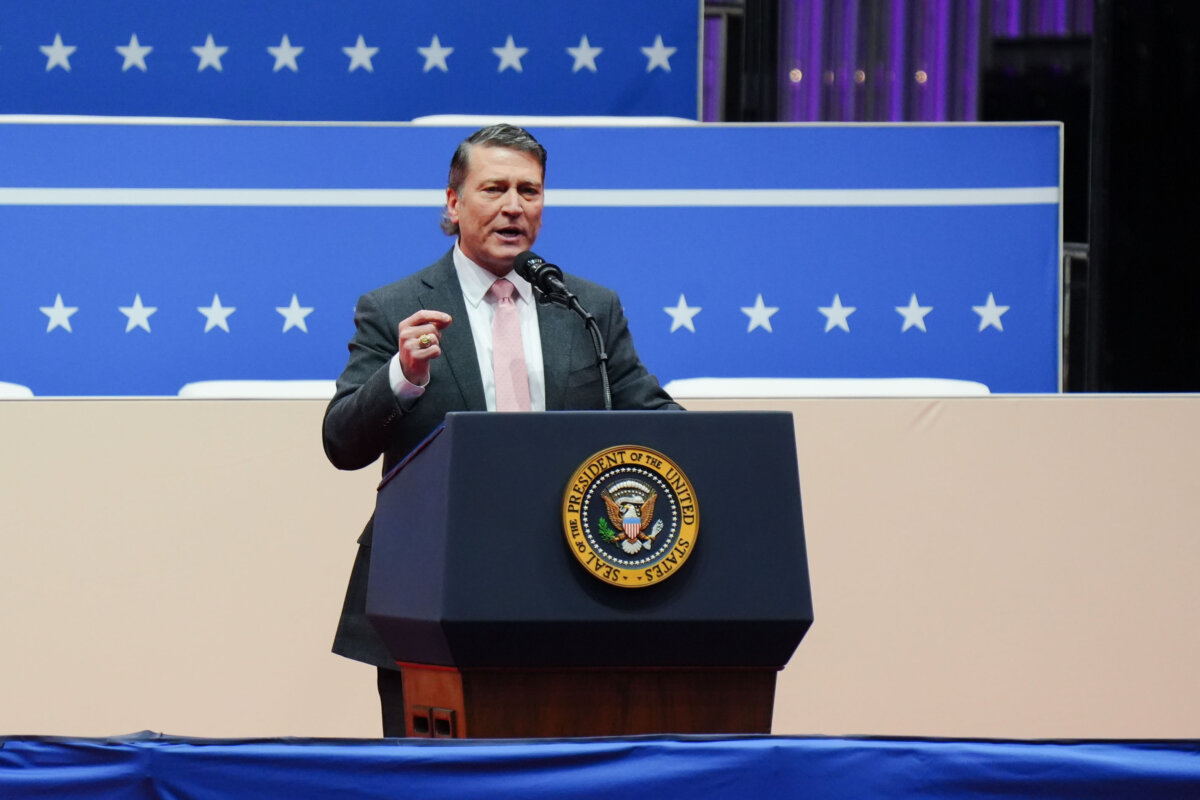
Rep. Ronny Jackson (R-Texas) is leading a bipartisan push for U.S. government sanctions against top ANC leaders. Jackson has introduced a bill in Congress that provides that within 120 days of the bill’s passage, the president will submit to the appropriate congressional committees a classified report containing “a list of senior South African government officials and ANC leaders the President determines have engaged in corruption or human rights abuses.”
In February, Trump stated in an executive order that the ANC’s Expropriation Act empowered Pretoria “to seize ethnic minority Afrikaners’ agricultural property without compensation.”
Trump said the BEE Act “follows countless government policies designed to dismantle equal opportunity in employment, education, and business, and hateful rhetoric and government actions fueling disproportionate violence against racially disfavored landowners.”
The Ramaphosa administration says attacks on white farmers are part of South Africa’s abnormally high rate of violent crime, under which citizens of all racial groups are suffering.
It says the government will only take land that isn’t being used productively, will redistribute it to poor black citizens, and won’t target white farmers.
Mbalula said “certain forces” in the United States are “meddling” in South Africa’s domestic affairs.
He said that the BEE Act and land expropriation are “a sticking point” in Pretoria’s ongoing talks with Trump’s trade representatives.
“The Americans want to use money to try to force us to change policies that make our country more equal, and it is so wrong,” Mbalula said. “We will not bow to the United States and we will not bow to the DA. We will do what is best for our people. Our laws are untouchable and if they want to put sanctions on us, so be it.”
The trade teams in Washington and Pretoria are bound by a nondisclosure agreement that prevents them from commenting to the media, according to Ramaphosa’s spokesperson, Vincent Magwenya.
Steenhuisen said the 30 percent duty will effectively end South Africa’s motor vehicle and fruit exports to the United States, costing it billions of dollars and tens of thousands of jobs.
“The ANC is now facing economic pressure and political pressure because of its failed policies and its untrammeled corruption,” the DA leader told The Epoch Times. “It’s clear that if it continues on the course it’s following, then its leaders will face sanctions. As far as the DA is concerned, we can’t stand by and watch as the ANC’s stubborn behavior and dedication to failed laws destroys our country.”
 Friends Read Free
Copy
Facebook
Tweet
Friends Read Free
Copy
Facebook
Tweet