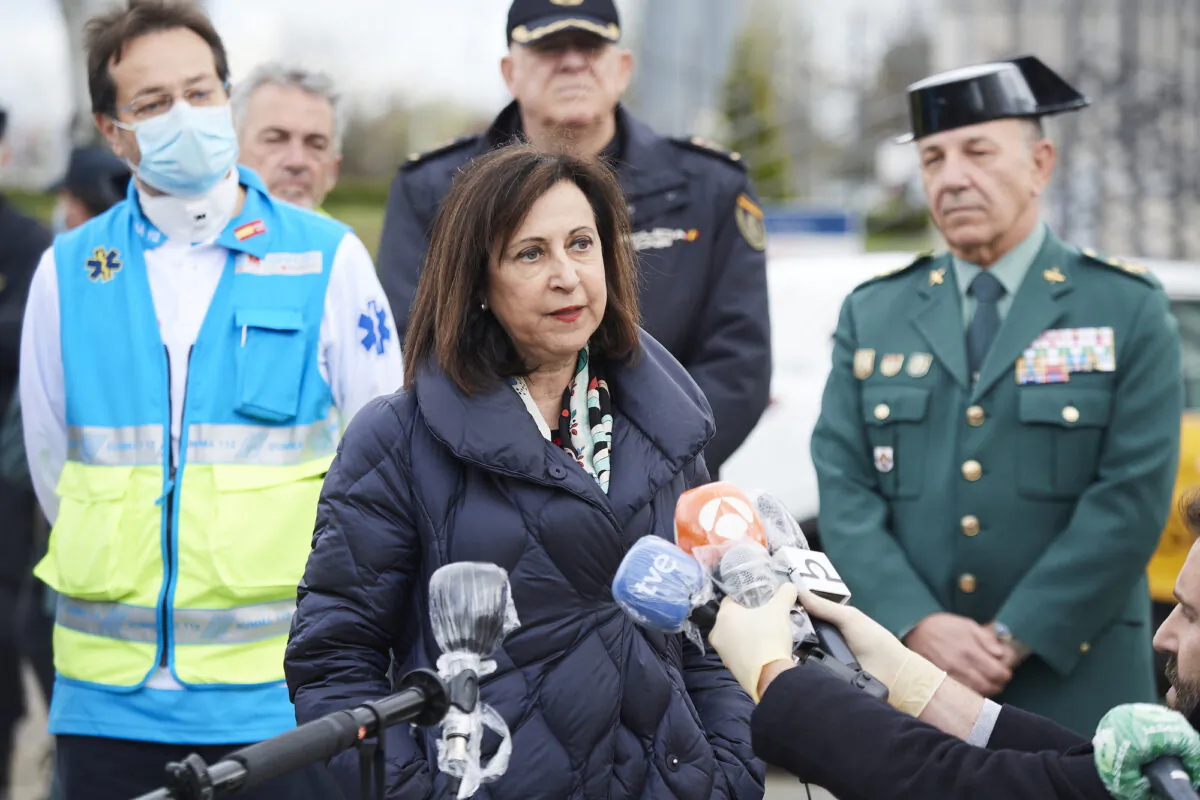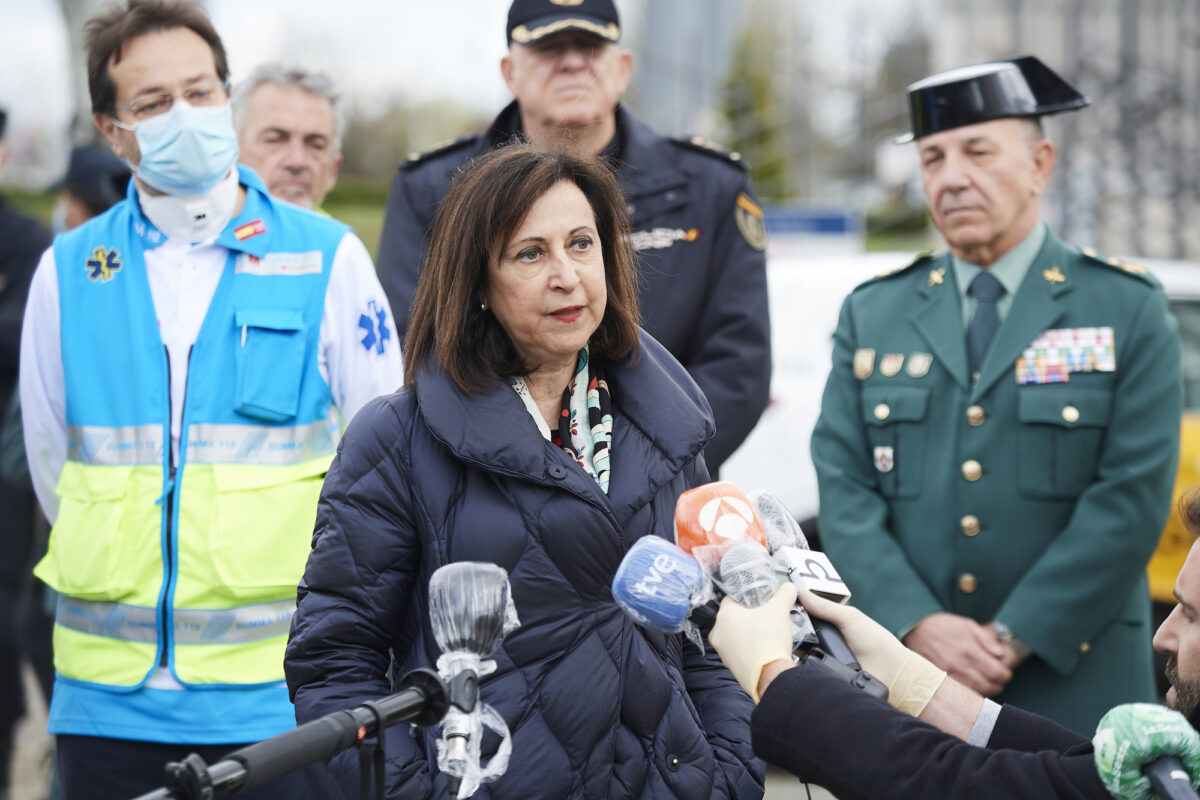

Spain’s government has closed its airspace to U.S. aircraft involved in the conflict with Iran, according to the country’s defense minister, Margarita Robles.
“It’s a very clear position: We are not going to authorize, as we have said at the beginning, the use of Morón and Rota bases for any act related to the war in Iran,” she told reporters in Madrid on March 25.
“And, of course, the use of Spanish airspace.”
That means that Madrid has banned fighter jets and refueling aircraft from using its bases and denied U.S. aircraft operating from third countries access to its airspace.
“This decision is part of the decision already made by the Spanish government not to participate in or contribute to a war which was initiated unilaterally and against international law,” Economy Minister Carlos Cuerpo told Spanish radio station Cadena SER when asked on March 30 whether the latest decision could worsen relations with the United States.
Spanish Prime Minister Pedro Sánchez said on March 25 in Congress that he would pursue such a course of action.
“We have denied the United States the use of the Rota and Morón bases for this illegal war,” he said in comments published in Spanish newspaper El Pais. “All flight plans involving actions related to the operation in Iran have been rejected. All of them, including those of refueling aircraft.”
Sánchez has been one of the most vocal opponents of the Iran war.
“Every bomb that falls in the Middle East hits the wallets of our families,” he told lawmakers in parliament on March 25, adding that Spanish firms are losing 100 billion euros ($116 billion) in less than a month because of the economic damage.
NATO allies have refused support for U.S.-led operations before. For example, France and Germany opposed the Iraq War outright in 2003.
Some other European leaders also do not back the current war.
German Defense Minister Boris Pistorius recently described the Iran conflict as an economic “catastrophe” during a visit to Australia on March 26.
He also said that Germany did not want to be drawn further into the conflict.
“Nobody asked us before. It’s not our war, and therefore we don’t want to get sucked into that war, to make it crystal clear,” he said.
In a March 30 post on X, UK Prime Minister Keir Starmer said, “We aren’t getting dragged into the Middle East conflict.”
Spain hosts two key joint U.S.–Spanish military bases, which operate under the bilateral U.S.–Spain defense cooperation agreement and support NATO operations across Europe, Africa, and the Middle East.
Naval Station Rota serves as a major naval hub for the U.S. Navy’s Sixth Fleet. Morón Air Base in the Andalusia region of Spain is located close to the Mediterranean and the Middle East and operates a long runway and aircraft refueling systems, according to the U.S. Navy.
Both installations remain under Spanish sovereignty but allow a permanent U.S. military presence and are considered among Washington’s most important defense facilities in southern Europe.
Spanish Foreign Affairs Minister José Manuel Albares told Telecinco on March 2 that Spanish military bases would not be used for operations that do not comply with international law.
Washington successfully negotiated with the UK government to use RAF Fairford in Gloucestershire, England, as an alternative European base instead.
U.S. President Donald Trump said on March 3 that he had instructed Treasury Secretary Scott Bessent to sever trade relations with Spain after the country’s leaders blocked the use of their military bases by U.S. forces.
“We don’t want anything to do with Spain,” Trump said.
“The United States Military is meeting or surpassing all of its goals under Operation Epic Fury and does not need help from Spain or anyone else,” a White House official told The Epoch Times by email.
Emel Akan, Evgenia Filimianova, and Reuters contributed to this report.
 Friends Read Free
Copy
Facebook
Tweet
Friends Read Free
Copy
Facebook
Tweet