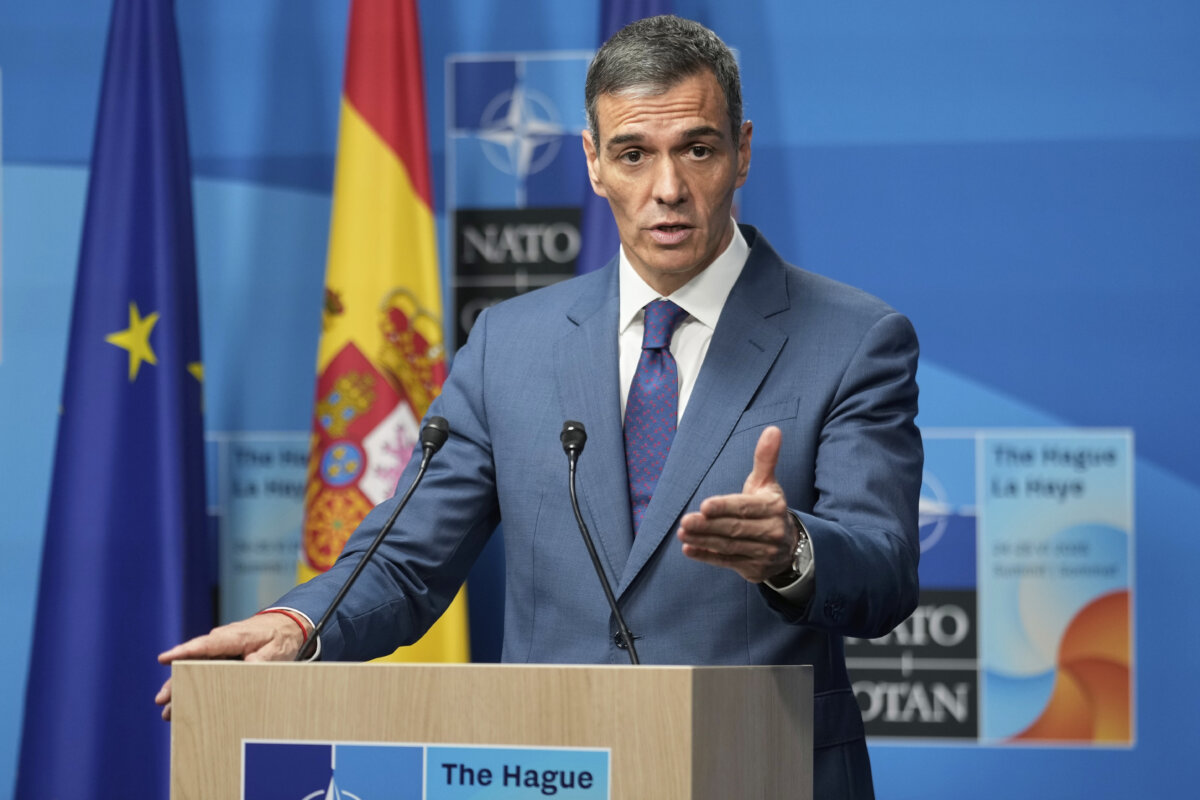

Spain will ban access to social media for minors under the age of 16, Prime Minister Pedro Sanchez said on Feb. 3, outlining what he described as sweeping measures to shield children from harmful online content.
Speaking at the World Governments Summit in Dubai, Sanchez said Spain would require platforms to adopt robust age-verification systems.
“Today, our children are exposed to a space they were never meant to navigate alone, a space of addiction, abuse, pornography, manipulation, violence. We will no longer accept that. We will protect them from the digital Wild West,” he said.
The proposal places Spain among a growing number of countries seeking to curb minors’ access to social media amid mounting concerns over mental health, online exploitation, and disinformation.
In a Feb. 3 post on X, Sanchez described social media as a “failed state.”
“If we want to protect our children, there is only one thing we can do: take back control,” he added.
Sanchez’s announcement comes after Australia’s ban on social media for children under 16 took effect on Dec. 10, 2025. France is debating legislation that would bar children under 15 from social media and prohibit cellphones in high schools starting in September.
In the UK, officials are considering measures including overnight curfews and mandatory breaks to prevent what policymakers describe as “doom-scrolling,” alongside a possible Australian-style ban.
Danish Prime Minister Mette Frederiksen said in October 2025 that her government would ban social media use for children under 15. Similar legislation is being prepared in Norway, while Malaysia has announced plans to introduce a social media ban for under-16s beginning in 2026 as part of broader youth protection measures.
Criminal Liability
Sanchez also said that Spain would hold platform executives personally responsible for certain violations.
Under the proposal, “CEOs of these techno platforms will face criminal liability for failing to remove illegal or hateful content,” he said.
Sanchez said governments must stop ignoring harmful material circulating online.
“I’m here in Dubai to tell you and explain that Spain is walking the talk. We are fighting back, and we will continue to do so. Starting next week, my government will implement the following actions,” he said at the summit.
In addition, Spain plans to classify the manipulation of algorithms and the amplification of illegal content as a new criminal offense.
“Disinformation doesn’t appear by itself. It is created, promoted, and spread by certain actors. We will go after them as well as after the platforms whose algorithms amplify this disinformation for profit. No more hiding behind code. No more pretending that technology is neutral,” he said.
Sanchez also announced what he called a “hate and polarization footprint,” a tracking system designed to measure and expose how digital platforms contribute to division and amplify hateful content.
According to the Spanish prime minister, the tool would serve as the basis for future penalties.
As part of the broader push, Sanchez said his government would work with Spain’s public prosecutor to investigate alleged infringements by Roku, TikTok, and Instagram.
“We will have zero tolerance on this matter, and we will defend our digital sovereignty against any form of foreign coercion,” he said.
The Epoch Times contacted Roku, TikTok, and Meta, but did not receive a response by the time of publication.
The European Commission (EC) is increasing regulatory pressure on major technology companies operating within the European Union.
On Jan. 26, the EC opened a new formal investigation into Elon Musk’s social media platform X, stepping up scrutiny of its artificial intelligence tool Grok over concerns it had been used to create sexualized images of real people.
The probe will assess whether X properly evaluated and mitigated risks associated with the rollout of Grok’s features in the EU, according to the EC’s Jan. 26 announcement.
 Friends Read Free
Copy
Facebook
Tweet
Friends Read Free
Copy
Facebook
Tweet