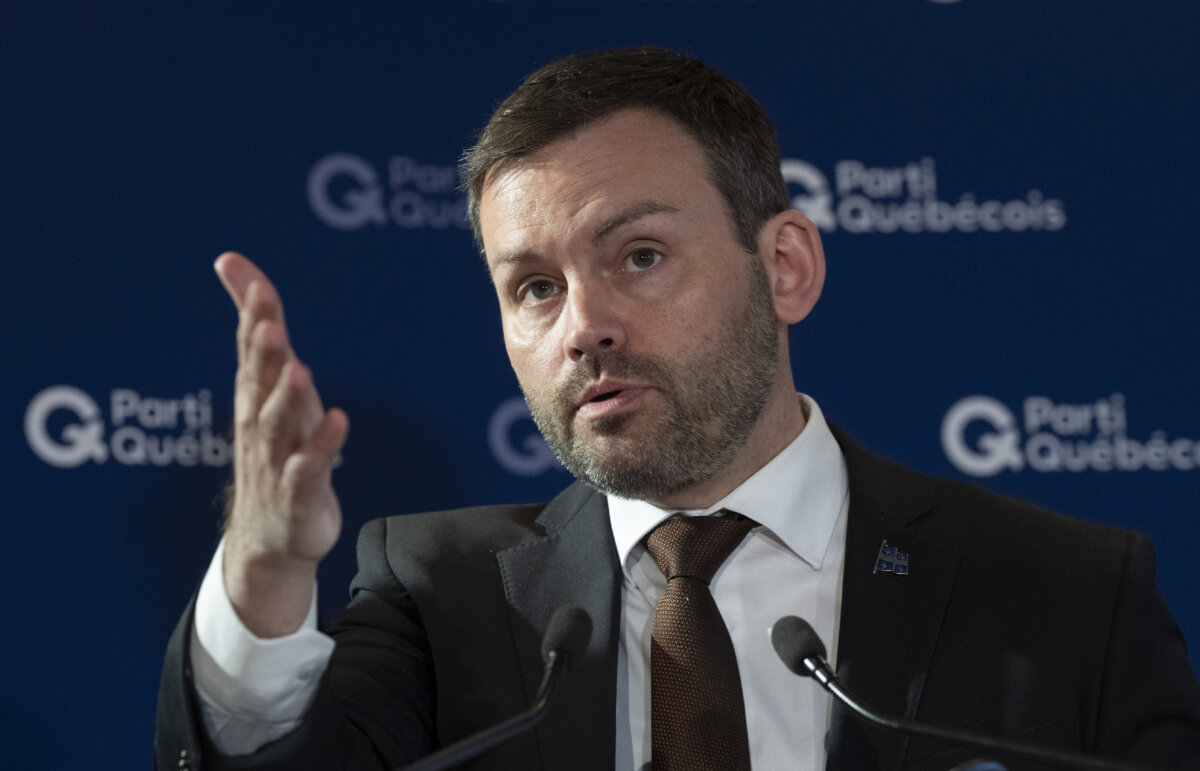
Parti Québécois Leader Paul St-Pierre Plamondon says he suspects Ottawa may be eavesdropping on him and other representatives of his party in a bid to quash the province’s separatist movement.
St-Pierre Plamondon made the comments to reporters in Quebec City on May 12. The PQ leader presented no evidence to back up his concerns, but said they stem from historical precedents.
“If there’s a constant in the history of the Parti Québécois, it’s that its leaders and influential elected officials are being spied on,” St-Pierre Plamondon said. He added that times have changed in the smartphone era, when “taping a recording device” to one’s body is no longer necessary to eavesdrop.
Pressed for more information, St-Pierre Plamondon said his party doesn’t have the means to prove what he says, but it has nonetheless sought unspecified outside expertise.
“We have information, but it’s not something to be shared in public,” he said.
The PQ leader said internal party guidance dictates that when certain sensitive discussions are held, participants put their cell phones in Faraday pouches, which are then placed outside the room. Faraday bags are made with material that blocks the transmission of signals and are designed to protect electronics and privacy.
“We don’t have the means to verify what is taking place, but we’re required to presume the federal government hasn’t changed and is doing that kind of surveillance,” said St-Pierre Plamondon.
The Epoch Times reached out to Public Safety Canada for comment but didn’t immediately hear back. The department oversees the Canadian Security Intelligence Service (CSIS) and the RCMP.
Former Prime Minister Pierre Trudeau reportedly circumvented the RCMP in the 1970s to investigate the activities of Quebec separatists by creating a spy unit within his office. Trudeau was in power during the 1970 October Crisis when separatists kidnapped and killed provincial Liberal minister Pierre Laporte.
St-Pierre Plamondon has pledged to organize a third referendum on separation if his party forms government after the October election.
He said federal scrutiny of his party has always ramped up ahead of referendums. The first one was held in 1980 under Premier René Lévesque, and a second one in 1995 under Premier Jacques Parizeau.
The PQ has been leading in the polls for an extended period but the Liberals gained ground each time they selected a new leader.
Former federal cabinet minister Pablo Rodriguez was picked as Quebec Liberal leader in June 2025, but stepped down six months later amid allegations of wrongdoing in his campaign. He has denied involvement.
Liberal support fell during this episode but climbed back after Charles Milliard became leader by acclamation in February. A Léger poll from April gives the PQ 31 percent of the voting intention, against 28 percent for the Liberals.
The ruling CAQ has also climbed back after Premier François stepped down and was replaced by Christine Fréchette. The CAQ polled in third place with 17 percent of voting intention in the Léger survey, followed by the Quebec Conservatives at 14 percent, and Québec solidaire at 8 percent.
Quebec’s provincial election is scheduled for Oct. 5.
 Friends Read Free
Copy
Facebook
Tweet
Friends Read Free
Copy
Facebook
Tweet