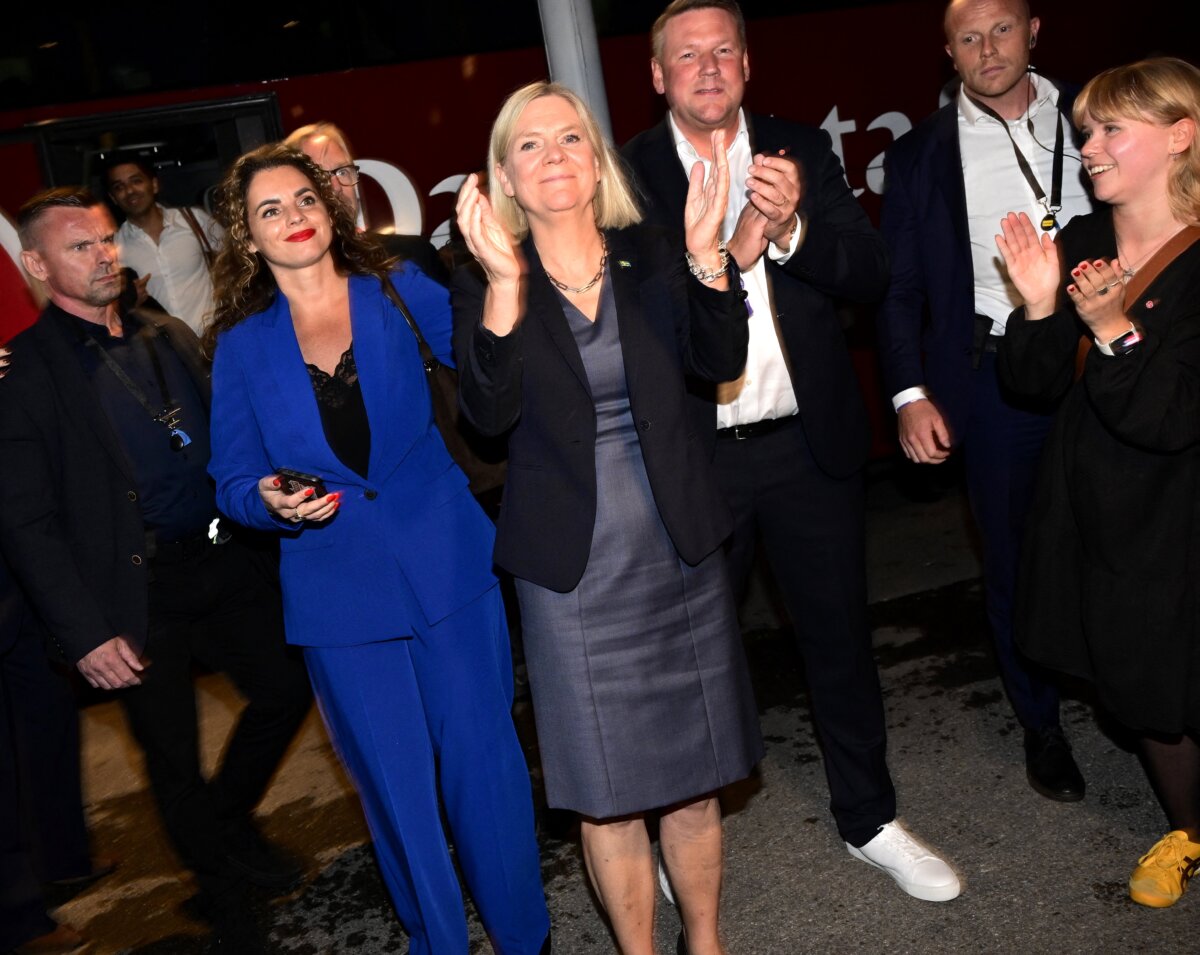

STOCKHOLM—Exit polls from Sweden’s general election show the left-wing opposition, led by the Social Democrats of former Prime Minister Magdalena Andersson, leading the governing bloc of Prime Minister Ulf Kristersson.
An exit poll by Swedish public broadcaster SVT on Sunday projected that the four parties backing Andersson would secure a parliamentary majority at 51.3 percent, potentially clearing the way for her return as prime minister following coalition negotiations.
The projection, however, is not definitive. Swedish exit polls have occasionally differed from the final result.
In 2022, an exit poll initially gave Andersson’s bloc the advantage, only for the final count to deliver victory to the right-wing parties led by Kristersson, who subsequently became prime minister.
Sweden has been governed by the Social Democrats for much of the period since the 1930s. Andersson held the premiership from 2021 until her party was voted out in 2022.
The final polls published Friday all gave the left-wing opposition an edge, though the gap varied widely, from just 0.3 percentage points in an Ipsos survey for Dagens Nyheter to 5.6 points in Verian’s poll for public broadcaster SVT. That marked a significant tightening of the race after the opposition’s lead had reached as much as 10 points three weeks earlier.
Should Kristersson’s bloc ultimately prevail, the anti-immigration Sweden Democrats, projected at 17.2 percent in SVT’s exit poll, would enter government for the first time.
In 2022, the Moderates, Sweden Democrats, Christian Democrats, and Liberals won a razor-thin majority of 176 seats to 173, ending eight years of Social Democratic-led government after years of mounting concern over immigration, gang violence, and crime. The Sweden Democrats won 20.5 percent of the vote, overtaking the Moderates to become the country’s second-largest party behind the Social Democrats, who took 30.3 percent.
The resulting Tidö Agreement allowed the Sweden Democrats to shape government policy while remaining outside the Cabinet.
After taking office, Kristersson told Parliament that “a paradigm shift is now taking place in Swedish migration policy” and pledged that his government would “launch the largest offensive against organized crime in Swedish history.”
His government moved to tighten asylum rules toward the EU minimum, reduced Sweden’s annual refugee resettlement quota from 5,000 to 900, and in June secured parliamentary approval for a requirement that government agencies report people believed to be living in the country without a legal right to stay.
Since Jan. 1, immigrants who voluntarily return to their country of origin have also been eligible for grants of up to 350,000 kronor, or about $36,100, per adult and 600,000 kronor per household.
Migration Minister Johan Forssell said in January that asylum applications had fallen 30 percent in 2025 to 6,735, the lowest level since 1985. Asylum seekers and their relatives accounted for 6 percent of immigration, down from 31 percent in 2018, while more people left Sweden than arrived for a second consecutive year.
Gang Crime
Crime policy underwent a similar shift.
The Tidö parties introduced “safety zones,” in which police can search people without individualized suspicion, while expanding electronic surveillance and toughening criminal penalties.
On Aug. 13, the Riksdag voted 281–66, with support from the Social Democrats, to lower the age of criminal responsibility from 15 to 14 for offenses carrying prison sentences of at least four years. The measure took effect on Sept. 10, just three days before the election.
The crackdown coincided with a sharp decline in gun violence.
Shootings fell from 390 in 2022 to 147 in 2025. Police recorded just 39 shootings in the first half of 2026, the lowest figure for any six-month period since records began in 2017.
Police have credited new investigative tools and working methods for some of the improvement, while cautioning that conflicts between criminal networks remain intense and that efforts to prevent gangs from recruiting new members have made less progress.
The National Council for Crime Prevention recorded 84 homicides in 2025, eight fewer than the previous year and the lowest total since 2012.
Yet the issues on which the government could point to some of its clearest results were no longer necessarily those dominating voters’ concerns.
In Verian’s August survey for SVT, 64 percent of voters named healthcare as one of their most important issues, with schools and elderly care close behind. Law and order had fallen in importance compared with 2022, while energy had dropped to ninth place.
Andersson focused her campaign on those concerns, promising more money for ordinary earners, shorter healthcare waiting times, and smaller school classes. At the same time, the Social Democrats maintained a restrictive line on migration and pledged to restore safety “on streets and squares.”
From Nothing to Kingmaker
The election also marked another stage in the Sweden Democrats’ transformation from an isolated protest party into one of the central forces of Swedish politics.
Founded in 1988 by activists including figures from the nationalist Keep Sweden Swedish movement, the party entered Parliament for the first time in 2010, winning 5.7 percent of the vote under Åkesson, who has led it since 2005.
Its 2026 platform, titled “We Are Making Sweden Sweden Again,” calls for keeping asylum immigration at the lowest possible level, deporting foreign nationals convicted of serious crimes, continuing incentives for voluntary “remigration,” and expanding the circumstances under which citizenship can be revoked from naturalized Swedes convicted of crimes.
 Friends Read Free
Copy
Facebook
Tweet
Friends Read Free
Copy
Facebook
Tweet