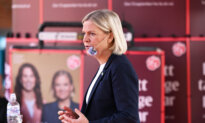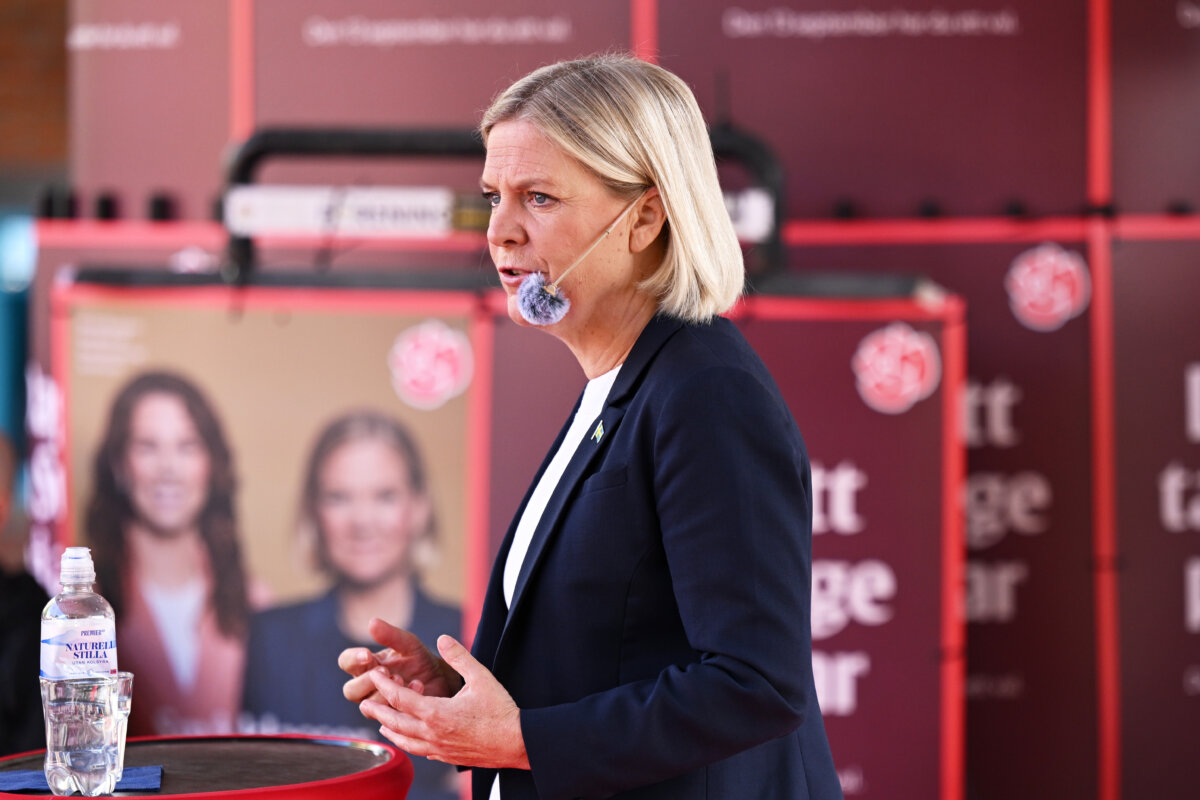

Swedish Social Democratic leader Magdalena Andersson said she did not have enough support to form government on Sept. 28, after 15 days of negotiations with the opposition left-wing bloc that secured a narrow majority in the election.
Andersson, whose party won the most votes but not enough to secure a majority government, said she was returning her mandate to form government to the speaker of Sweden’s parliament after failing to reach an agreement with the Left Party, the successor to Sweden’s former communist party.
The Left Party had previously said it would only support Andersson as prime minister under conditions acceptable to the party.
Speaker Andreas Norlén of the Moderate Party, reelected with support from the Left Party over a Social Democrat candidate, said he would meet with party leaders on Sept. 30 to decide who should receive the next mandate to try to form a government.
The Arithmetic Behind the Deadlock
The Sept. 13 election left the Social Democrats, Left Party, Centre Party, and Greens with a slim 176-seat majority in the 349-seat Riksdag. The Moderates, Sweden Democrats, Christian Democrats, and Liberals, which made up Prime Minister Ulf Kristersson’s outgoing right-wing governing bloc, won a combined 173 seats.
The Social Democrats remained the largest party in parliament with 99 seats. Kristersson, whose party won 62 seats, is currently heading a caretaker government.
The three-seat advantage has not translated into an agreement to form a government for the left. The Left Party is seeking cabinet positions, while the Centre Party has ruled out participating in a government that includes Left Party ministers.
Centre Party leader Elisabeth Thand Ringqvist said on Sept. 28 that her party had received a mandate from voters to support a centrist government “without either the Sweden Democrats or the Left Party.”
Ludvig Aspling, a Sweden Democrat member of parliament, told The Epoch Times that while the Social Democrats built much of their campaign around Andersson’s ability to lead, events since the election show how these claims were never going to hold up.
“She couldn’t get her candidate for speaker elected, and her supposed coalition is in a state of civil war,” he said.
Aspling said Kristersson’s failure to assemble a government was because the Centre Party would rather give up the majority than accept Left Party ministers, while the Left Party is reluctant to abandon its demands.
“We are probably looking at a hung parliament and another election,” he said.
Nima Gholam Ali Pour, another Sweden Democrat lawmaker, told The Epoch Times that the impasse was foreseeable.
“Ultimately, the red-green parties will have to form a government,” he said. “Otherwise, they will lose a snap election.” An extraordinary election must be held within three months if the parliament fails to elect a prime minister after four votes.
Fraud Allegations Under Investigation
Meanwhile, authorities are looking into alleged electoral fraud in several parts of the country.
On Sept. 25, Stockholm police said they had opened preliminary investigations into five complaints in the capital region, two of them involving suspected vote-buying. They have not released any further details about those involved in the allegations.
In Borlänge, in central Dalarna, the Swedish Prosecution Authority’s anti-corruption unit is investigating suspected “improper influence during voting” in a case linked to the Left Party. Mohamed Abdukardir Ali unexpectedly jumped ahead of others on the party’s ballot through personal votes and won a seat.
Ali has denied any wrongdoing. The Left party said it agreed with Ali that he would take a leave of absence from parliament while the accusations are being investigated.
“I want to be clear that my leave application does not mean that I am resigning from my assignment, nor should it be interpreted as an admission of guilt,” he wrote on social media.
Prosecutors say the investigation is still at an early stage and that no one has been formally notified of suspicion.
The Election Review Board can order a recount or a new election in Dalarna, which sends 11 lawmakers to parliament, if it concludes that irregularities undermined the reliability of the result. That possibility keeps the final outcome in flux: a rerun of those 11 seats could shift the balance toward the right-wing bloc.
 Friends Read Free
Copy
Facebook
Tweet
Friends Read Free
Copy
Facebook
Tweet