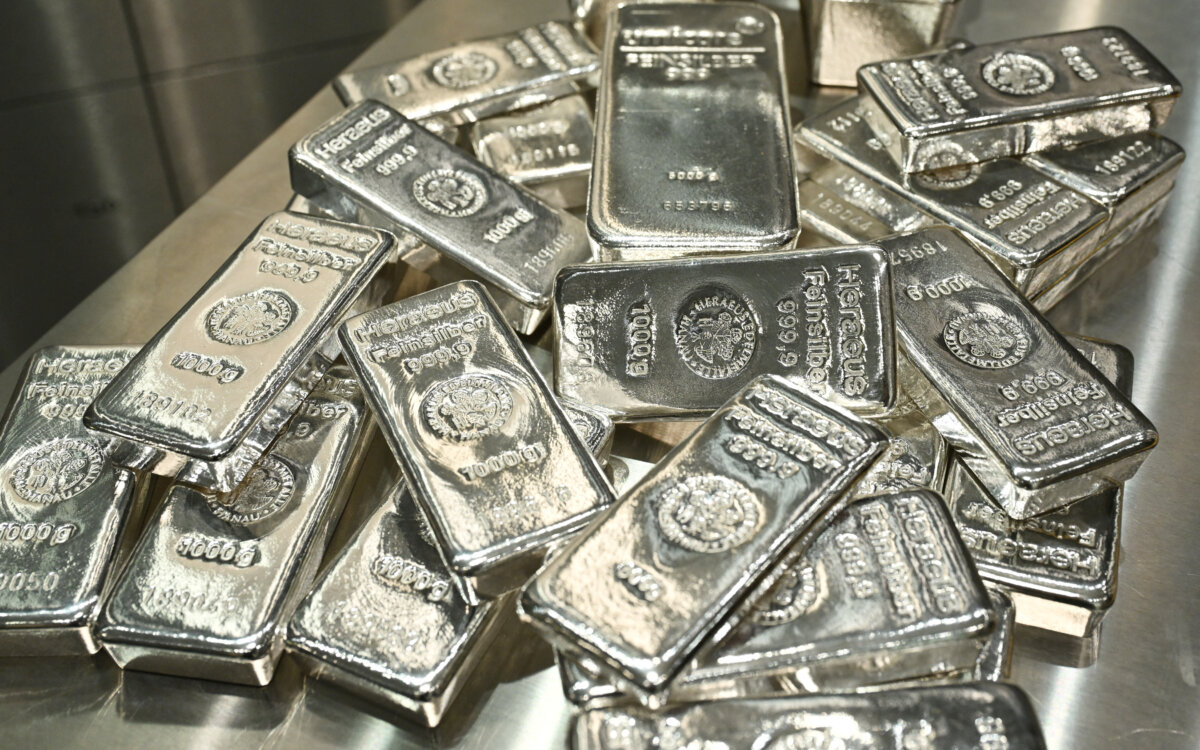

TD Securities has been forced to close its silver short position at a “theoretical loss” of $606,000 on Jan. 15 after the price hit its stop-loss of $93.15 per ounce.
Daniel Ghali, senior commodity strategist at TD Securities, had announced on Jan. 7 in its commodities portfolio update that the bank was entering a short position on silver at $78, anticipating it would fall to $40 an ounce as “silver’s devilish blow-off top comes to completion.” Ghali set a “stop-loss” at $93.15, meaning the bank’s position would automatically be sold when it hit that level in order to minimize losses.
The price of silver rose by 142 percent in 2025, marking its best year since 1979, but it had fallen from $82 to $78 on Jan. 7.
Ghali wrote that silver’s price action since October had been due to continued liquidity restraints and arbitrage opportunities ahead of U.S. President Donald Trump’s upcoming decision on Jan. 19, 2026, on whether to impose Section 232 tariffs on critical minerals like rare earths, lithium, and silver. Trump announced on Jan. 14 that he had decided against imposing these tariffs, and had instead ordered his administration to seek supplies from international trading partners, which sent silver falling.
Ghali said the bank expected “large-scale selling activity” to happen because of high open interest on silver at 13 percent, as well as poor liquidity that would lead to larger price declines. Since that portfolio update, silver has risen to over $92.
In Ghali’s Jan. 15 portfolio update, he said there was “significant” institutional selling of silver that totalled about $7 billion, but prices did not fall because new buyers absorbed the selling pressure. Ghali said these new long positions on silver are “vulnerable,” but sentiment would need to shift for the price to fall. “Silver markets have progressed beyond rational momentum over the last months, but an inflection point could be on the horizon,” Ghali said.
He added that TD Securities has “high conviction” that concerns about a silver shortage will soon deteriorate, with physical silver vaults in London—where wholesale silver trades between banks and corporations are settled—being restocked with 430 million ounces of silver from Comex warehouses in New York.
In October, TD Bank also incurred a $2.4 million loss shorting silver, as it entered a short as the precious metal’s price was breaking above $50 an ounce. In early September, the bank closed out its long position in gold and made $3 million in profits.
Silver Projections
Bank of America’s Head of Metals Research Michael Widmer recently projected that silver prices could peak at between $135 and $309 in 2026. Morgan Stanley also said there would be an “upside risk for silver” in 2026 due to China’s export license requirements for the metal.
In October 2025, China’s Commerce Ministry announced it would impose new restrictions on the export of rare earth metals. Then in December, China released a list of 44 companies that would be approved to export silver under the new measures beginning in 2026, which sent silver prices higher.
The new policy also formally elevated silver from an ordinary commodity to a strategic material, putting its export controls under the same regulatory scheme as rare earth minerals. In November, the United States also added silver to its nationally designated list of critical minerals.
In addition to historically being used as currency, silver also has industrial applications for solar panels, electric vehicles, batteries, and advanced military equipment like missiles and drones. The majority of silver is produced as a byproduct of copper and lead-zinc mines.
Silver’s rising price led two Chinese companies to contact a Canada-based silver mining and exploration company in late December, attempting to buy physical silver at $8 higher than its market price. Kuya Silver CEO David Stein told The Epoch Times that an Indian buyer also recently approached his company looking to buy physical silver at premiums of more than $10.
 Friends Read Free
Copy
Facebook
Tweet
Friends Read Free
Copy
Facebook
Tweet