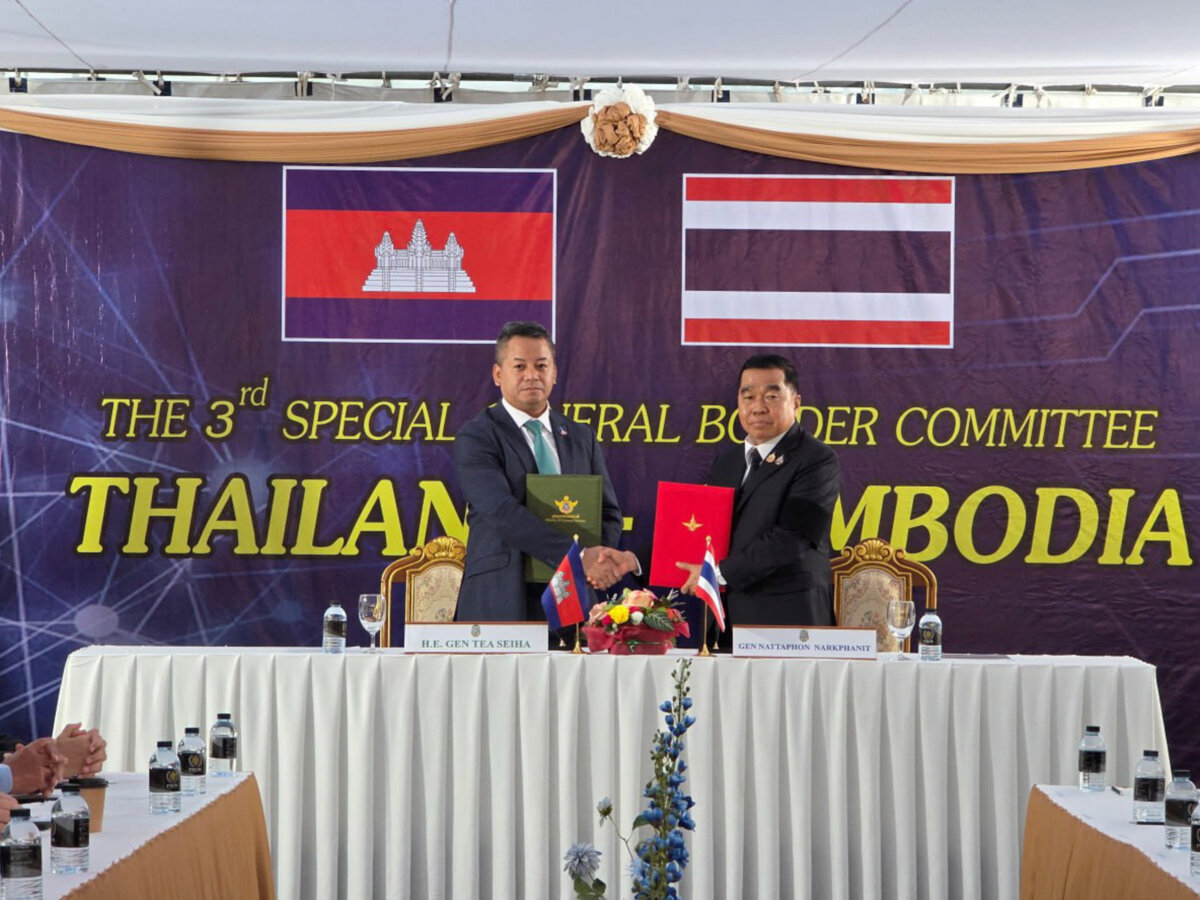

Thailand and Cambodia signed a cease-fire agreement on Dec. 27, putting an end to weeks of border clashes, the deadliest in years between the two Southeast Asian countries, with airstrikes, rocket exchanges, and artillery fire.
The deal, which became effective at noon local time, requires both sides to hold current troop positions without advances, according to a joint statement from their defense ministers.
“Both sides agree to maintain current troop deployments without further movement,” the statement said. “Any reinforcement would heighten tensions and negatively affect long-term efforts to resolve the situation.”
The agreement was signed by Thai Defense Minister Natthaphon Narkphanit and his Cambodian counterpart, Tea Seiha, concluding 20 days of violence that has taken at least 101 lives and displaced more than 500,000 people from their homes.
The fighting erupted anew in early December after the collapse of a previous cease-fire that U.S. President Donald Trump had helped negotiate in July to halt an earlier outbreak of hostilities.
That July truce, described as immediate and unconditional, was brokered during talks in Malaysia mediated by the country’s prime minister, Anwar Ibrahim, who chairs the Association of Southeast Asian Nations (ASEAN). At the time, fighting had already led to at least 35 deaths and the evacuation of more than 260,000 residents along the 500-mile border.
Trump held separate phone calls with acting Thai Prime Minister Phumtham Wechayachai and Cambodian Prime Minister Hun Manet, during which he called for an “immediate cease-fire.” He later said the leaders desired an end to the violence after he gave an ultimatum that he would withhold potential trade deals with the United States unless the fighting stopped. Trump called the discussions “very good” and highlighted that both sides were aiming for a resolution.
Manet nominated Trump for the Nobel Peace Prize in August, which was backed by 70,000 Buddhist monks in Cambodia who praised his role in stopping the earlier conflict.
In mid-December, Thai and Cambodian forces were fighting at multiple points along their 508-mile shared border. Thailand cut fuel shipments through a Laos border checkpoint, highlighting fears that supplies could be diverted to Cambodian military units.
Officials from both countries expressed hope that the new cease-fire would pave the way for diplomatic talks to address underlying issues.
The violence drew international concern, including calls for an end to fighting from regional powers and the United Nations. Monitors from ASEAN are expected to deploy to verify compliance, continuing its involvement in bringing the conflict to an end.
Reuters contributed to this report.
Correction: A previous version of this article misspelled the name of Thai Defense Minister Natthaphon Narkphanit. The Epoch Times regrets the error.
 Friends Read Free
Copy
Facebook
Tweet
Friends Read Free
Copy
Facebook
Tweet