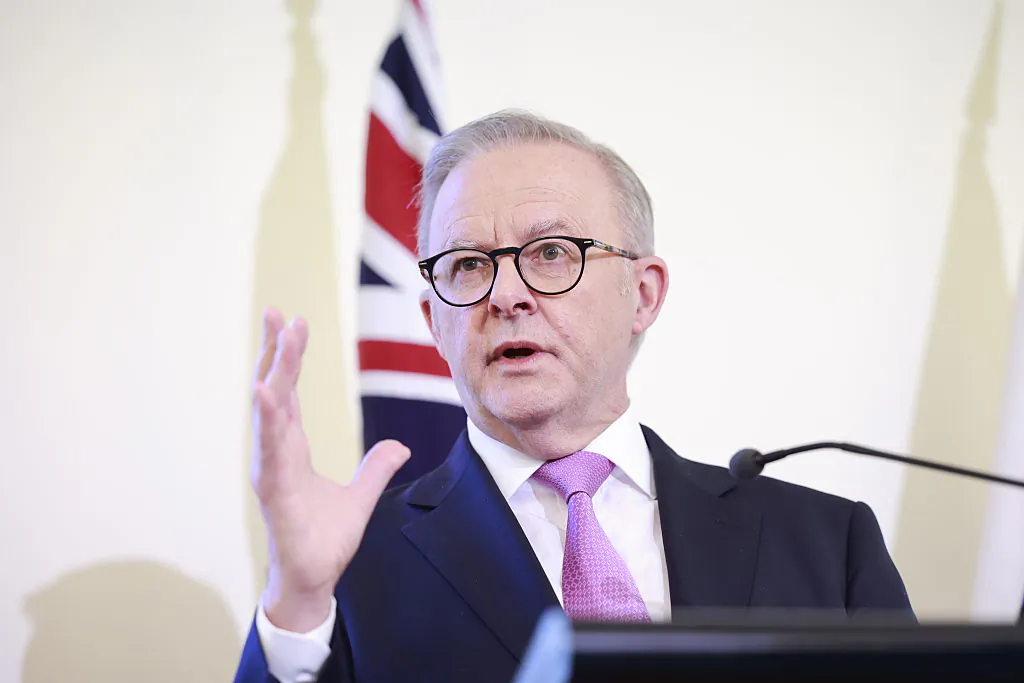

Prime Minister Anthony Albanese says Australia will make its own decisions on defence spending amid a call to arms from the United States.
This comes after U.S. Defense Secretary Pete Hegseth asked Australia to lift its defence investment to 3.5 percent of gross domestic product (GDP) as soon as possible during the Shangri-La Dialogue in Singapore.
When asked about the request from the United States, Albanese indicated that Australia would make its own strategic decisions and pointed to the government’s 2.3 percent defence spending target.
“What you should do in defence is decide what you need, your capability, and then provide for it. That’s what my government’s doing. Investing in our capability and investing in our relationships,” Albanese told reporters on June 2.
“We’ve provided an additional $10 billion of investment into defence over the forward estimates. We’re continuing to lift up, that adds up to 2.3 percent of GDP is where defence spending will rise.”
Albanese’s latest comments come after he said on June 1, “What we’ll do is we’ll determine our defence policy” when asked about the request from the United States.
In the 2025-26 federal budget, the Albanese government promised that “defence funding will exceed 2.3 percent of GDP by the early 2030s.” This falls considerably short of Hegseth’s request.
Earlier in 2025, Undersecretary of Defense Policy Elbridge Colby told a U.S. Senate Armed Services Committee that Australia should lift its spending to at least 3 percent of GDP.
“Australia is a core U.S. ally. It has the right strategic approach as reflected in its strategic documents. The main concern the United States should press with Australia, consistent with the president’s approach, is higher defense spending,” Colby said in the formal questionnaire submitted as part of his nomination process (pdf).
“Australia is currently well below the 3 percent level advocated for NATO by NATO Secretary General Rutte, and Canberra faces a far more powerful challenge in China.”
Can’t Leave it to the US Alone
Hegseth said he looks forward to continuing to work with Deputy Prime Minister Richard Marles to maintain peace through strength in the Indo-Pacific.
“Secretary Hegseth and Deputy Prime Minister Marles discussed aligning investment to the security environment in the Indo-Pacific, accelerating U.S. force posture initiatives in Australia, advancing defense industrial base cooperation, and creating supply chain resilience,” a readout from the Pentagon said.
Marles welcomed Hesgeth’s reaffirmation that the Indo-Pacific remains the United States’ strategic priority.
“The reality is that there is no effective balance of power in this region absent the United States. But we cannot leave this to the U.S. alone,” he said in an address to the Shangri-la Dialogue.
“Other countries must contribute to this balance as well, including Australia.
“Our government is making a generational investment into defence, and we will continue to make further funding decisions based on the assets and capabilities we need to play our part and to meet the strategic moment.”
Marles attended the Shangri-La Dialogue in Singapore from May 30 to June 1, along with global leaders and defence officials.
Other notable attendees included French President Emmanuel Macron, Malaysian Prime Minister Anwar Ibrahim, and Singapore Defence Minister Chan Chun Sing.
During his speech, Marles said Australia cannot be complacent in the Indo-Pacific while war and disorder rage in European and Middle Eastern theatres.
He also raised concerns that Beijing had embarked on the “largest conventional military build-up” since World War II.
“It is doing so without providing any strategic transparency or reassurance. And this remains a defining feature of the strategic complexity that the Indo-Pacific and the world faces today,” Marles said.
The deputy prime minister also talked up AUKUS, the trilateral security partnership between Australia, the United Kingdom and the United States.
“Australia acquiring a nuclear-powered submarine capability under the banner of AUKUS is essential to our national security and will play a part in providing geostrategic balance in the Indo-Pacific,” Marles said.
 Friends Read Free
Copy
Facebook
Tweet
Friends Read Free
Copy
Facebook
Tweet