
In-Depth
As the federal government greenlit the sale of two Canadian companies operating in the sensitive areas of satellite and laser technologies to Chinese firms in 2017, U.S. lawmakers urged Ottawa to be “more vigilant” when it comes to national security issues involving the Chinese Communist Party.
Later, in 2019, as most of Canada’s partners in the Five Eyes intelligence alliance blocked China’s Huawei from their 5G networks and Ottawa didn’t follow suit, then–U.S. Secretary of State Mike Pompeo threatened that his country would hold back intelligence sharing with any partner that kept Huawei in its critical infrastructure.
Canada ultimately banned Huawei equipment in 2022, aligning with its allies. And in recent years, with China’s increasingly aggressive stance on the world stage, and as more reports of China’s interference in the West emerges, Ottawa has stepped up efforts to restrict the operations of Chinese entities in Canada.
A 2021 House of Commons report says national security risks related to foreign investment in Canada frequently involve China. The report cites testimony from Charles Burton, a senior fellow of the Macdonald-Laurier Institute, who says Chinese companies often work in concert with the regime’s military and intelligence apparatuses to further Beijing’s goals.
He added that all Chinese firms, under the Investment Canada Act, meet the definition of a state-owned enterprise, given their close links to the Chinese Communist Party (CCP).
Meanwhile, Canada’s national security efforts have extended into the education sector, with Ottawa ending all research funding in February 2023 for projects where any of the researchers is “affiliated with a university, research institute or laboratory connected to military, national defence or state security entities of foreign state actors that pose a risk to our national security.”
The move came after reports that researchers from some 50 universities in Canada had been collaborating with one of China’s top military institutions on research ranging from quantum cryptography to photonics to space science.
Here is a look at some of the Chinese companies that have come under scrutiny or faced restrictions in Canada.
Hikvision
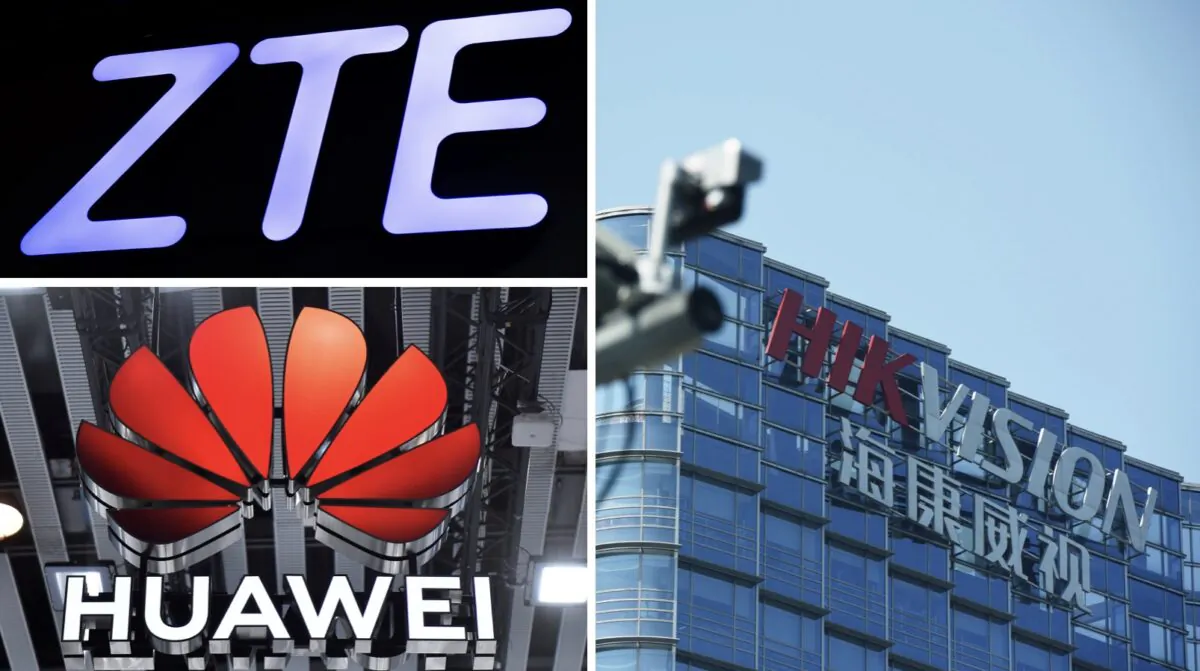
Ottawa’s recent decision to shut down Chinese surveillance camera company Hikvision over national security concerns marks the latest in a series of federal actions aimed at protecting Canada from threats posed by companies with ties to the Chinese regime.
Hikvision had already faced sanctions in other countries, including the United States, the UK, and Australia over privacy and security threats stemming from its ties to the CCP.
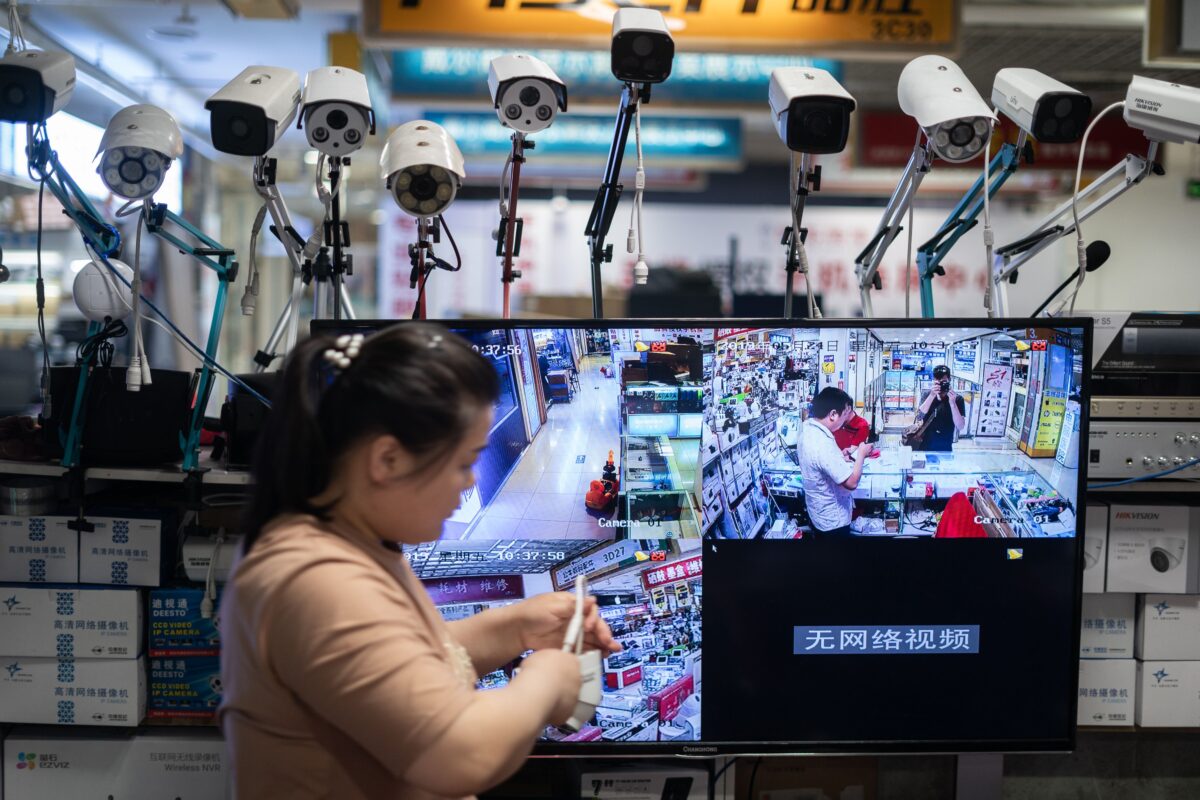
Industry Minister Mélanie Joly said on June 27 that Ottawa’s decision resulted from a national security review which determined that Hikvision’s continued operations in Canada would be “injurious to Canada’s national security.”
The company has called the allegations “unfounded,” saying its products comply with all applicable Canadian laws and regulations and that Ottawa’s decision reflects an “unjustified bias” against Chinese companies. It has also filed for a judicial review of the government’s order.
Hikvision is partly owned by the Chinese regime. In 2020, the U.S. Department of Defence categorized the company as having ties to the Chinese military, an allegation Hikvision has denied.
Then in 2022, the U.S. Federal Communications Commission banned authorizations for the import or sale in the United States of equipment made by Hikvision and a number of other Chinese companies, saying that they posed an “unacceptable risk to national security of the United States or the security and safety of United States persons.”
In a similar move, the UK government in 2022 banned its departments and agencies from buying new Chinese closed-circuit television (CCTV) video surveillance cameras, including Hikvision cameras, over security concerns. Australia followed suit in 2023, ordering the removal of surveillance cameras made by Hikvision and another Chinese firm from government sites.
Hikvision has also faced international scrutiny over its alleged involvement in human rights violations in China’s northwestern region of Xinjiang, reportedly supplying surveillance equipment to the Chinese regime for the suppression of Uyghur Muslims. These human rights concerns prompted the U.S. Commerce Department to place Hikvision on a trade blacklist in 2019.
TikTok
In a move similar to its action on Hikvision, Canada last November ordered Chinese social media app TikTok to close its Canadian offices. Then-Industry Minister François-Philippe Champagne said the decision resulted from a “multi-step national security review.”
“The decision was based on the information and evidence collected over the course of the review and on the advice of Canada’s security and intelligence community and other government partners,” Champagne said on Nov. 6, 2024.
TikTok has challenged the order in court.

Ottawa had earlier banned TikTok from government devices in 2023, saying it presented “an unacceptable level of risk to privacy and security.” It noted that, on a mobile device, the app’s data collection methods provided “considerable” access to the contents on the phone, and that Ottawa was committed to keeping government information secure.
In his 2024 announcement, Minister Champagne said the government would not ban the app, indicating it was a personal decision for Canadians to make as to whether they wished to continue using it. However, he urged users to exercise caution and understand how their personal information could be managed, used, or shared by foreign actors.
Former FBI director Christopher Wray has said the app poses national security concerns.
“They include the possibility that the Chinese government could use it to control data collection on millions of users or control the recommendation algorithm, which could be used for influence operations if they so chose, or to control software on millions of devices which gives it opportunity to potentially technically compromise personal devices,” he said back in 2022.
Huawei and ZTE
Canada banned Chinese telecommunications companies Huawei and ZTE from its 5G wireless infrastructure in May 2022, saying it had “serious concerns” over those companies complying with directions from foreign governments that could be “detrimental” to Canadian interests.
“There are many hostile actors who are ready to exploit vulnerabilities in our defences. We must redouble our efforts,” then-Public Safety Minister Marco Mendicino said.
Concerns about Huawei stem from allegations of illegal data collection, industrial espionage, and ties to the Chinese regime. A 2021 report from a research institute affiliated with the French Ministry of Armed Forces described Huawei as playing a key role in the Chinese Communist Party’s long-running influence operations in the West.
Ren Zhengfei, Huawei’s founder and a former member of China’s People’s Liberation Army, has denied allegations that his company spies for Beijing, saying that his political beliefs are separate from his business activities.
Meanwhile, the December 2018 arrest of Huawei executive Meng Wanzhou—Ren’s daughter—in Vancouver on a U.S. extradition order over charges including bank fraud marked a turning point in Canada-China relations, straining diplomatic ties ever since.
Following her placement under house arrest, China arbitrarily detained Canadians Michael Spavor and Michael Kovrig in a move widely seen as retaliation. The two were released from detention in China in September 2021, shortly after Meng was released from house arrest in Canada.
Dissolution of Two Tech Firms
Ottawa last year ordered two B.C.-based tech firms to cease operations, citing national security concerns. One of them, Bluvec Technologies Inc., was found by a B.C. court in 2023 to have supplied stolen technology to a China-based company.
Then-Industry Minister Champagne said the dissolution order resulted from a “multi-step national security review process” but did not provide details on how both companies threatened national security.
“The government’s decisions are based on facts and evidence and on the advice of Canada’s security and intelligence community and other government partners,” he said in a May 24, 2024, statement.
The founder and CEO of Bluvec Technologies, Junfeng (Jack) Jia, worked in China’s security research and software development industry before moving to Vancouver more than a decade ago, according to his LinkedIn page. He founded Bluvec in 2018.
Jia earned a bachelor’s degree in nuclear technology from the National University of Defense Technology, a top military academy in China affiliated with Beijing’s Central Military Commission. That university is the premier scientific research and educational institution of the Chinese People’s Liberation Army, according to defence and strategic policy think tank the Australian Strategic Policy Institute.
In 2023, the B.C. Supreme Court ruled that Bluvec got anti-drone source code from B.C.-based competitor Skycope Technologies Inc. and incorporated it into its direction-finding technology, later selling the tech to China-based company Lizheng Technology Co. Inc. Bluvec, Jia, and another defendant were ordered to pay Skycope $800,000 in general damages for misuse of Skycope’s confidential business information.
The second B.C. company ordered to cease operations was Pegauni Technology Inc., an IT services and consulting firm about which little public information is available. Its website is inactive. Like Bluvec, it was founded in 2018 and was headquartered in Burnaby, a Metro Vancouver city located just east of the City of Vancouver.
According to B.C. corporate registry records obtained by the Vancouver Sun, Bluvec’s CEO Junfeng Jia is listed as CEO and sole director of Pegauni.
Chinese Companies Ordered to Divest From Canada’s Critical Minerals
Following another national security review, this time of foreign investments in Canadian companies in the critical minerals sector, Ottawa in 2022 ordered three Chinese companies to sell their stakes in Canadian critical minerals firms.
Ottawa’s order followed the government’s announcement that same year that it would limit the involvement of foreign state-owned companies in the industry.
“While Canada continues to welcome foreign direct investment, we will act decisively when investments threaten our national security and our critical minerals supply chains, both at home and abroad,” then–Industry Minister Champagne said in a Nov. 2, 2022, statement.
He said that all foreign investments in Canada are subject to national security reviews under the Investment Canada Act, and that those involving critical minerals, such as lithium, are subject to “enhanced scrutiny.”
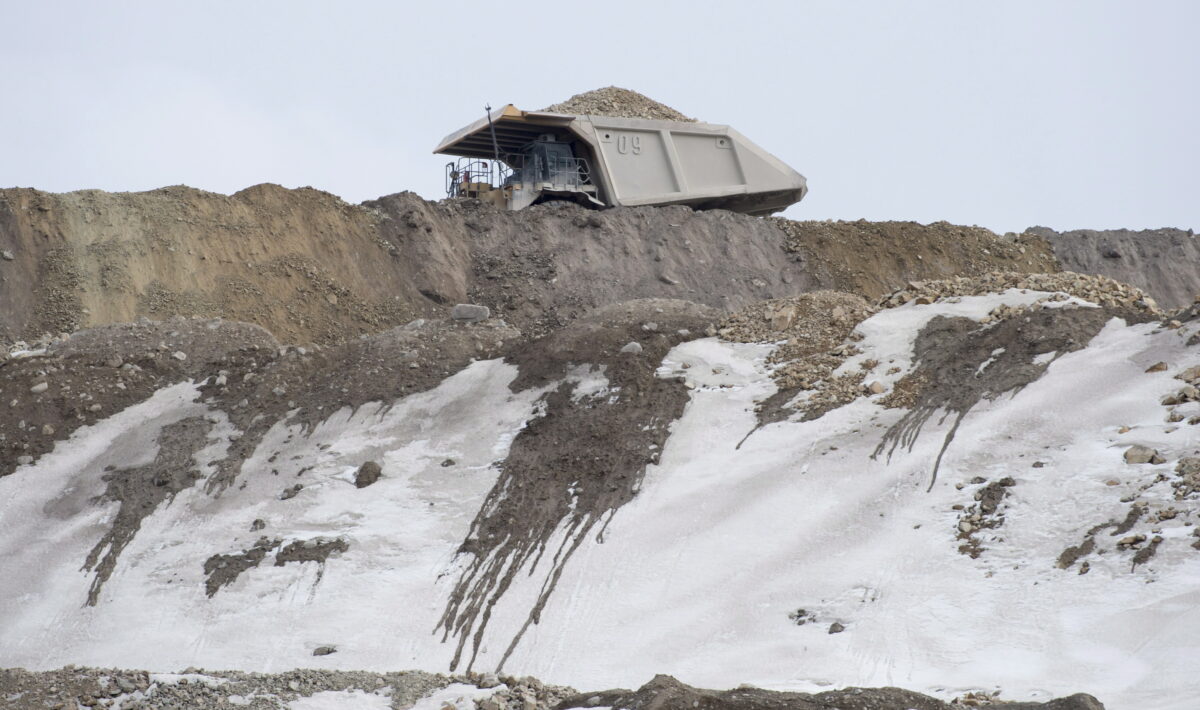
The move came as China has been vying for dominance in the critical minerals and metals sector, vital for producing components used in everything from wind turbines and electric vehicles to laptops, solar panels, and rechargeable batteries.
In 2020, Ottawa blocked a Chinese state-owned company from buying a Nunavut gold mine, also on national security grounds. Shandong Gold Mining Co. Ltd. was barred from acquiring gold producer TMAC Resources Inc., which was later bought by a Canadian gold mining company.
Ottawa’s 2022 order required Sinomine (Hong Kong) Rare Metals Resources to sell its investment in Vancouver-based Power Metals Corp, which explores and develops cesium, lithium, and tantalum assets in Canada. The government also asked Chengze Lithium International Ltd. to divest its interests in Lithium Chile Inc., a company headquartered in Calgary with mining activities in Chile and Argentina.
Lastly, it ordered Zangge Mining Investment to sell its investment in Ultra Lithium Inc., a Vancouver-based resource development firm with lithium and gold projects in Canada, Argentina, and the United States.
Champagne said the decision was based on “facts and evidence and on the advice of critical minerals subject matter experts, Canada’s security and intelligence community, and other government partners.” He added the government would work with Canadian firms to attract foreign investment from partners that “share our interests and values.”
Securing access to critical minerals was a key focus at this year’s G7 Leaders’ Summit in Canada, where the leaders announced an action plan to safeguard supply chains and counter what they described as “non-market policies and practices” in the sector.
Critical minerals is not the only sector where Canada has raised and acted on concerns about Chinese investment.
In 2018, the federal government blocked the sale of Canadian construction company Aecon Group Inc. to a Chinese state builder, also citing national security concerns. Ottawa did not provide details on what those concerns were, but said the order resulted from a “multi-step national security review process” and engagement with Canada’s national security agencies.
In addition, Canada last year announced tighter guidelines for the review of foreign investments in the interactive digital media sector under the Investment Canada Act, citing the risk of disinformation propagation or information manipulation by “hostile state-sponsored or influenced actors.” Ottawa did not directly mention China but broadly referred to “hostile states.”
“The Government of Canada recommends that all non-Canadian investors and Canadian businesses in these sectors to review their investment plans to identify any potential connections to entities owned or influenced by foreign states, particularly hostile states,” it said in a March 2024 statement.
Recent Concerns
The potential security risks posed by Chinese state-owned enterprises or companies with close ties to the Beijing regime drew attention last month after a publicly owned ferry operator in British Columbia announced it had hired a state-owned Chinese shipyard to build four new vessels.
BC Ferries announced in June that it had selected China Merchants Industry Weihai Shipyard to build four new vessels, following a “rigorous global procurement process.”
The deal has faced opposition from both federal and provincial politicians, who cite not only lost opportunities for Canada’s domestic shipbuilding industry, but also potential national security risks associated with building the vessels in China.

The shipyard’s parent company, China Merchants Group Limited, is a state-owned enterprise that describes itself as being “directly administered by the central government.”
Federal Transport Minister Chrystia Freeland voiced concern over the deal, citing potential security risks associated with China, including cybersecurity threats. In a letter to her B.C. counterpart dated June 16, she requested details on the measures BC Ferries will take to mitigate risks to national security.
B.C. Conservative MLA and transportation critic Harman Bhangu also sounded the alarm over hiring a company with direct ties to the Chinese communist regime.
“We are funding their state-owned shipyard that is directly related to the People’s Liberation Army–we are literally funding the communist army,” Bhangu previously told The Epoch Times in an interview.
“With a lot of the technology that will be on the vessels, the hard drives and everything, who gets to keep that data? That is a huge concern.”
 Friends Read Free
Copy
Facebook
Tweet
Friends Read Free
Copy
Facebook
Tweet