
Explainer
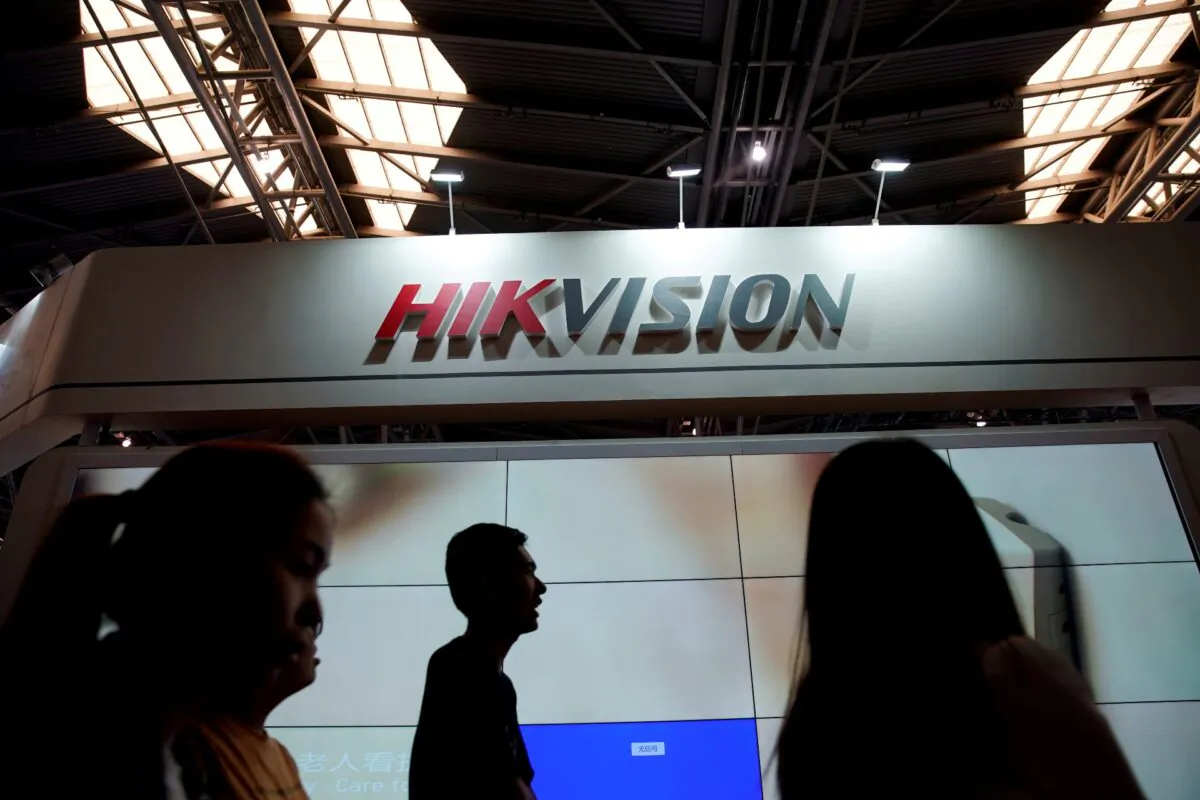
Hikvision, the Chinese company that was ordered by Ottawa to shut down Canadian operations last week, has been mired in a number of security issues for years.
The company’s products have been banned by the U.S. Federal Communications Commission for posing an “unacceptable risk” to national security and the security and safety of Americans. Likewise, its cameras have also been subject to restrictions on use by UK government departments over its connections to the Chinese regime.
Industry Minister Mélanie Joly, in a social media post late last Friday, announced Ottawa had ordered Hikvision to cease all operations in Canada and close its business in the country over national security concerns.
She said the government had concluded that the firm’s continued operations would be “injurious to Canada’s national security,” following a “multi-step review” based on evidence from Canada’s security and intelligence community. She also said the company’s products would be banned from government departments, agencies, and Crown corporations.
Following Joly’s announcement, the Chinese Embassy in Canada took to social media, calling the move an “overstretching” of the concept of national security to “discriminate against and suppress Chinese enterprises.” It also called for a “fair, just and non-discriminatory environment” for Chinese enterprises to operate.
Hikvision and the Chinese Regime
What is Hikvision and why is it being flagged by the government of Canada?
Hangzhou Hikvision Digital Technology Company Ltd. was founded in 2001 and is partly owned by the Chinese regime. Its latest annual report, published in April 2025, lists the China Electronics Technology Group Corporation (CETC) as the company’s “actual controller.”
CETC is a Chinese state-owned military industrial group with an “explicit role” in developing technology for China’s People’s Liberation Army, according to Washington-based defence policy think tank the Jamestown Foundation. A subsidiary of CETC is Hikvision’s largest shareholder.
In October 2019, the U.S. Commerce Department placed Hikvision on a trade blacklist, saying the firm was supplying surveillance equipment to the Chinese regime for the suppression of Uyghur Muslims.
Uyghurs and other Muslim minorities in China’s northwestern region of Xinjiang face severe oppression, with an estimated 1 million or more being placed in re-education camps or other detention facilities. Survivors of the camps have described experiences of forced labour, forced sterilizations, political indoctrination, electric shocks, and other forms of abuse during their time in detention.
In 2020, the U.S. Department of Defence categorized a number of Chinese technology companies and organizations, including Hikvision and Chinese telecom equipment company Huawei, as being owned or controlled by the Chinese military. Hikvision has denied the allegations of having military ties, saying it is a publicly traded company and an independently operated enterprise.
The U.S. Federal Communications Commission (FCC) determined in March 2021 that Hikvision was among five Chinese telecom equipment companies that “pose an unacceptable risk to U.S. national security or the security and safety of U.S. persons.” That list also included Huawei.
The following year, the FCC banned equipment authorization for those five companies. Hikvision tried to get the ban lifted but its request was rejected by a U.S. appeals court earlier this year.
Hikvision also aids the Chinese regime to surveil prisoners, according to Pennsylvania-based video surveillance information company IPVM, which reported in July 2022 that the Chinese firm had developed a device to enhance and record interrogation sessions, monitor prisoners’ vital signs under intensive supervision, and automatically alarm if they make any “vigorous motions.”
Hikvision’s interrogation device could also be integrated with tiger chairs, IPVM said, a torture tool in Chinese prisons that restrains the body in painful positions, according to Amnesty International.
In November 2022, the UK government banned its departments and agencies from buying new Chinese CCTV cameras, including Hikvision cameras, and began phasing out legacy equipment. The government cited China’s national intelligence law, which compels all individuals and organizations in China to hand over data to the state when required to help with intelligence work.
Australia followed suit in 2023, ordering the removal of Chinese surveillance cameras made by Hikvision and Zhejiang Dahua Technology from all government sites over the companies’ connections to the Chinese Communist Party.
Hikvision in Canada
Last year, 24 federal government agencies reported having purchased or used Hikvision cameras. The report was the result of an inquiry from Bloc Quebecois MP René Villemure.
Those agencies and departments included the RCMP, the Canadian Services Agency, the CBC, the Canadian Space Agency, the Coast Guard, and the departments of health, immigration, environment, and innovation. Many of them said they were looking to replace the cameras.
By 2023, Hikvision cameras were reportedly used across 50 public bodies in Quebec including cities, provincial ministries, schools, and hospitals, according to an investigation by Le Journal de Montréal. The media outlet also obtained a copy of a security alert provided to the Quebec government by the Canadian intelligence officials on Nov. 2, 2022.
“Chinese company Hangzhou Hikvision Digital Technology Co. Ltd poses a threat to Canada’s national security because it and its products could serve as an intelligence collection platform at home and abroad,” reads the security alert, as reported by the newspaper in French in December 2023.
Minister Joly said in her recent announcement the decision to order Hikvision to shut down operations was the result of a national security review, and that another review of existing products is underway to ensure they are no longer used.
The Canadian branch of Hikvision responded by calling the allegations of national security concerns “unfounded,” and saying the decision lacks “a factual basis, procedural fairness, and transparency.”
In her statement, Joly said that compromising national security was off the table.
“The Government of Canada welcomes foreign investment—but will never compromise on Canada’s national security,” she said.
Lily Zhou contributed to this report.
 Friends Read Free
Copy
Facebook
Tweet
Friends Read Free
Copy
Facebook
Tweet