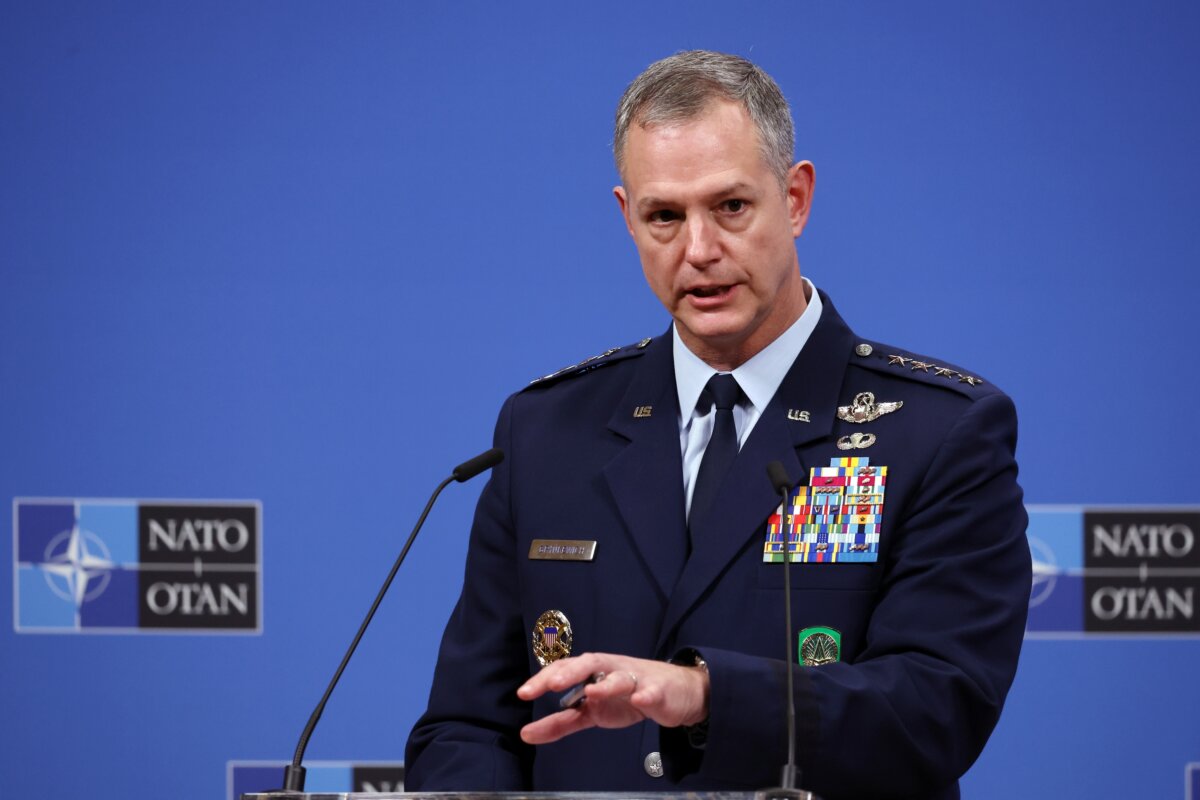

NATO’s top military commander has repeated his concern that allies must be ready for military conflicts in more than one part of the world at the same time, as hostile states China, Russia, Iran, and North Korea begin to cooperate more.
Commander U.S. Air Force Gen. Alexus Grynkewich told lawmakers at the European Parliament in Brussels on Monday that the broad global security environment is both unsettling and complex, and likely to become even more so in the coming years.
“Increasingly, around the globe, we see China, Russia, Iran, and North Korea collaborating in ways directly counter to all of our global interests,” said the NATO Supreme Allied Commander and head of the United States European Command.
Grynkewich added that in considering the return of large-scale conflict in Ukraine and the Middle East, “we see not only a changing character of warfare, but also a sobering preview of how future simultaneous and potentially protracted conflicts might look: multi-theater conflicts, multi-domain conflicts, and highly autonomous conflicts.”
Grynkewich was reiterating concerns about the risk of what he called the “simultaneity of conflict,” warning that Russia and China could launch new acts of military aggression in Europe and Asia at the same time.
During the LANDEURO symposium in Wiesbaden, Germany, on July 17, 2025, the senior NATO commander highlighted that in the Indo-Pacific, China poses a systemic challenge to Euro-Atlantic security and enables Russia in its war with Ukraine. Further, Russia’s war was being conducted with the support of North Korean troops.
He said at the time that “each of these threats that are out there cannot be viewed, in my estimation, as discrete challenges.”
“We’ve got to think about how all of them are aligning, and the risk of simultaneity of conflict across the globe.”
Sabotage Efforts Becoming Brazen
Speaking to European lawmakers on Sept. 28, Grynkewich also warned that hybrid attacks and threats to critical infrastructure were increasing.
“State-directed sabotage is growing increasingly brazen,” he told European lawmakers, pointing to a recent attempted drone attack against Leipzig/Halle Airport in Germany, which he said was meant to instill fear and discourage support for Ukraine.
He also highlighted incidents such as a Russian warship firing flares in the direction of a Danish military helicopter earlier this month.
Following the incident, the Danish government expedited the delivery of a donation to Ukraine, estimated at 1.8 billion Danish crowns ($276 million), to be used for air defenses.
“If the Russians think they can rattle us … then our response is to ramp up our support for Ukraine faster than we had intended,” Danish Defense Minister Jeppe Bruus told reporters on Sept. 18.
Grynkewich said the Danish response to the flare incident was one he had recommended to allies.
“If there is a hybrid attack on your country, reinforcing the will to support Ukraine will show the Russians that their strategy isn’t working, and maybe have them back off that strategy,” he said.
The remarks were made the same day that defense ministers from EU member states met to discuss collective responses to Russian hybrid warfare. The proposals follow warnings from Danish intelligence and other European officials that Moscow could intensify nonconventional attacks against the West.
Russia has denied that it is involved in committing any covert attacks against Europe and has instead accused NATO countries of falsely blaming Moscow in order to increase tensions.
 Friends Read Free
Copy
Facebook
Tweet
Friends Read Free
Copy
Facebook
Tweet