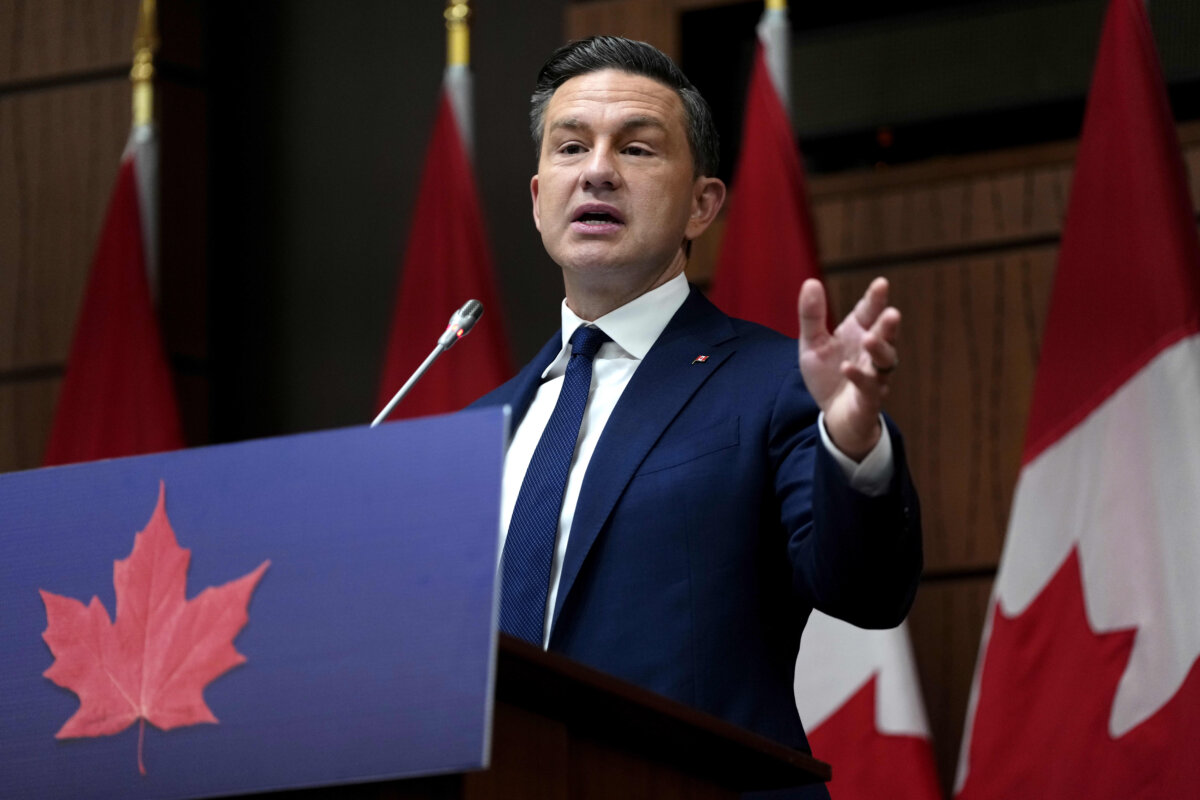

Conservative Leader Pierre Poilievre has sent a letter to the prime minister ahead of the upcoming federal budget release, requesting the government reduce taxes on food, homes, and energy, while keeping the deficit under $42 billion.
Poilievre called on Prime Minister Mark Carney in the Oct. 20 letter to use the upcoming budget, set to be tabled on Nov. 4, to “restore Canada’s promise that hard work is rewarded, food and homes are affordable, streets are safe and our economy is self-reliant.”
“We will work with anyone from any party to achieve that goal. So please feel free to steal our ideas — in action, not just talk,” he said.
Regarding cost-of-living issues, Poilievre urged Carney to remove four “hidden food taxes” that he says have kept food costs elevated while food banks see “record numbers” of users. The Tories called for an end to the industrial carbon tax impacting fertilizer and farm equipment, the fuel standard carbon tax on gas and diesel, the “food packaging tax,” and the “inflation tax.”
Poilievre’s comment on the “food packaging tax” refers to the government’s proposed new labelling and packaging requirements, as well as the Liberals’ ban on single-use plastics. The party has also said that large deficits generate inflation, which increases the price of everyday items and amounts to a “sneaky” tax on food.
While the Liberal government removed the consumer carbon tax earlier in the year, Canada’s industrial pricing regime has continued as a way to reduce greenhouse gas emissions, which the Tories have said is increasing the cost of fertilizer and farm equipment. The Conservatives have noted the government said its Clean Fuel Standard would increase fuel costs by 13 cents per litre for gasoline and 16 cents per litre for diesel by 2030.
The Liberal government has said there is no tax on food, and has criticized the Conservatives for previously voting against the National School Food Program. The Liberals have also pointed to their recent affordability measures such as tax cuts impacting 22 million Canadians, as well as eliminating the GST for first-time home buyers on new homes up to $1 million.
In his letter, Poilievre also called for the Liberal government to cut taxes on income, homebuilding, investment, and energy, so “life costs less and our workers make more.” Specifically, Poilievre said the income tax, capital gains tax, and industrial carbon tax and homebuilding taxes should be reduced.
The Liberal government cancelled a proposed hike of the capital gains inclusion rate in March.
Deficit
Poilievre also said the federal deficit should be kept under $42 billion, which was close to the target made by the government during the last fiscal update. While the Liberal government had adopted a fiscal anchor of keeping the deficit below $40.1 billion in 2024, the deficit for the 2023-24 fiscal year was around $61.9 billion, according to the fall economic statement.
Parliamentary Budget Officer Jason Jacques has projected the upcoming budget will include a deficit of $68.5 billion, which is $26.6 billion higher than the March projection by previous budget officer Yves Giroux due to new measures announced by the government.
Carney promised during the last election that his government would run a “small deficit on capital spending that aligns with our fiscal capacity,” while ensuring government debt-to-GDP continues to decline.
The prime minister recently said that the upcoming budget would “meet this hinge moment in Canadian history” and would require making “responsible and pragmatic choices,” like reducing spending on government operations while protecting programs and initiatives that support vulnerable Canadians.
Interim NDP Leader Don Davies said while he has not made any specific requests for the upcoming budget, his party will not support an austerity budget, and wants to see increased federal investments in workers, businesses, and infrastructure. The Bloc Québécois has made a list of 18 budget demands to Ottawa, including six it calls “unavoidable.”
The Conservatives have not said whether they will support the budget, with Poilievre previously telling reporters he would wait until he reads the document on Nov. 4.
 Friends Read Free
Copy
Facebook
Tweet
Friends Read Free
Copy
Facebook
Tweet