
The Conservatives are raising concerns about the Liberal government’s budget bill granting ministers sweeping powers that would enable them to exempt any individual or company from federal laws, except the Criminal Code.
The federal government’s budget bill, Bill C-15, says a minister could use these powers “only if the minister is of the opinion” that the exemption is in the public interest, would enable the testing of a product, service, procedure, or regulatory measure, and its benefits would outweigh the risks.
The measures aim to encourage innovation, competitiveness, and economic growth, the bill says, adding that ministers could use such powers to provide an exemption for up to six years.
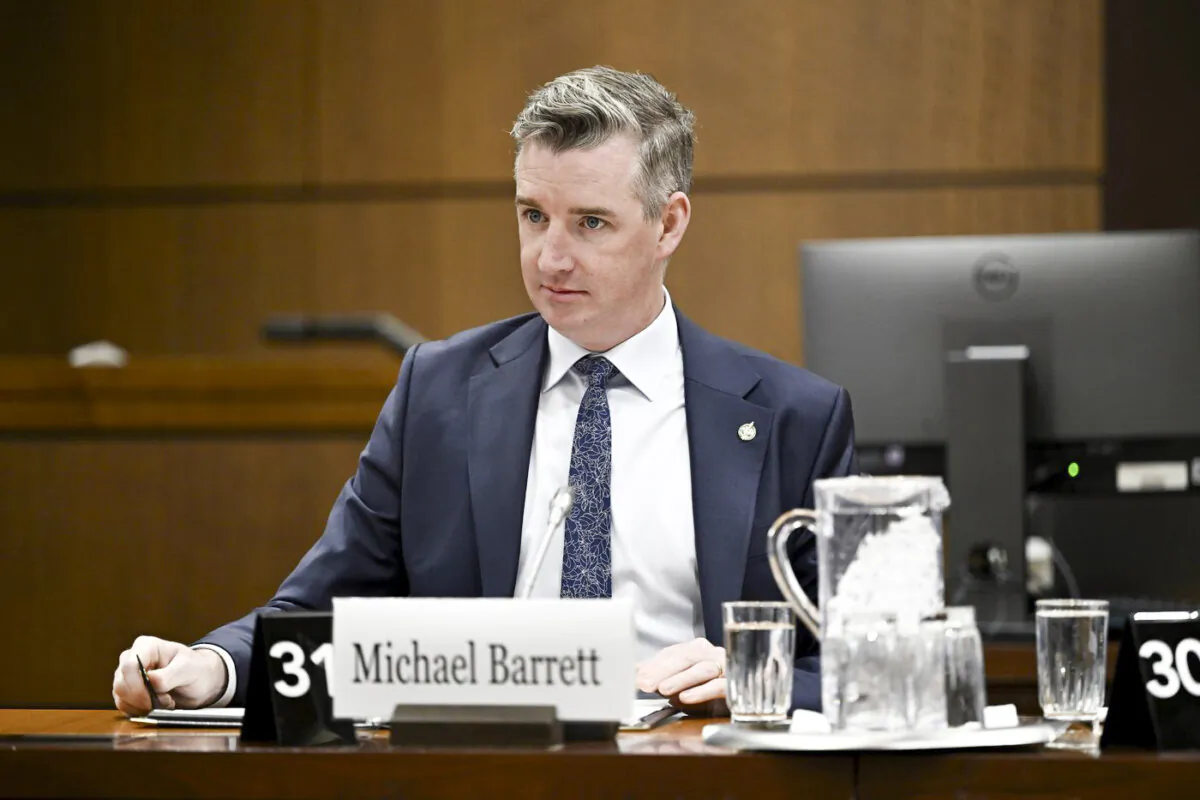
Conservative MP and ethics critic Michael Barrett asked Ethics Commissioner Konrad von Finckenstein, who testified before the ethics committee on Dec. 8, whether the measures would create the opportunity for conflicts of interest to occur and make them harder to detect.
The ethics committee is currently conducting a review of the Conflict of Interest Act as opposition MPs are scrutinizing Prime Minister Mark Carney’s conflict-of-interest disclosures and ethics screen.
“It’s a path for ministers to bypass the usual parliamentary safeguards and ethical scrutiny by shifting decisions into private exemption orders,” Barrett said. “Does that not present a cause for concern for parliamentarians?”
Von Finckenstein responded that ministers still have to comply with the Conflict of Interest Act and must recuse themselves from a decision if the exemptions were to involve a company that the minister could be seen as having a conflict of interest with.
“The act is quite clear,” von Finckenstein said. “[The minister] cannot participate in the decision. He can’t even be in the room. He has to leave and absence himself when that decision is made.”
Barrett noted that under Bill C-15, ministers could make an exemption order without making it public. However, von Finckenstein said the exemption would have to be published “somewhere,” noting that the “effect” of the exemption would be public. He said he hadn’t looked at the legislation from this particular aspect, but didn’t understand how an exemption could be secret.
“The expectation, I think, that Canadians have is … that there’s no reason for a government to put forward legislation that gives them the opportunity to exempt themselves from all laws except the Criminal Code,” Barrett said. “I think that Canadians should be rightly concerned, and I certainly am.”
While the bill does mention the minister must provide the public with a “description of the decision-making process and a summary of the reasons for the order,” it also says that the minister may exclude information that would be, in the minister’s opinion, “inappropriate to make publicly accessible for reasons that include safety or security considerations or the protection of confidential or personal information.”
A spokesperson from the Treasury Board of Canada Secretariat told The Epoch Times that the measure in Bill C-15 is designed to enable “regulatory sandboxes,” which allow temporary exemptions from “certain legislative requirements so that innovative products, services, or processes can be tested under controlled conditions.”
“These sandboxes help regulators keep pace with technological change and assess real-world impacts before making permanent regulatory changes,” the spokesperson said in a Dec. 9 email statement.
“The goal is to foster innovation, competitiveness, and economic growth while maintaining protections for health, safety, and the environment.”
The spokesperson said that currently only select regulators, like Transport Canada and Health Canada, have the authority to enable regulatory sandboxes, but the proposed measure will expand the authority to all ministers.
This provision is part of the more than 600-page omnibus budget bill, and also appears in Budget 2025, tabled by the Liberal government on Nov. 4.
 Friends Read Free
Copy
Facebook
Tweet
Friends Read Free
Copy
Facebook
Tweet