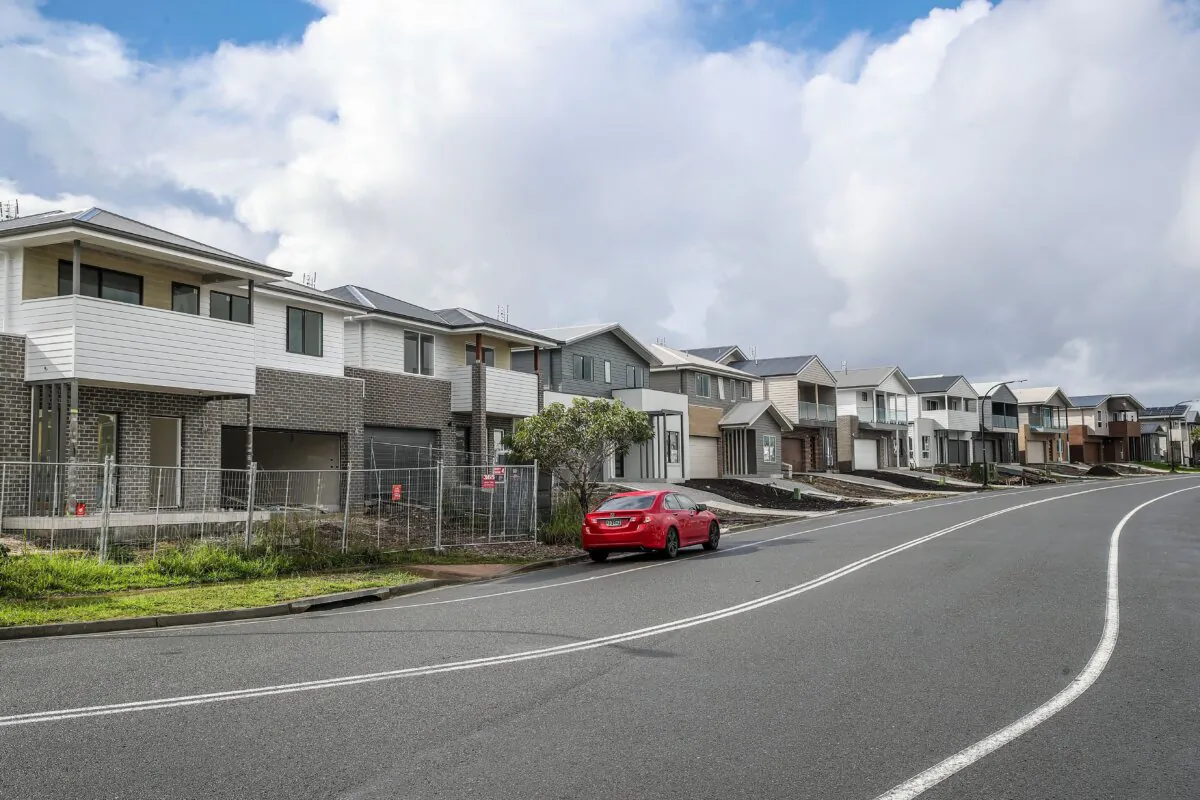

The total value of residential dwellings in Australia reached $11.4 trillion (US$7.4 trillion) in the March 2025 quarter, up 1.2 percent from $11.2 trillion in the December 2024 quarter, Australian Bureau of Statistics (ABS) data shows.
Household-owned properties accounted for $10.9 trillion of the total value of residential dwellings.
In the March quarter of 2025, all states and territories recorded a rise in the total value of residential dwellings, with the highest growth in Queensland (1.9 percent) and South Australia (1.6 percent).
Australia had 53,400 more homes this quarter, bringing the total to about 11.3 million. The mean dwelling price grew by $6,900 to $1,002,500 (0.7 percent), surpassing $1 million for the first time.
New South Wales (NSW) continues to record the highest mean residential dwelling price at $1.25 million, followed by Queensland at $944,700 and the Australian Capital Territory (ACT) at $941,300. The Northern Territory remains the lowest at $517,700.
“Western Australia, South Australia, and Queensland were the main drivers of the rise, with Queensland reaching the second highest mean price in Australia, behind New South Wales,” said Mish Tan, ABS Head of Finance Statistics.
“Despite the quarterly rise in national dwelling value, annual growth in the March quarter slowed to 5.9 percent. This was down from 9.5 percent in March quarter 2024.”
Gap Between Budget and Available Properties
On another note, Domain Group research reveals that there is a significant gap between homebuyers’ budgets and available properties in Melbourne.
Inner-city buyers face a $310,000 shortfall, with the gap widening to $967,500 in the most in-demand suburbs.
The study compares current buyer search data with property listings. It points to a shift in demand towards well-located, medium- and high-density housing, influenced by affordability challenges, demographic changes, and evolving lifestyle preferences.
Melbourne Budget Mismatch Breakdown
In areas within 10 kilometres of Melbourne’s CBD, the median difference between buyer budgets and house asking prices stands at $310,000. In high-demand suburbs such as Boroondara and Stonnington-West, the mismatch exceeds $900,000.
In contrast, Melbourne’s northern and western regions exhibit smaller or reversed differences, indicating a more balanced market.
More than 30km from the CBD, buyer budgets are up to $83,000 higher than listing prices, hinting at undervalued supply in outer suburbs or a shortage of larger homes.
While houses continue to be sought after, there is also strong interest in townhouses and units within 20km of the CBD, where buyers are falling short by up to $198,000.
Townhouses attract a wide range of buyers across the city, creating chances for development in both established and emerging suburbs.
Buyer budgets in outer suburbs go beyond listing prices by as much as $81,000 for townhouses and $55,000 for units. This suggests a limited supply of larger, quality, or family-friendly homes in suburban growth corridors.
“We’re seeing sustained demand for well-located, medium and high density housing like townhouses, apartments, and mixed-use developments within 20 kilometres of the CBD, as well as increased interest in outer suburban areas and growth corridors,” said Nicola Powell, Chief of Research and Economics at Domain Group.
“These trends highlight a pressing need for more diverse, affordable housing options. For developers and urban planners, understanding these shifting buyer preferences is essential to delivering liveable, future-ready communities that align with where and how people want to live.”
Brisbane Rapid Growth
At the same time, based on the same analysis by Domain Group, inner-city buyers within 10km of the Brisbane CBD face a shortfall of $350,000, rising to $800,000 in the most desirable areas.
Premium middle-ring suburbs like Sherwood-Indooroopilly, Carindale, and Mt. Gravatt manifest price disparities ranging from $350,000 to $500,000 for houses.
In suburbs once viewed as aspirational but still within reach, property prices are surging faster than buyer budgets. Beyond 30km from the CBD, buyers outpace listing prices by up to $8,000.
Outer suburban buyer budgets are up to $100,000 above townhouse prices and $301,000 above unit prices.
Buyers’ property searches outside 20km of Brisbane’s CBD have been up 37.5 percent since 2020, while inner-area demand has declined by 13.4 percent. This trend reflects growing decentralisation caused by affordability concerns, remote work, and population growth.
“Brisbane’s rapid property price growth is forcing many buyers to make tough trade-offs, either compromising on location or adjusting their expectations around property type,” said Powell.
“We’re seeing sustained demand for well-located, medium and high density housing like townhouses, apartments, and mixed-use developments within 20 kilometres of the CBD, as well as increased interest in outer suburban areas and growth corridors. These trends highlight a pressing need for more diverse, affordable housing options.”
 Friends Read Free
Copy
Facebook
Tweet
Friends Read Free
Copy
Facebook
Tweet